

 Travel Essentials
 Travel Essentials

Colorado’s voter-led wolf reintroduction is restoring an apex predator, reshaping ecosystems, and testing coexistence with ranching communities.
 Travel Essentials
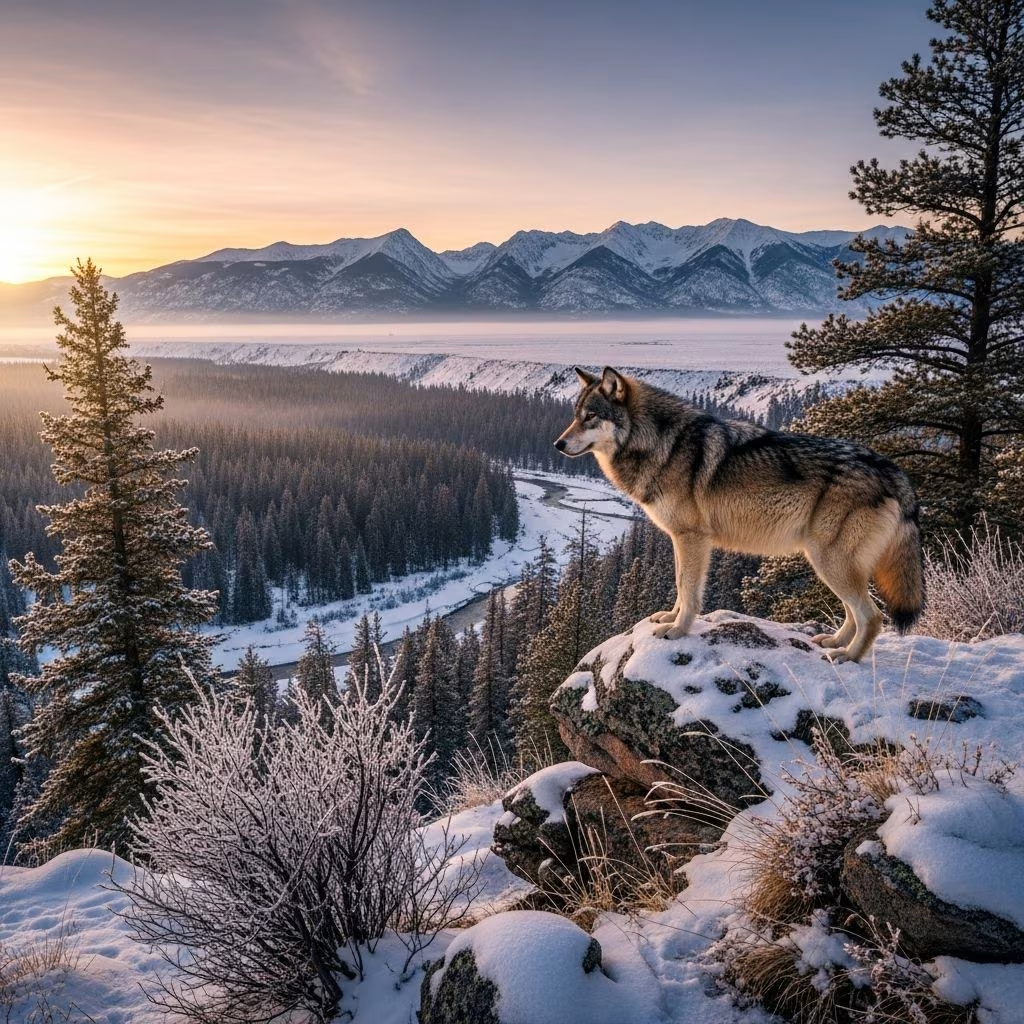
Gray wolves, absent from Colorado for over 80 years, are once again roaming the state’s rugged terrain thanks to a pioneering voter initiative. This effort marks the first time U.S. voters directly mandated the restoration of a large carnivore species, signaling a shift toward balancing human development with natural ecosystems.
In November 2020, Colorado residents narrowly passed **Proposition 114**, a ballot measure requiring the state to develop a plan for reintroducing gray wolves west of the Continental Divide by December 31, 2023.
This proposition transformed into state statute 33-2-105.8, tasking the Colorado Parks and Wildlife (CPW) Commission with crafting the Colorado Wolf Restoration and Management Plan. The plan outlines capturing and translocating 10-15 wolves annually for three to five years, aiming for a total of 30-50 wolves to establish a sustainable population.
Prior to formal reintroduction, wolves had begun trickling back naturally. Since 2014, solitary wolves from reintroduced northern Rocky Mountain populations entered Colorado. By early 2020, a resident pair was confirmed in the northwest, and in June 2021, CPW documented the first wolf litter born in the state since the 1940s—proof that suitable habitat persisted despite historical eradication.
The first phase launched in December 2023 with a partnership between CPW and the Oregon Department of Fish and Wildlife. Ten wolves—five released in Grand County and five in Summit County—were darted from helicopters, netted, radio-collared, and transported to remote forests on state land.
Releases occur between December and mid-March to align with denning seasons, minimizing dispersal risks. Wolves are placed at least 60 miles from borders with Wyoming, Utah, New Mexico, and Southern Ute tribal lands to respect jurisdictional boundaries and a 2008 memorandum of understanding on wildlife management.
In January 2025, a second translocation brought 15 more wolves from British Columbia, in collaboration with that province’s Ministry of Water, Land and Resource Stewardship. To date, 25 wolves have been reintroduced, with ongoing annual efforts targeting additional packs via trapping, darting, or net-gunning in fall and winter.
| Translocation Event | Date | Source Location | Number of Wolves | Release Counties |
|---|---|---|---|---|
| First | Dec 2023 | Oregon | 10 | Grand, Summit |
| Second | Jan 2025 | British Columbia | 15 | Eagle, Pitkin |
As apex predators and keystone species, gray wolves regulate ecosystems by preying on herbivores like elk and deer, preventing overgrazing that harms vegetation and riparian areas. University of Colorado Boulder ecologist Joanna Lambert notes that wolves promote biodiversity by influencing prey behavior—grazers avoid risky areas, allowing willow, aspen, and other plants to regenerate.
In Rocky Mountain National Park and surrounding regions, wolves’ return could restore balance disrupted by their 1940s extirpation through hunting and poisoning. Natural recolonization litters underscore wolves’ adaptability to Colorado’s diverse habitats, from high alpine meadows to dense forests.
While ecologically promising, wolf restoration stirs tensions with agriculture. Of the 25 reintroduced wolves, 10 have died—some from mountain lions, others poached, and several euthanized after repeated livestock depredations.
CPW provides non-lethal deterrents like range riders, fladry (flagged fencing), and compensation for verified losses exceeding fair market value. A December 2023 wolf found in New Mexico was recaptured and returned under a multi-state MOU to prevent hybridization with endangered Mexican wolves.
As of late 2025, 20 collared wolves remain active, with at least 10 pups born, indicating breeding success amid challenges. Rancher concerns focus on economic impacts, prompting calls for robust mitigation.
Radio collars enable real-time tracking, revealing wolves’ extensive movements across Colorado and into neighboring states. Pups from 2024-2025 demonstrate pack formation and reproduction, critical for self-sustaining populations.
CPW monitors health, dispersal, and conflicts, adjusting strategies yearly. Success metrics include genetic diversity from multiple sources and minimal human-caused mortality.

Conservationists hail the effort as science-based restoration reclaiming Colorado’s natural heritage. Critics, including some rural communities, worry about livestock safety and question voter mandates overriding local input.
Interstate cooperation, like the 2023 MOU with Utah, Arizona, New Mexico, and USFWS, ensures subspecies integrity. Globally, Colorado’s model inspires voter-led conservation.
By the 1940s, gray wolves were nearly wiped out in the Southern Rockies due to predator control programs favoring livestock and game.
The plan targets 30-50 translocations, but natural reproduction could accelerate growth to 50-100 wolves for sustainability.
CPW funds verified livestock losses and promotes deterrents; funds come from voters and donors.
Likely, as they favor such habitats; monitoring continues without active management inside park boundaries.
Despite mortalities, pup production and territory establishment signal progress, though more releases are vital.
Upcoming translocations in winter 2025-2026 aim to bolster numbers amid a “tenuous” phase. Adaptive management, public education, and conflict resolution will determine long-term success. Wolves’ return revitalizes Colorado’s wild heart, blending conservation triumphs with human-wildlife coexistence challenges.
