

 Travel Essentials
 Travel Essentials

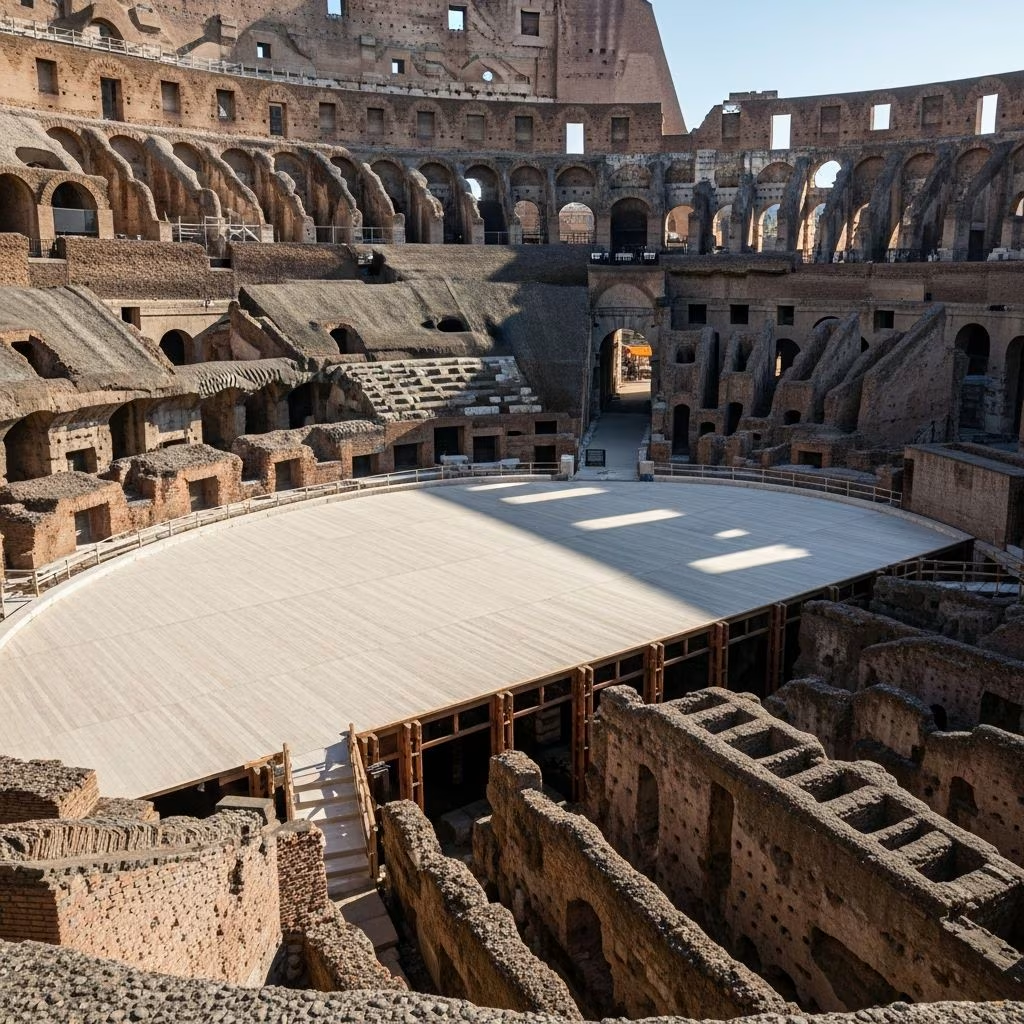
Explore the ambitious project to install a retractable floor in the Colosseum, restoring the gladiator-era arena while revealing the hypogeum below. Learn about design, timeline, and future events.
 Travel Essentials
The Colosseum in Rome, one of the world’s most visited ancient landmarks, is undergoing a transformative project to restore its original arena floor. This innovative retractable structure will allow visitors to experience the amphitheater as gladiators and spectators did nearly 2,000 years ago, while also enabling modern events.
Built between 70 and 80 CE under the Flavian emperors, the Colosseum—originally called the Flavian Amphitheatre—could seat up to 87,000 spectators for spectacles including gladiatorial contests, animal hunts, and public executions. Central to these events was the arena floor, a wooden platform covered in sand (arena in Latin) that concealed a complex underground network known as the hypogeum.
The hypogeum featured an intricate system of tunnels, ramps, trapdoors, and elevators powered by slaves and counterweights. This allowed dramatic entrances: wild animals could burst through trapdoors, gladiators emerge from passages, and scenery shift via lifts. Nearly 36 trapdoors dotted the floor, connected to 88 stairways and service corridors below.
Archaeological excavations in the 19th century removed the floor to expose this subterranean world, leaving the hypogeum visible today but denying visitors the full ancient perspective.
The idea for a new arena floor originated in 2014 from archaeologist Daniele Manacorda and was formalized in Italy’s Great Cultural Projects Strategic Plan in 2015. A design competition launched in late 2020 culminated in approval for a €18.5 million (about $22 million USD) contract announced by Culture Minister Dario Franceschini in May 2021. Completion is targeted for 2023, though updates as of 2026 confirm ongoing progress amid logistical challenges.
Winning the bid were architecture studio Labics, designer Fabio Fumagalli, and engineering firm Milan Ingegneria. Their reversible design rests on existing masonry without invasive anchors, ensuring no harm to the UNESCO World Heritage site.
The new floor spans the arena’s 86 x 54 meter (3,357 square meters) dimensions, positioned at the original Flavian height. It comprises movable panels with carbon-fiber cores clad in Accoya wood—a durable, acetylated timber from certified sustainable forests.
Operation involves a sophisticated roto-translation mechanism: panels rotate 90 degrees vertically to reveal the hypogeum, then slide away. This allows partial or full openings for views of underground structures.
| Feature | Description | Benefits |
|---|---|---|
| Material | Carbon-fiber slats with Accoya wood finish | Lightweight, strong, weather-resistant; sustainable sourcing |
| Mechanism | Remote-controlled rotation and retraction | Quick reconfiguration; reveals hypogeum on demand |
| Ventilation | 24 units along perimeter | Controls hypogeum temperature/humidity; full air renewal in 30 min |
| Water System | Rainwater collection integrated | Recycles for site toilets; eco-friendly |
| Reversibility | Non-invasive mounting | Removable without residue; preserves authenticity |
These elements ensure functionality for heavy visitor traffic while protecting the fragile hypogeum.
Currently, limited arena access lets some tourists glimpse the hypogeum and upper tiers. The new floor will grant full traversal of the central arena, offering 360-degree views of the 48-meter-high walls and arches.
Imagine standing where Maximus might have fought, surrounded by the roar of 50,000 ghosts. Partial openings will educate on ancient mechanics, with configurations demonstrating how beasts and warriors ascended.
Beyond tourism, the floor enables cultural events like concerts and theater, echoing ancient naumachiae (mock sea battles) and venationes (animal hunts)—minus the violence. Officials envision Shakespearean plays or operas under the stars.
This aligns with the Colosseum’s evolution: post-2020 pandemic reopening emphasized accessibility, including barrier-free paths and panoramic lifts to upper levels.
Balancing restoration with conservation is paramount. The project avoids altering original stone, using advanced materials to withstand Rome’s climate. Ventilation prevents hypogeum decay from humidity, and rainwater harvesting promotes green practices.
Critics worry about wear from millions of annual visitors (7+ million pre-pandemic), but reversible design and engineering mitigate risks. Italian authorities prioritize UNESCO guidelines for authenticity.
Enhance your trip with tickets like the Full Experience (€24 full fare), covering arena, upper levels, Roman Forum, and Palatine Hill—valid two days.
Post-installation, expect new floor-inclusive tours by 2027, weather permitting.
Originally slated for 2023, the project is advancing, with full operation expected soon, pending final engineering and approvals.
It recreates the original size, height, and function using modern, reversible materials faithful to Flavian design.
Yes, the entire arena will be accessible, with remote retraction for hypogeum views.
Yes, planned for performances, reviving the venue’s entertainment legacy.
Ventilation units and non-contact support ensure preservation.
This project elevates the Colosseum amid Italy’s cultural investments, drawing parallels to Pompeii restorations. It positions Rome as a fusion of antiquity and innovation, boosting post-pandemic recovery. Visitors gain deeper appreciation for Roman engineering—acqueducts, roads, and now this arena revival—while sustainable features set preservation precedents.
The Colosseum’s story transcends stone: from imperial propaganda to Christian pilgrimage site (later a quarry), now a global icon. The arena floor bridges eras, letting modern eyes witness imperial spectacle.
