

 Travel Essentials
 Travel Essentials

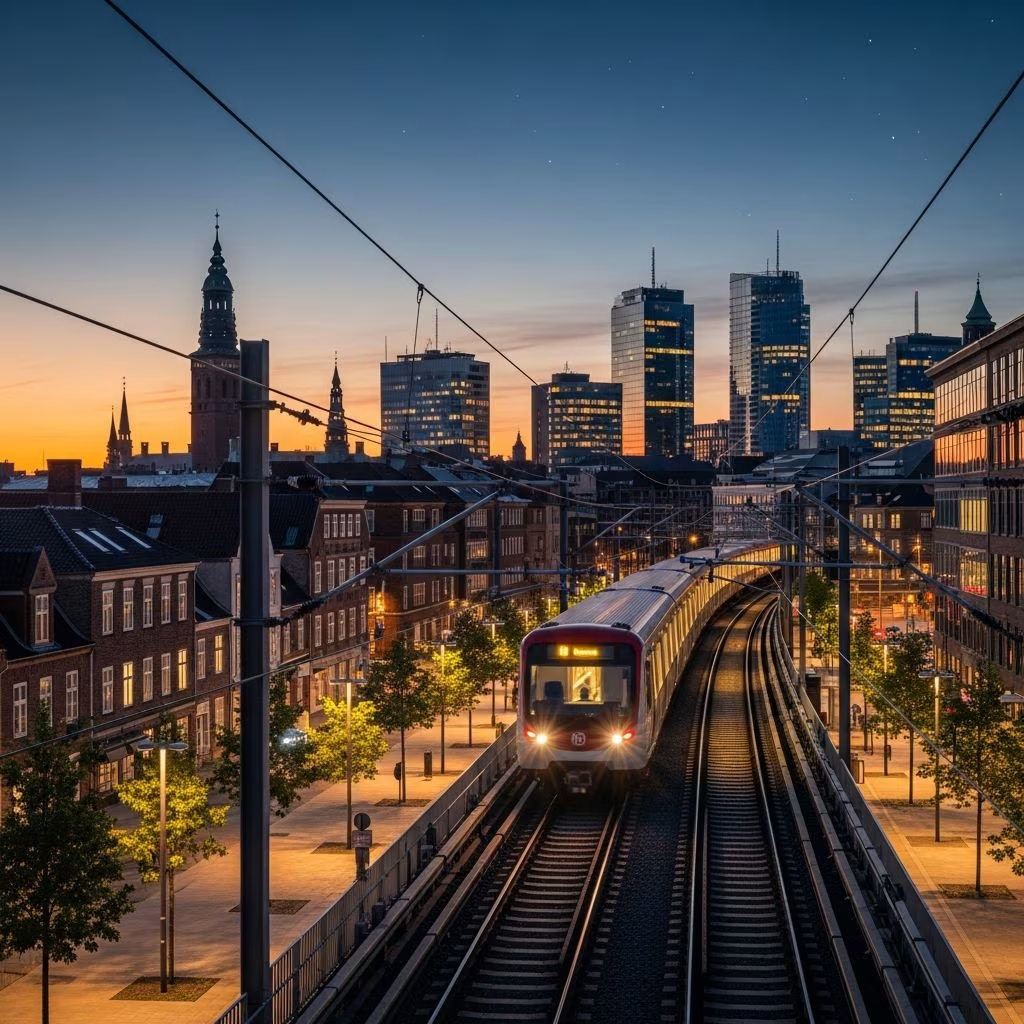
Copenhagen’s M5 metro will boost connectivity, ease congestion, and support sustainable growth with phased openings in 2036 and 2045.
 Travel Essentials
Copenhagen’s public transportation infrastructure stands as one of Europe’s most sophisticated systems, and the Danish capital is poised to elevate this distinction further. The City of Copenhagen and the national government have reached a comprehensive political agreement to construct the M5 metro line, a transformative addition to the existing network that will fundamentally reshape how residents and visitors navigate the city. This ambitious project represents more than just infrastructure development; it embodies Copenhagen’s commitment to sustainable urban growth, enhanced connectivity, and maintaining its status as a world-class city with modern transit solutions.
The M5 line will establish a critical connection between Copenhagen Central Station and the emerging development areas across Amager, particularly the East Harbour district and Lynetteholm. This strategic routing addresses a significant gap in the current metro network, bringing modern rapid transit to neighborhoods that have historically lacked direct metro access. The line’s design reflects Copenhagen’s core urban planning objectives: reducing carbon emissions, improving quality of life for residents, and creating seamless connections throughout the metropolitan area.
Unlike many infrastructure projects that aim for a single opening date, the M5 metro line will be developed in two distinct phases, allowing for staged investment and managed growth. The first phase is scheduled to open in 2036, introducing six stations that will immediately improve transit access across significant portions of the city. The second phase will follow approximately nine years later, with completion targeted for 2045, adding three additional stations that will extend service to the developing Lynetteholm area and maximize the network’s capacity and reach.
This phased approach offers several strategic advantages. It allows developers and city planners to coordinate infrastructure construction with residential and commercial development projects, ensuring that transit capacity aligns with population growth. Additionally, the staged implementation enables continuous refinement of operations and passenger experience based on real-world performance data from the initial stations.
The first phase of the M5 line will establish foundational connectivity with five underground stations and one elevated station:
The second phase will complete the M5 network with three elevated stations extending toward Lynetteholm, the ambitious waterfront development project that will transform eastern Copenhagen:
Additionally, the Copenhagen Central Station facility will be engineered with provisions for potential future extensions toward Østerport via Gammel Kongevej, ensuring the metro network maintains flexibility for future expansion as the city continues to evolve.
One of the M5 line’s most significant advantages lies in its strategic integration with Copenhagen’s existing metro infrastructure. The line’s routing has been carefully planned to create efficient transfer opportunities at multiple key locations, ensuring passengers can seamlessly connect between different transportation modes and metro lines.
At Copenhagen Central Station, travelers will enjoy comprehensive transfer options to the established M3 and M4 metro lines, connecting them to virtually every neighborhood in the metropolitan area. The same station provides connections to regional and long-distance rail services, as well as the S-train commuter network. This multi-modal integration transforms Central Station into an even more powerful transportation hub, consolidating access to various transit options in a single, convenient location.
The DR Byen station creates an important interchange between the M5 and the M1 line, while Lergravsparken provides connection points with the M2 line. These strategic transfer locations ensure that passengers throughout Copenhagen’s broader metro network can access the new line’s routes, distributing ridership efficiently across the system.
The M5 metro line serves as a crucial enabler for Copenhagen’s ambitious urban development agenda. The project is specifically designed to unlock growth in areas that currently lack metro service while facilitating planned development in the East Harbour and Lynetteholm districts. These emerging neighborhoods represent significant opportunities for residential, commercial, and cultural development.
The Lynetteholm project represents one of Copenhagen’s most innovative urban development initiatives. This artificial island will incorporate new residential communities, office spaces, recreational facilities, and public spaces. The M5 line’s extension to this area will ensure residents and workers can access the broader city without reliance on automobile transportation, supporting Copenhagen’s environmental objectives while promoting the project’s economic viability.
Beyond specific development projects, the M5 line strengthens Copenhagen’s broader economic competitiveness. Enhanced transit connectivity improves the city’s attractiveness to businesses, professionals, and residents, while reducing transportation costs and congestion. The improved accessibility to eastern neighborhoods opens previously underdeveloped areas for investment and revitalization.
Copenhagen’s existing metro network, particularly the M1 and M2 lines and the cross-harbor sections, has begun experiencing capacity constraints during peak travel periods. Population growth and increased urbanization have generated transit demand that approaches the limits of current infrastructure. The M5 line addresses this critical challenge by providing an alternative route for passengers, distributing demand more effectively across the network.
By offering a new major corridor from Central Station through Amager, the M5 reduces pressure on the M1 and M2 lines while simultaneously improving overall system resilience. The distributed network design ensures that maintenance or operational disruptions on any single line create fewer cascading impacts throughout the system. This operational robustness becomes increasingly important as the metropolitan area continues expanding.
The M5 metro line represents a significant investment in Copenhagen’s sustainability objectives. By providing efficient public transit to currently underserved neighborhoods, the project enables residents to reduce automobile dependency for daily transportation. This shift from private vehicles to rapid transit generates substantial environmental benefits through reduced emissions and improved air quality.
Copenhagen has established ambitious climate neutrality targets, and public transportation infrastructure plays a central role in achieving these goals. The fully-automated metro system, consistent with existing Copenhagen metro lines, operates with exceptional energy efficiency. As more residents and workers utilize the M5 for commuting, the cumulative environmental impact multiplies across thousands of daily journeys.
The line’s design incorporates modern sustainability principles throughout its infrastructure, from station construction to operational systems. This commitment to environmental responsibility aligns with Copenhagen’s broader reputation as a leader in sustainable urban development and green urban planning.
While the M5 line’s primary focus addresses Copenhagen’s internal transit needs, the project has been designed with consideration for broader regional transportation planning. City planners and transit authorities have discussed potential cross-border connections to Malmö, Sweden, which could create seamless transit connectivity across the Øresund Region. Although such extensions remain in the conceptual phase, the M5 network design accommodates these future possibilities.
This forward-thinking approach ensures that the M5 investment will continue delivering value for decades, even as regional transportation priorities and technologies evolve. The line’s infrastructure provides a foundation for future innovations in transit systems while maintaining compatibility with existing Copenhagen metro operations.
Copenhagen’s metro system is renowned for efficient, well-designed stations that prioritize passenger comfort and accessibility. The M5 line continues this tradition through thoughtful station design that emphasizes user experience. Each station incorporates clear wayfinding, modern amenities, and accessibility features ensuring that passengers of all abilities can navigate the system comfortably.
The combination of underground and elevated stations reflects engineering optimization for both construction efficiency and operational performance. Underground sections integrate seamlessly with Copenhagen’s urban fabric, while elevated sections offer efficient service to developing districts while minimizing construction disruption to established neighborhoods.
Large infrastructure projects require significant community engagement and transparent planning processes. The City of Copenhagen has committed to comprehensive public consultation regarding the M5 line’s development. In June 2024, the city initiated an eight-week public consultation period, inviting residents, businesses, and stakeholders to provide feedback on the project plans and supplementary design considerations.
This inclusive approach ensures that community concerns receive proper attention while allowing planners to incorporate local knowledge and preferences into final project design. Public engagement processes like these strengthen community support for major infrastructure investments while improving project outcomes through collaborative problem-solving.
The M5 metro line represents a substantial public investment in Copenhagen’s transportation infrastructure. The comprehensive political agreement between national government and city authorities establishes a financing framework that distributes costs across appropriate governmental levels. This collaboration ensures that the project receives adequate funding while maintaining fiscal responsibility.
Infrastructure investments of this magnitude typically generate substantial economic returns through increased property values, business development, employment creation, and reduced transportation costs for residents and workers. The M5 line’s strategic importance to Copenhagen’s long-term development makes it a high-priority investment worthy of significant public resources.
The M5 line will open in two phases: the first six stations are scheduled for 2036, while the final three stations extending to Lynetteholm will open in 2045.
The complete M5 line will comprise nine stations: six in the first phase and three in the second phase.
The M5 line provides transfer connections at Copenhagen Central Station (M3 and M4 lines), DR Byen (M1 line), and Lergravsparken (M2 line).
The M5 line serves Copenhagen Central Station, Amager neighborhoods, and extends to the East Harbour and Lynetteholm development areas.
The M5 line will reduce congestion on existing metro lines, enable urban development in currently underserved areas, improve environmental sustainability through reduced automobile use, and enhance overall transit network capacity and reliability.
The M5 metro line represents Copenhagen’s unwavering commitment to maintaining world-class public transportation infrastructure while accommodating sustainable urban growth. This ambitious project demonstrates how modern cities can balance population expansion with environmental responsibility through strategic infrastructure investment. As Copenhagen continues evolving into the 21st century, the M5 line will serve as a critical artery connecting established neighborhoods with emerging development districts, ensuring equitable transit access and supporting the city’s long-term prosperity and sustainability objectives.
