

 Travel Essentials
 Travel Essentials

Copenhagen is turning parks, sidewalks, and public spaces into an edible city, offering free fruit while boosting nutrition, equity, and green space.
 Travel Essentials
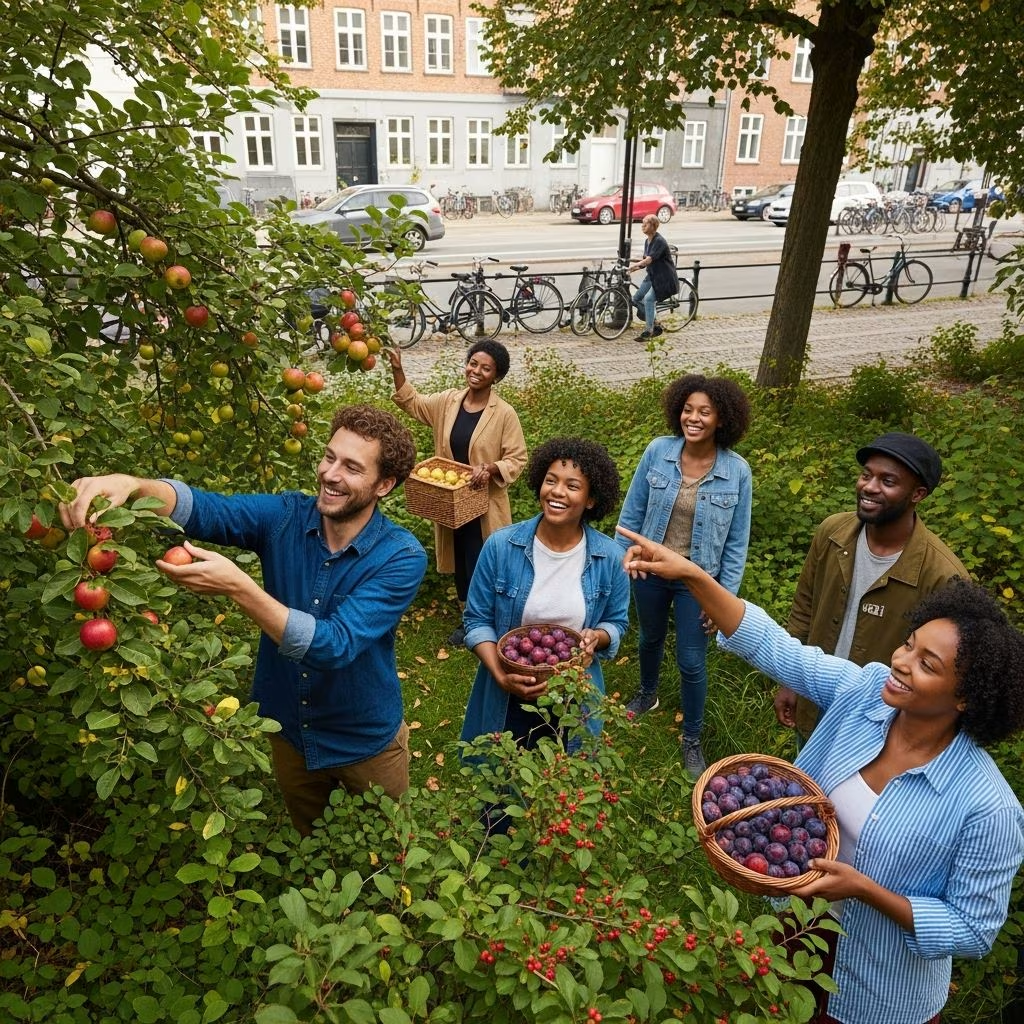
Walking through Copenhagen’s streets has taken on a new dimension as the city transforms itself into an urban orchard. What was once an ambitious proposal has become reality as the Copenhagen City Council voted to plant hundreds of public fruit trees throughout the Danish capital. This innovative initiative represents a fundamental shift in how cities can integrate food production with urban planning, making fresh, nutritious snacks accessible to every resident without cost.
The Copenhagen public fruit initiative emerged from a desire to reconnect urban residents with local food sources and the natural world. City Councilor Astrid Aller, a key figure from the Socialist People’s Party in advancing this proposal, articulates the philosophy underlying the project with clarity and passion. The fundamental concept centers on reimagining municipal spaces not merely as aesthetic amenities but as functional components of the community food system.
The initiative operates from a democratically-informed perspective that views public spaces as collectively owned resources that should benefit all inhabitants equally. Rather than restricting access to fruits and vegetables to those who can afford them or maintain private gardens, Copenhagen’s approach ensures that economic status does not determine access to healthy, fresh produce. This represents a meaningful response to food insecurity while simultaneously fostering a stronger connection between urban dwellers and agricultural processes.
The fruit trees and berry bushes have been strategically distributed across Copenhagen’s diverse public spaces, maximizing accessibility and community engagement. The selection of locations reflects careful urban planning that prioritizes areas with high foot traffic and community usage.
The choice of fruit varieties prioritizes species native to Denmark that require minimal maintenance while thriving in the Nordic climate. Selection criteria emphasize indigenous plants that grow spontaneously in natural Danish reserves, ensuring ecological appropriateness and sustainability.
The Copenhagen fruit tree initiative addresses multiple societal challenges simultaneously, making it an efficient allocation of municipal resources and planning attention. The project’s structure demonstrates how thoughtful urban design can simultaneously tackle food insecurity, environmental degradation, and social disconnection.
From a nutritional perspective, the initiative provides access to fresh, unprocessed fruits rich in vitamins, minerals, and fiber. This becomes particularly significant in urban environments where residents may lack gardens or face financial barriers to purchasing quality produce. The availability of free fruits throughout the city encourages healthier eating habits while reducing dependence on processed foods available in convenience stores.
Environmentally, fruit trees contribute meaningfully to carbon sequestration while increasing urban green coverage. Trees absorb carbon dioxide, reducing the urban heat island effect and improving air quality. The vegetation also enhances water infiltration, reducing stormwater runoff and associated flooding risks. Beyond individual trees, the initiative represents a philosophical shift toward integrating food production within urban ecosystems rather than maintaining the conventional separation between cities and agriculture.
At the heart of Copenhagen’s fruit initiative lies a distinctly Nordic conception of public space and collective responsibility. Astrid Aller emphasizes that the project embodies principles of democratic access and communal resource sharing. The vision extends beyond mere fruit distribution to encompass a transformation in how residents conceptualize their relationship with urban environments.
This philosophical framework challenges conventional notions of property and consumption. Rather than perceiving cities as spaces designed exclusively for commerce and private accumulation, the Copenhagen model presents municipalities as shared commons where all inhabitants possess equal rights to resources. Such thinking reflects deeper Scandinavian commitments to egalitarianism and social cohesion that distinguish Nordic cities from many other global urban centers.
The initiative also serves an educational function, particularly for children who may lack direct exposure to agricultural processes. By encountering fruit-bearing trees throughout their daily routines, young residents develop a tangible understanding of where food originates and how natural systems function. This experiential learning proves more impactful than abstract instruction, fostering environmental consciousness from early ages.
Copenhagen’s success with public fruit trees has inspired similar initiatives across multiple continents. Recognizing the dual benefits of addressing hunger while sequestering carbon, other municipalities have adopted comparable models. International examples demonstrate the scalability and adaptability of this urban agriculture approach.
| City | Country | Initiative Type |
|---|---|---|
| Ottawa | Canada | Fruit and nut trees supplied to food banks |
| Seattle | United States | Urban fruit trees in public spaces |
| Boston | United States | Distributed public orchards |
| San Francisco | United States | 25 urban orchards plus guided wild food walks |
| Asheville | United States | Community-accessible fruit cultivation |
The global expansion of such initiatives reflects growing recognition that conventional approaches to food security and urban planning prove inadequate for addressing contemporary challenges. As food insecurity affects billions worldwide, innovative solutions that integrate production systems into existing urban infrastructure gain increasing support from municipal governments and community organizations.
While the concept proves compelling, practical implementation requires addressing several logistical considerations. Municipal authorities must establish clear protocols for tree maintenance, pest management, and seasonal care. The selection of hardy, low-maintenance species helps minimize ongoing resource requirements, yet consistent attention remains necessary for optimal productivity.
Public education campaigns ensure residents understand which fruits are safe for consumption and proper harvesting techniques that don’t damage trees. Managing expectations around seasonal availability becomes important, as residents must recognize that fruit production fluctuates with weather patterns and natural cycles. Winter months present particular challenges in Nordic climates where many trees remain dormant.
Community stewardship models may develop organically, with neighborhood residents adopting informal responsibility for nearby trees. This participatory approach strengthens community bonds while distributing maintenance burdens across multiple stakeholders rather than concentrating them solely on municipal staff.
The fruit tree initiative represents merely one component of Copenhagen’s broader commitment to reimagining urban food systems. City leadership envisions expanded programs that further integrate food production and education into municipal spaces. Proposed additions include urban petting zoos where children interact with farm animals, creating visceral connections between residents and the animals that constitute their food supply.
Such expansions extend the philosophical foundation underlying the fruit initiative into comprehensive food system transformation. By exposing urban residents to multiple dimensions of agricultural production—from plant cultivation to animal husbandry—Copenhagen fosters informed citizens capable of making conscious food choices grounded in understanding of production processes and environmental impacts.
Yes, Copenhagen selects varieties and locations carefully to ensure fruit safety. The city prioritizes native species and avoids areas with heavy pollution or chemical applications.
The initiative welcomes all residents and visitors to harvest ripe fruit freely. The project explicitly embraces universal access as a core principle.
Most fruit-bearing trees and bushes go dormant in winter, with production primarily occurring during growing seasons from spring through autumn. This aligns with natural cycles and Nordic climates.
Municipal staff provide primary maintenance, though community stewardship and volunteer participation increasingly contribute to ongoing care. Species selection emphasizes low-maintenance varieties suited to local conditions.
Yes, multiple international cities have adopted comparable initiatives, including Seattle, San Francisco, Boston, and Ottawa. Each adapts the model to local climate and cultural contexts.
Copenhagen’s public fruit tree initiative represents a significant milestone in the evolution of urban food systems toward greater sustainability and equity. As global populations increasingly concentrate in cities while agricultural land continues fragmenting, integrating food production into urban infrastructure becomes not merely desirable but essential.
The Copenhagen model demonstrates that cities need not remain purely consumptive entities dependent on distant agricultural regions. Instead, municipalities can develop productive capacity that provides genuine nutritional contributions while strengthening social cohesion, environmental resilience, and community connection. As other cities observe Copenhagen’s success and adapt comparable approaches to their unique contexts, the trajectory suggests growing recognition that sustainable urbanism necessarily includes food system transformation.
The initiative ultimately invites residents to reconsider their relationship with public spaces and shared resources. By transforming streets and parks into productive landscapes, Copenhagen challenges the separation between consumption and production that characterizes modern urban life. Whether through harvesting berries from a neighborhood tree or understanding where food originates, the public fruit initiative fosters a fundamentally different urban experience—one that acknowledges humans as participants in ecological systems rather than external observers of managed landscapes.
