

 Travel Essentials
 Travel Essentials

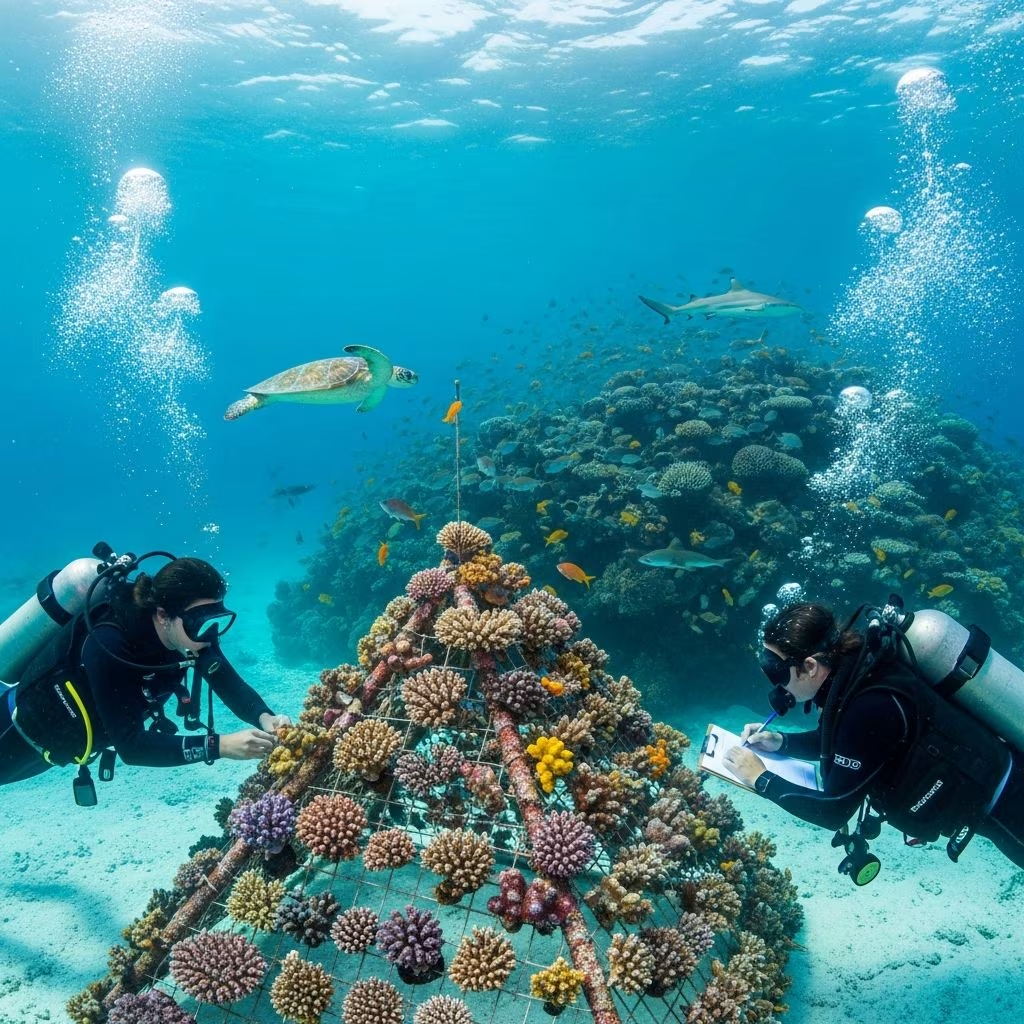
Explore cutting-edge coral regeneration efforts from government pledges to community-driven nurseries, highlighting tech and strategies saving reefs globally.
 Travel Essentials
Coral reefs, often called the rainforests of the sea, support a quarter of all marine species despite covering less than 1% of the ocean floor. Facing severe threats from climate change, pollution, and overfishing, these ecosystems are declining rapidly. However, a surge in restoration efforts worldwide offers hope. From high-tech nurseries to international funding coalitions, diverse strategies are accelerating reef recovery and building resilience against warming oceans.
Coral bleaching events, driven by rising sea temperatures, have devastated reefs globally. In 2023-2024, record heatwaves affected over 80% of the world’s reefs. Restoration initiatives aim to not only replant corals but also enhance genetic diversity and ecosystem health to withstand future stresses. These projects combine scientific research, local involvement, and substantial funding to scale up efforts.
Key challenges include low natural recovery rates, disease outbreaks, and human pressures. Successful programs address these by selecting climate-resilient coral genotypes and integrating habitat protection. Governments, NGOs, and private sectors are collaborating on ambitious scales, targeting millions of coral fragments for outplanting.
In a landmark move at the UN Ocean Conference, 11 governments committed to protecting climate-resilient coral reefs. This pledge leverages new global science from the Wildlife Conservation Society (WCS), including the “50 Reefs+” analysis. This high-resolution map spans 8.7 million reef pixels, integrating live coral cover data, life histories, climate models, and human impact assessments via the MERMAID platform.
These tools guide prioritized conservation, helping allocate resources to reefs with the highest survival potential. By focusing on resilient sites, the initiative aims for long-term protection amid climate change, influencing funders and policymakers worldwide.
The Global Fund for Coral Reefs (GFCR) stands as the premier financial mechanism for reef futures. This public-private partnership unites over 60 nations, UN agencies, banks, philanthropies, and conservation groups. It mobilizes resources for sustainable businesses and financial solutions in 20+ developing countries, deploying grants and investments to tackle ecosystem stressors.
Complementing this, the G20’s CORDAP awarded $1.5 million to 16 projects in 2025, empowering 63 researchers from 13 low- and middle-income countries. Each up-to-two-year project receives up to $100,000 for breakthrough restoration science.
Restoration employs diverse methods, from micro-fragmentation to electrical stimulation. Micro-fragmenting breaks corals into tiny pieces that grow 25-40 times faster than on reefs. Land-based nurseries then rear them for transplantation, achieving high survival rates.
Biorock technology, pioneered by the Global Coral Reef Alliance (GCRA), uses low-voltage currents to mineralize structures, accelerating growth and resisting bleaching. Deployed globally since the 1980s, it supports mariculture, tourism, and shore protection in community-led projects.
| Technique | Description | Benefits | Example Locations |
|---|---|---|---|
| Micro-Fragmentation | Dividing corals into fragments for rapid nursery growth | 25-40x faster healing; 2,000+ replanted since 2020 | Mauritius, Florida |
| Biorock Electrolytic | Low-voltage mineral accretion on frames | 2-5x growth speed; bleaching resistance | Indonesia, Bali, Jamaica origins |
| Larval Propagation | Capturing and settling wild larvae | Genetic diversity boost | Florida Keys, Caribbean |
In French Polynesia and Fiji, diver-led programs have planted over 100,000 corals since 2017, with 82% survival and 69,890 added in 2023 alone. Local leaders’ involvement ensures cultural buy-in, expanding to employ Fijian communities planting 11,000+ fragments.
NOAA’s initiative targets seven key sites in Florida Keys National Marine Sanctuary, aiming to boost coral cover from 2% to 25%. Partners use gardening, outplanting, and egg harvesting for large-scale restoration. Mote Marine Laboratory complements this with veteran and youth programs, launching a 15-year Caribbean-Florida effort with The Nature Conservancy.
Mauritius’ marine centers employ micro-fragmentation, allowing guest participation via ‘adopt-a-coral’ schemes. Over 2,000 fragments restored since 2020, educating tourists on reef health.
Organizations like Coral Reef Alliance focus on upstream threats, reducing sewage, runoff, and development pollution to prevent disease and aid natural growth. The Coral Restoration Foundation perfects scalable techniques for ecological significance.
Successful restorations prioritize locals, creating jobs in nurseries and monitoring. In Fiji, tribal blessings enable sustainable harvesting. Eco-tourism generates revenue, funding ongoing work while raising awareness.
Survival rates above 80% in top projects signal promise, but scaling remains key. Metrics include coral cover increase, biodiversity recovery, and fish population rebounds. Challenges persist: funding gaps and super-bleaching events demand adaptive strategies.
By 2030, GFCR and similar funds aim for widespread resilience. Integrating restoration with protection—like marine protected areas—multiplies impacts.
Primarily elevated sea temperatures expelling symbiotic algae, worsened by pollution and acidity.
With techniques like micro-fragmentation, 6-12 months in nurseries; full colonies take years.
Yes, through donations, volunteering, reducing plastic use, or choosing reef-safe sunscreen.
They enhance resilience and biodiversity, bridging gaps until natural recovery.
Mission: Iconic Reefs targets massive scale in Florida; GFCR spans 20+ nations.
