


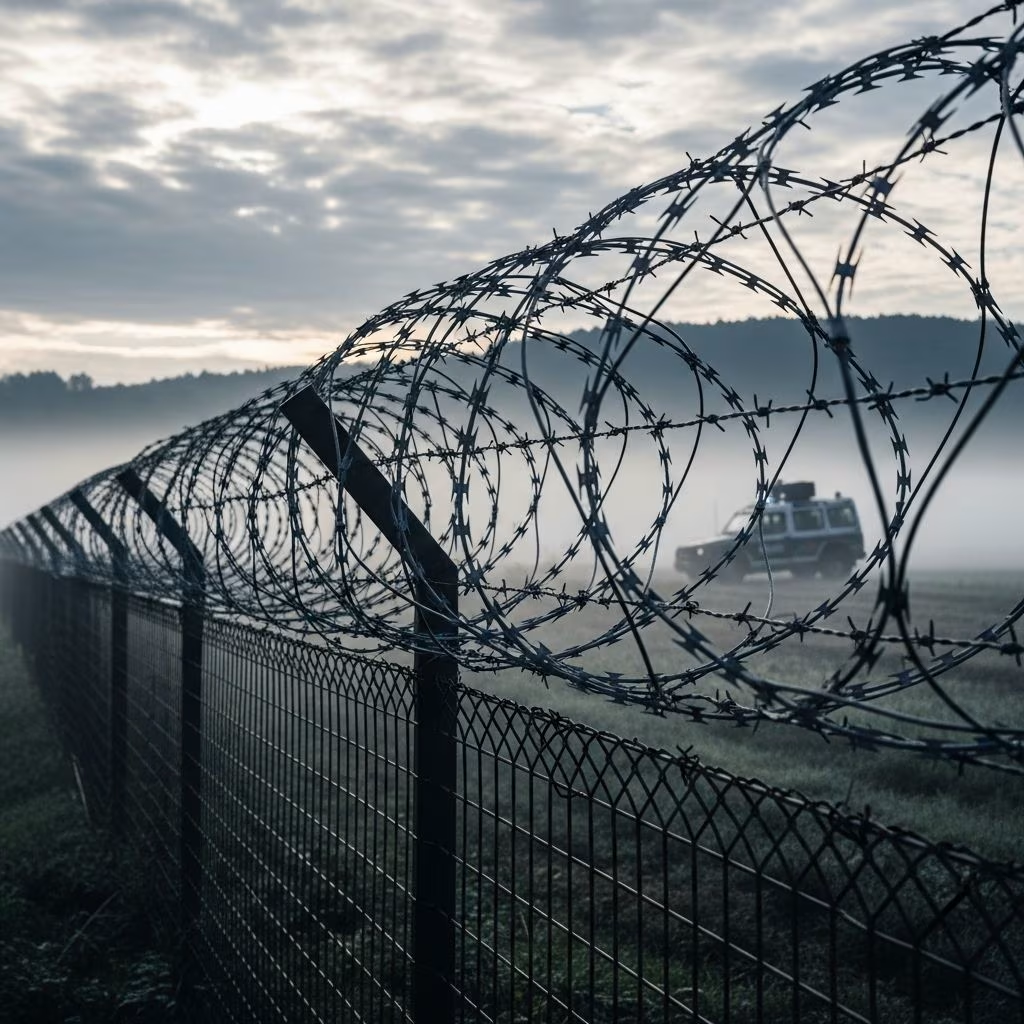
The 2015 European migrant crisis reached a fever pitch in the Balkans when Croatia abruptly closed most of its border crossings with Serbia. This decision came after an overwhelming influx of over 10,000 people in just two days, forcing authorities to declare the country at capacity.Croatia’s Interior Minister Ranko Ostojic stated the nation was ‘absolutely full’ and urged migrants not to proceed.
Roots of the Balkan Migration Pathway
The pathway through the Western Balkans emerged as a primary route for migrants fleeing war and poverty in the Middle East and beyond. Starting from Greece, many aimed for Germany and other wealthy EU nations. Hungary’s construction of a border fence with Serbia in September 2015 redirected thousands northward into Croatia, turning a transit nation into a frontline state.
Croatia, not initially prepared for such volumes, initially allowed passage. However, chaotic scenes at border towns like Tovarnik and Opatovac quickly escalated. Crowds attempted to breach police lines, leading to scuffles and overwhelming local resources.
Immediate Actions and Border Shutdown
On September 17, 2015, Croatia shuttered seven of eight border posts with Serbia, deploying the army on high alert. This followed Hungary’s own border sealing the day prior, effectively severing the main overland route from Greece to Central Europe.
- Rapid influx: Approximately 11,000 migrants crossed in under 48 hours, straining buses, camps, and police.
- Official plea: Minister Ostojic warned, ‘Don’t come here anymore… This is not the road to Europe.’
- Military involvement: Troops supported border control amid rising tensions.
Neighbouring Slovenia also announced a 10-day closure of its Hungarian border, compounding the bottlenecks.
Human Stories from the Borderline
Migrants, primarily from Syria, Afghanistan, and Iraq, faced dire conditions. Stranded in ‘no-man’s land’ between Croatia and Serbia, thousands endured cold, rain, and uncertainty. One report described 3,000 people trapped before Croatia briefly reopened crossings on September 21.
“Authorities struggled to cope with the sudden influx, leading to desperate attempts to push forward.”
Families with children and the elderly were particularly vulnerable, relying on limited aid from NGOs and local volunteers. Videos captured tense standoffs, with police using non-lethal force to manage crowds.
Regional Ripple Effects
| Country | Action Taken | Date | Impact |
|---|---|---|---|
| Hungary | Sealed Serbia border, built fence | Sept 16, 2015 | Diverted flows to Croatia |
| Croatia | Closed 7/8 Serbia crossings | Sept 17, 2015 | Stranded thousands |
| Slovenia | Closed Hungary border (10 days) | Sept 17, 2015 | Further bottlenecks |
| Macedonia/Serbia | Overcrowded camps | Ongoing | Increased smuggling |
This chain reaction highlighted the fragility of uncoordinated national responses. Serbia and Macedonia saw camps overflow, pushing migrants toward riskier sea routes or smugglers.
Shift to Pushbacks and Restrictions
By March 2016, Croatia joined Slovenia, Austria, Macedonia, and Serbia in formal border controls along the Western Balkan route. This aimed to stem irregular EU entries but led to widespread pushbacks.Human Rights Watch documented cases where Croatian police forcibly returned asylum seekers to Serbia, often with violence, denying asylum claims.
Ten Afghans, including children, reported beatings, theft of phones and money, and summary deportations despite requests for protection. Such practices violated EU asylum law and the 1951 Refugee Convention.
Legal and Humanitarian Fallout
Pushbacks drew international condemnation. HRW called on the European Commission to investigate and halt returns, emphasizing Croatia’s obligations under EU law.
- Violations noted: Denial of asylum access, use of force, property confiscation.
- Stranded populations: Thousands stuck in Serbia, exposed to weather and exploitation by smugglers.
- Prior incidents: Similar pushbacks reported in January 2016 by NGOs like Moving Europe.
The EU faced criticism for lacking a unified policy, leaving frontline states to bear the burden.
Long-Term Policy Changes
The crisis prompted the EU-Turkey deal in 2016, reducing Aegean crossings by over 90%. Balkan closures contributed to this decline, but at a cost: irregular migration persisted via other routes.
Croatia registered over 650,000 migrants in 2015, processing most as transit but detaining some. Asylum grants remained low, with many continuing northward irregularly.
Challenges for Transit Nations
Croatia’s infrastructure buckled: The Opatovac camp expanded to 4,000 capacity, but arrivals exceeded plans. Police worked overtime, and buses ferried people to Slovenia or Hungary before closures.
Serbia emerged as a reluctant host, with NGOs providing shelter amid government appeals for EU aid.
Personal Impacts and Testimonies
Migrants shared harrowing accounts: families separated in the chaos, children in wet clothes, and hopes dashed by fences. One video showed migrants chanting for passage, met by police lines.
EU-Wide Implications
The Balkan route’s closure marked a turning point, shifting debates toward external border deals and quotas. It exposed divisions: Germany’s ‘Wir schaffen das’ contrasted with Eastern Europe’s resistance.
Current Reflections on 2015 Events
Though flows have ebbed, lessons linger. Improved Frontex operations and hotspots in Greece manage arrivals better, but pushback concerns persist in reports from 2017 onward.
Frequently Asked Questions
Why did Croatia close its border with Serbia?
Croatia closed seven crossings after 10,000+ migrants arrived in two days, following Hungary’s fence, to manage capacity.
What was the Western Balkan route?
A land path from Greece via Macedonia, Serbia, Croatia/Hungary to Western Europe, used by hundreds of thousands in 2015.
Were there human rights issues?
Yes, post-2016 pushbacks involved force and denied asylum, per HRW.
How did the crisis end?
EU-Turkey deal and Balkan closures reduced crossings dramatically by 2016.
Impact on Croatia?
Overwhelmed resources; registered 650k+, minimal asylum grants.
References
- Refugee Crisis: Croatia Closes Border Crossings With Serbia — TIME. 2015-09-17. https://time.com/4039742/croatia-border-crossings-closed-refugees-migrant-crisis/
- Croatia closes border with Serbia as thousands of migrants arrive — YouTube (Reuters). 2015-09-18. https://www.youtube.com/watch?v=ZSbT1UmuU4w
- Croatia: Asylum Seekers Forced Back to Serbia — Human Rights Watch. 2017-01-20. https://www.hrw.org/news/2017/01/20/croatia-asylum-seekers-forced-back-serbia
- Migrant crisis: Trapped in no-man’s land at the Croatia/Serbia border — YouTube (AFP). 2015-09-21. https://www.youtube.com/watch?v=919RTN0uaks

