

 Travel Essentials
 Travel Essentials

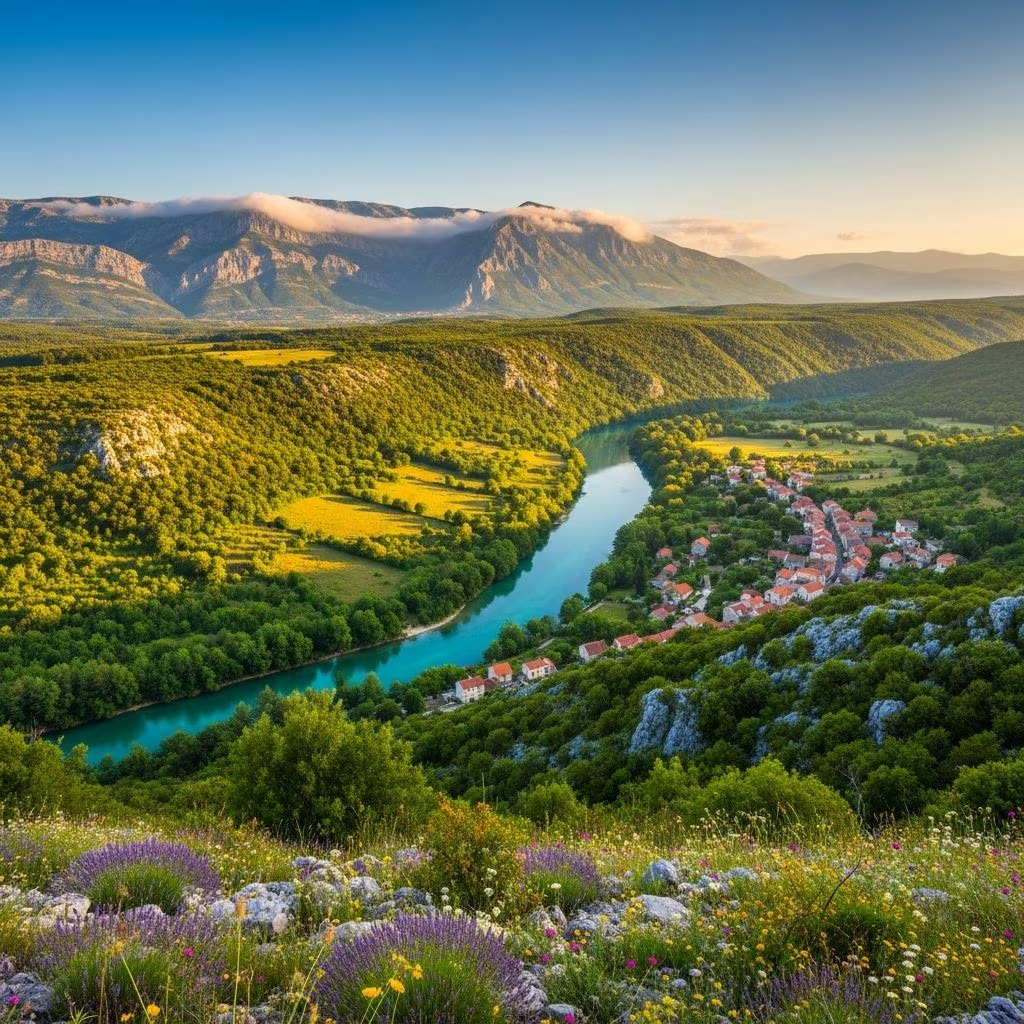
Discover Croatia's diverse protected natural areas including 8 national parks and 12 nature parks offering mountain hikes, waterfall tours, and endemic wildlife across the Balkan interior.
 Travel Essentials
While Croatia’s reputation rests primarily on its crystalline Adriatic coastline and island-dotted seascapes, the nation’s interior landscape conceals equally remarkable natural treasures. Beyond the sandy beaches and rocky coves that dominate tourist itineraries, Croatia’s hinterland encompasses a sophisticated network of protected conservation areas that showcase continental European ecosystems at their finest. This inland wilderness represents a parallel dimension to Croatia’s maritime identity—one characterized by cascading waterfalls, soaring mountain ranges, dense forests, and wildlife habitats that have remained largely undisturbed by development.
The Croatian government has formalized this commitment to environmental preservation through the establishment of eight national parks and twelve nature parks, creating a framework that balances ecological protection with sustainable tourism development. This dual-category system reflects an intentional approach to conservation, where different protection levels serve distinct ecological and social purposes. Together, these designated areas encompass approximately 38.6% of Croatia’s total land area, positioning the nation as a regional leader in environmental stewardship.
Croatia’s approach to landscape protection operates through a hierarchical classification system that distinguishes between national parks and nature parks based on conservation stringency and human utilization parameters. National parks represent the pinnacle of protective designation, reserved for territories containing exceptional natural phenomena and pristine ecosystems requiring maximum safeguarding from anthropogenic disturbance. These areas typically showcase singular geological formations, rare biodiversity concentrations, or landscape configurations deemed irreplaceable from a scientific perspective.
Nature parks, conversely, accommodate a more flexible framework permitting controlled human activity, sustainable resource extraction, and community integration within conservation boundaries. This classification recognizes that many valuable ecosystems can coexist with thoughtful human presence, particularly when economic incentives align with preservation objectives. By allowing limited recreational development, agricultural practices, and resource harvesting within designated parameters, nature parks demonstrate that conservation and livelihood sustainability need not remain antagonistic forces.
Both categories function as interconnected components of a comprehensive biodiversity protection strategy, extending beyond mere designation to encompass active management, scientific monitoring, and ecotourism infrastructure development. This integrated approach has established Croatia as a model for European nature conservation, demonstrating how economic development through responsible tourism can fund environmental protection initiatives.
Croatia’s protected territories span a remarkable geographical continuum, extending from the Istrian peninsula’s northwestern reaches southward through Dalmatia’s Mediterranean landscapes, and inland across mountain chains and river valleys. This north-to-south progression encompasses radically different ecological zones, each hosting specialized flora and fauna adapted to particular environmental conditions.
The distribution pattern reflects Croatia’s complex topography, where the Dinaric Alps form a natural spine separating coastal regions from continental plateaus. Mountain parks feature alpine meadows, coniferous forests, and rocky terrain supporting hardy plant species and specialized wildlife populations. Coastal parks encompass archipelagos and maritime ecosystems containing seagrass meadows, coral formations, and fish spawning grounds essential for Mediterranean fisheries. Interior lowland parks preserve wetlands, floodplain forests, and river corridors supporting migratory bird populations and aquatic biodiversity.
This ecological stratification creates opportunities for visitors to experience dramatically different natural environments within a single nation, from submaritime Mediterranean climates to temperate continental forests to subalpine grasslands, all within driving distances of each other.
Among Croatia’s eight national parks, Plitvice Lakes commands international recognition as the nation’s flagship natural attraction and UNESCO World Heritage Site. Spanning approximately 75,000 acres of protected territory located roughly 73 miles northeast of the ancient city of Zadar, this karst landscape represents a geological masterpiece shaped by millennia of limestone dissolution and travertine deposition. The park derives its ecological significance from sixteen interconnected lakes connected by an intricate system of subterranean rivers and calcite-rich waterfalls that cascade continuously across pale limestone formations.
The visual spectacle of Plitvice’s waters owes its distinctive character to suspended limestone particles that refract light wavelengths, producing a kaleidoscopic palette ranging from emerald green to sapphire blue to milky jade, with colors varying seasonally based on mineral concentration and light angle. This natural filtering system transforms the landscape into a photographer’s paradise and draws over one million annual visitors seeking to witness one of Europe’s most photogenic natural phenomena.
The Brijuni Archipelago presents an entirely contrasting conservation model—a maritime park comprising fourteen islands positioned in the northern Adriatic near the Istrian coast. Rather than emphasizing pristine wilderness isolation, Brijuni integrates cultural heritage, recreational infrastructure, and ecological preservation within an island setting. Visitors encounter not only Mediterranean vegetation and coastal wildlife but also archaeological remains, historic fortifications, and established cycling networks that facilitate active exploration of island ecosystems.
Croatia’s interior mountain parks preserve some of southeastern Europe’s most intact alpine and subalpine environments. The Northern Velebit National Park, established in 1999 as Croatia’s newest national park at the time of its designation, exemplifies mountain conservation at its most rigorous. Positioned just south of the coastal town of Senj, this rugged terrain rises dramatically from Mediterranean lowlands to summit elevations supporting specialized high-altitude flora adapted to harsh conditions including seasonal snow cover and wind exposure.
The Northern Velebit ecosystem hosts the renowned Velebit Botanical Garden, a monument-designated landscape featuring concentrations of rare endemic plant species found nowhere else globally. The park’s geological and biological diversity creates a living laboratory for botanical research while offering hikers, climbers, and nature photographers terrain that presents genuine physical challenges and extraordinary visual rewards.
The recently designated Dinara Nature Park, formalized in February 2021 as Croatia’s twelfth protected area and second-largest by acreage at 155,000 acres, demonstrates the ongoing expansion of the conservation network into previously undesignated territories. This mountain range park encompasses far more ecological variety than its peak-focused nomenclature suggests, combining rocky summits with forested slopes, grassland plateaus, river valleys, limestone cave systems, and waterfall cascades.
The ecological significance of Dinara extends beyond its dramatic topography—the park functions as a refuge for twenty endemic animal species found only within this specific geographic range, plus supporting over one thousand plant species representing an extraordinary concentration of botanical diversity. This intersection of geological drama and biological richness creates a destination combining serious mountaineering opportunities with world-class naturalist observations.
The Croatian conservation landscape continues evolving, with recent designations reflecting commitment to expanding protected territory networks. The Zagorje Mountains Nature Park, Croatia’s most recent protected area designation, sprawls across 30,000 hectares positioned approximately one hour’s drive northwest of Zagreb. This park represents the first new nature park designation since Dinara in 2021, extending protection to inland mountain regions historically overshadowed by coastal tourism dominance.
The Zagorje Mountains encompass five distinct mountainous components—Ravna Gora, Ivanščica, Strahinjčica, Macelj Mountain, and the Bednja region—each contributing distinct ecological characteristics while collectively creating a regionally significant conservation zone. The park’s designation explicitly aims to increase tourism awareness for Croatia’s interior landscapes, shifting visitor attention from exclusively coastal experiences toward the nation’s equally compelling continental ecosystems. The protected area features oak forests, medieval towns, historic castles, and prehistoric cave systems that combine natural and cultural heritage within single protected boundaries.
| Category | Protection Level | Human Activity | Visitor Experience | Examples |
|---|---|---|---|---|
| National Parks | Maximum protection | Limited to passive recreation | Guided tours, hiking, photography | Plitvice Lakes, Northern Velebit |
| Nature Parks | Moderate protection | Sustainable resource use permitted | Broader activity range, local engagement | Dinara, Zagorje Mountains |
Croatia’s protected natural areas function as biological repositories preserving plant and animal species representing millions of years of evolutionary adaptation to southeastern European environmental conditions. The nation’s position at the intersection of Mediterranean, continental, and Alpine biogeographic zones creates habitat mosaics supporting extraordinary species diversity within relatively compact geographical areas.
Plitvice Lakes ecosystem illustrates this principle through its combination of aquatic, riparian, and forest habitats supporting fish populations, aquatic invertebrates, waterbird species, and terrestrial vertebrates within integrated ecological communities. Mountain parks including Northern Velebit and Dinara preserve endemic species with restricted geographical ranges, ensuring that global biodiversity protection depends on maintaining these specific protected territories.
The 1,000+ plant species concentrated in Dinara Nature Park alone represent not merely numerical abundance but functional diversity—each species occupies distinct ecological niches, responds to particular soil conditions, and contributes specialized services to ecosystem functioning. This botanical richness creates visual landscapes characterized by wildflower displays, diverse forest types, and vegetation zonation patterns reflecting altitude and microclimate variations.
Croatia’s protected areas present dramatically different experiences depending on seasonal conditions, with each season offering distinct advantages for particular activity types and aesthetic experiences. Spring (April-May) and autumn (September-October) represent optimal periods for active recreation, combining comfortable temperatures with minimal precipitation, producing clear visibility for photography and hiking.
Winter visitation requires careful planning, particularly for mountain parks including Northern Velebit, where seasonal snow closure restricts access from approximately November through April depending on specific conditions. Mountain parks may remain inaccessible during winter months, while coastal parks and lower-elevation areas remain open year-round with reduced visitor density and alternative aesthetic qualities.
Summer (June-August) brings peak tourist seasons, particularly at flagship attractions like Plitvice Lakes, resulting in crowded conditions that may diminish solitude experiences but ensuring full infrastructure availability and guided program offerings.
Croatia’s protected area system demonstrates how properly structured ecotourism generates revenue streams funding conservation initiatives while creating economic incentives for local communities to support preservation objectives. Entrance fees, guided tour services, and visitor spending within park regions contribute directly to habitat management, species monitoring, and infrastructure maintenance.
The designation of new protected areas like Zagorje Mountains explicitly aims to increase conservation funding by diversifying tourism distribution across formerly underappreciated inland regions, reducing pressure on existing flagship parks while creating employment opportunities within historically economically disadvantaged areas.
National parks enforce maximum protection with minimal human activity, while nature parks permit sustainable resource use and local community engagement within conservation frameworks. Both protect biodiversity but serve different conservation philosophies.
Plitvice Lakes National Park features the most extensive waterfall systems, with sixteen interconnected lakes connected by cascading calcite-depositing waterfalls creating iconic limestone formations.
Northern Velebit and other alpine parks typically close from November through April due to snow conditions, though lower-elevation parks remain accessible seasonally.
Activities vary by park type—national parks emphasize hiking, photography, and passive observation, while nature parks permit additional activities including cycling, limited resource harvesting, and community recreation.
Most inland parks require 1-3 hours’ driving from major coastal cities, making day-trip combinations feasible for multi-activity vacation planning.
