

 Travel Essentials
 Travel Essentials

This comprehensive guide categorizes cruise ships by size, detailing passenger capacities, amenities, and ideal itineraries to help you select the best fit for your travel style.
 Travel Essentials
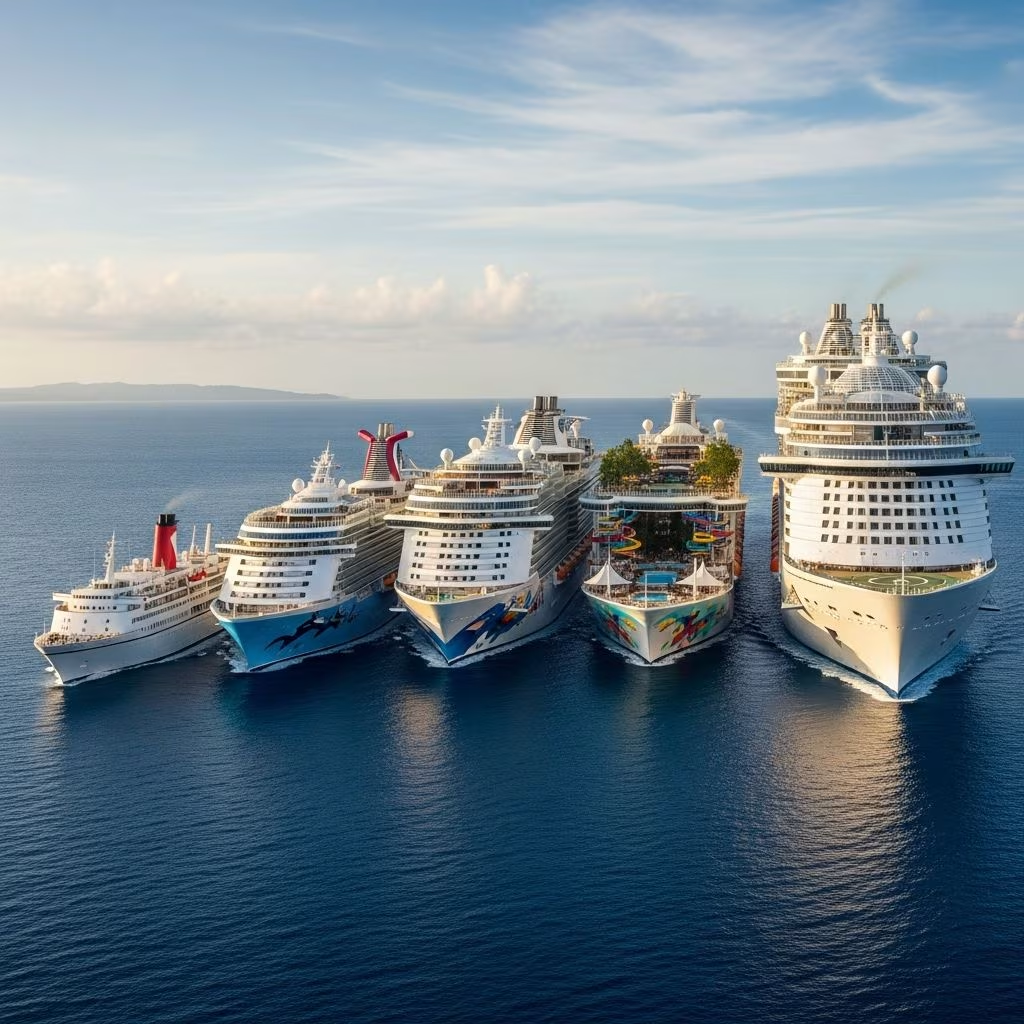
Cruise ships vary dramatically in scale, from cozy expedition boats to floating cities that dwarf landmarks. Size influences everything from passenger numbers and onboard facilities to the types of destinations accessible and the overall vacation vibe. Understanding these differences empowers travelers to choose a ship matching their preferences, whether seeking personalized service or high-energy entertainment.
Key metrics define a ship’s size. **Gross tonnage (GT)** measures internal volume, not weight, with one GT equaling 100 cubic feet. Length spans bow to stern, while beam is the widest point. Passenger capacity lists double occupancy (two per cabin) and maximum (with extras like pullouts). Crew ratios also matter for service quality.
These figures help compare vessels accurately. For instance, a ship’s length affects stability in rough seas, and beam influences docking options at smaller ports.
Ships group into small, mid-size, large, and mega categories based on GT and guests. Each offers unique advantages.
Under 50,000 GT, these carry fewer than 1,000 passengers, ideal for remote itineraries like Antarctica or the Galapagos. High crew-to-guest ratios (often 1:1) ensure attentive service. Examples include Viking’s Ocean class at 47,800 GT with 930 guests.
Such ships excel in cultural immersion and nature-focused trips.
50,000-100,000 GT accommodates 1,000-2,500 guests. They blend amenities with accessibility to varied ports. TUI Cruises’ Mein Schiff Herz (77,300 GT, 1,912 passengers) exemplifies this.
Perfect for families or couples wanting variety without overwhelm.
100,000-150,000 GT hosts 2,500-4,000 guests with extensive options like multiple pools and theaters. Princess Cruises’ Emerald class (113,500 GT, 3,080 passengers) fits here.
Over 150,000 GT, carrying 4,000+, these are entertainment hubs. Royal Caribbean’s Icon of the Seas leads at 250,800 GT, 1,198 feet long, up to 7,600 guests.
MSC World Europa (215,800 GT, 6,762 passengers) showcases innovation.
Here’s a comparison table of standout vessels:
| Ship | Line | GT | Length (ft) | Passengers (Double/Max) |
|---|---|---|---|---|
| Icon of the Seas | Royal Caribbean | 250,800 | 1,198 | 5,610/7,600 |
| MSC World Europa | MSC | 215,863 | 1,093 | 6,762/8,000 |
| Queen Anne | Cunard | 113,000 | 1,058 | 2,600/3,000 |
| Viking Vesta | Viking | 54,300 | 781 | 998/998 |
| Mein Schiff Herz | TUI | 77,302 | 866 | 1,912/2,669 |
Larger ships mean more dining venues, shows, and kids’ clubs but longer lines and less personalized service. Small ships offer quiet luxury and agile navigation.
Mega-ships shine with splash zones and arcades. Icon of the Seas has eight neighborhoods for varied fun. Mid-size options balance this for smaller groups.
Small to mid-size provide romance without crowds. Viking ships emphasize adults-only serenity.
Small luxury lines like Ritz-Carlton (47,000 GT, 448 guests) deliver yacht-like elegance.
Size dictates destinations. Small ships access fjords or islands; mega-ships favor Caribbean or Mediterranean hubs.
Consider group size, activity preferences, and budget. Test via shorter cruises. Newer ships prioritize sustainability and tech.
Icon of the Seas at 250,800 GT, holding 7,600 passengers.
Depends on priorities—more amenities vs. intimacy.
Larger ships with stabilizers feel smoother.
Mid-size offers a gentle intro.
1:2 or better on luxury small ships.
Oasis-class evolutions and LNG-powered giants like MSC World America signal bigger, greener vessels. Expect hybrid sizes for niche markets.
