

 Travel Essentials
 Travel Essentials

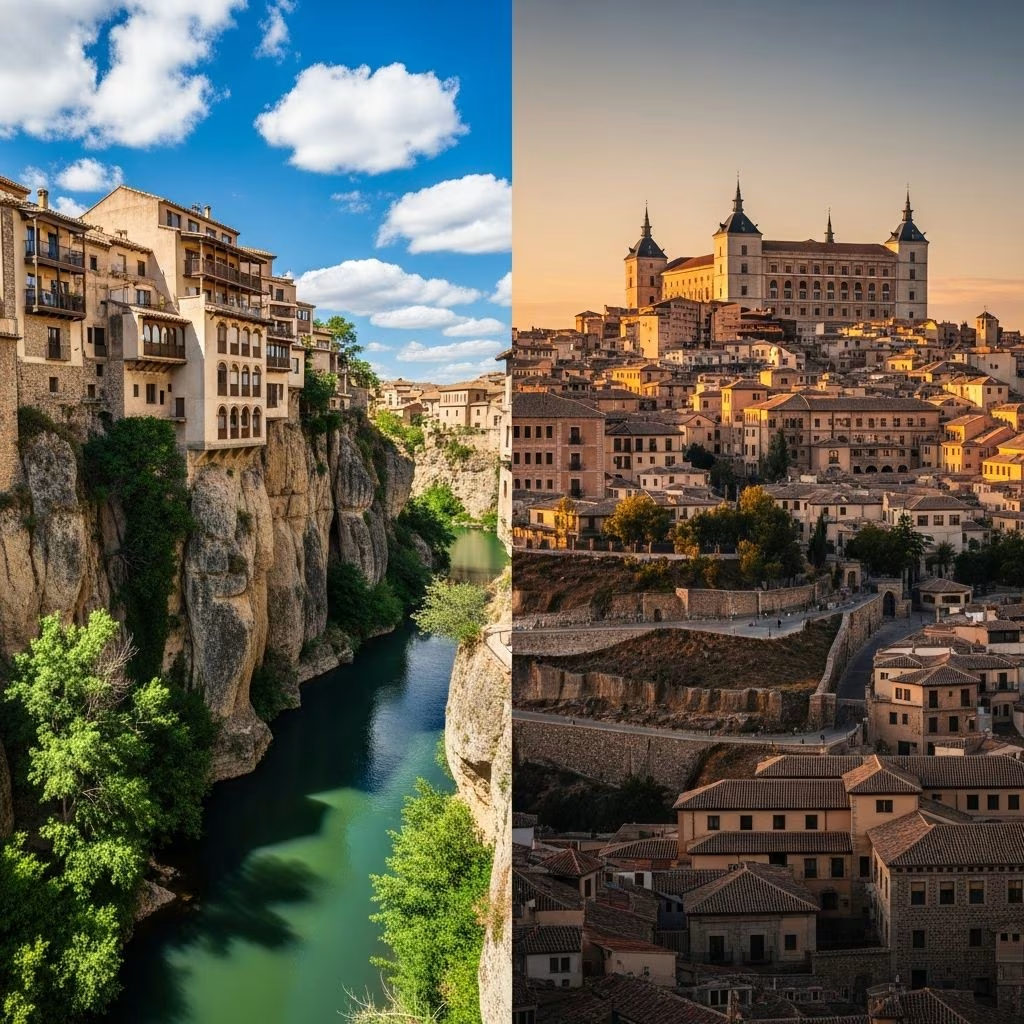
Explore the UNESCO-listed wonders of Cuenca with its iconic hanging houses and Toledo's layered history of Gothic, Moorish, and Renaissance styles in this comprehensive guide.
 Travel Essentials
Perched dramatically between deep river gorges, Cuenca captivates with its medieval fortress-like old town and iconic hanging houses, while Toledo enchants with a tapestry of religious and royal monuments reflecting centuries of cultural fusion. These two Castilian jewels, both UNESCO World Heritage sites, offer travelers a profound dive into Spain’s architectural evolution from Moorish origins to Gothic grandeur.
Cuenca’s unique geography defines its architecture. Nestled on a steep promontory flanked by the Huécar and Júcar rivers, the city was strategically built by Moors in the 8th century as a defensive stronghold within the Caliphate of Cordoba. Conquered by Castilians in the 12th century, it evolved into a royal town and bishopric, preserving an intact medieval townscape that blends seamlessly with its rugged landscape.
The upper town’s walls and towers rise defiantly above the gorges, exemplifying the archetype of a medieval fortress-town. This harmonious integration of urban design and natural contours earned Cuenca its UNESCO status under criterion (ii) for outstanding examples of religious and secular architecture from the 12th to 18th centuries.
The casas colgadas, or hanging houses, are Cuenca’s most photographed marvels. Dating back to the 14th or 15th century, these wooden-balconied residences cling to sheer cliffs over the Huécar River, originally part of a larger network that has dwindled over time. Only a few survive today, with three prominent examples housing the Spanish Abstract Art Museum, offering interiors that contrast their vertiginous exteriors.
Access these wonders via Calle Canónigos from Plaza Mayor. Their gabled facades and expansive balconies symbolize human ingenuity adapting to extreme terrain, drawing visitors to peer into the abyss below.
| Feature | Description | Historical Note |
|---|---|---|
| Construction Era | 14th-15th century | Originally more numerous; survivors now museums |
| Location | Over Río Huécar gorge | Accessed from medieval lanes |
| Current Use | Abstract Art Museum | Preserves interiors while showcasing views |
Beyond the hanging houses, Cuenca’s religious buildings span Gothic origins to Baroque flourishes. The Cathedral of Saint Mary and Saint Julian stands as Spain’s earliest Gothic cathedral, constructed from the 12th century on the site of an 11th-century mosque. Its design draws from Norman and Anglo-Norman influences, akin to Soissons and Laon Cathedrals, possibly inspired by Eleanor Plantagenet, wife of Alfonso VIII.
From Plaza Mayor, the neo-Gothic facade (1902) belies its ancient roots. Nearby, the 18th-century Iglesia de San Pedro represents Cuenca’s oldest church site, while the 13th-century Iglesia de San Miguel exemplifies Gothic simplicity amid the old town’s cobbled streets.
The Baroque ayuntamiento (town hall) arches over Plaza Mayor, framing the cathedral and adding Renaissance elegance to the medieval core.
Start at Plaza Mayor, the bustling heart overlooked by town hall and cathedral. Wander north on Calle San Pedro to Iglesia de San Pedro, then east to the hanging houses. Venture into the Castillo quarter outside the walls for Islamic fortress remnants, or explore the upper town’s religious ensemble, including the Nuestra Senora de las Angustias Shrine with its centuries-old devotional traditions.
Toledo’s architecture narrates a history of coexistence among Christians, Muslims, and Jews. Its cobbled, hilly lanes wind around the Alcázar fortress, Gothic churches, converted mosques, and synagogues, embodying Moorish, Gothic, Mudéjar, and Renaissance styles.
From the Alcázar, delve west into medieval alleys past the 11th-century Mezquita de las Tornerías, a remnant of Islamic influence, en route to the towering Catedral de Toledo—a 250-year Gothic opus (1227-1493).
The Catedral Primada de Toledo dominates with its intricate facade and vast interior, a testament to medieval ambition. Completed over two and a half centuries, it exemplifies pure Gothic with soaring vaults and luminous stained glass.
Along Calle de Alfonso XII lies Iglesia de Santo Tomé, guardian of El Greco’s El Entierro del Conde de Orgaz, a Mannerist masterpiece accessed via Plaza del Conde. Further on Calle de los Reyes Católicos, the Monasterio de San Juan de los Reyes boasts a two-story Gothic-Isabeline cloister with Mudéjar ceilings and royal crests of Castile and Aragón, commissioned by Ferdinand and Isabella to commemorate their victories.
| Aspect | Cuenca | Toledo |
|---|---|---|
| Primary Styles | Gothic, Baroque, Medieval | Gothic, Mudéjar, Renaissance, Moorish |
| Signature Landmark | Hanging Houses | Catedral Primada |
| UNESCO Criterion | Fortress-town preservation | Cultural confluence |
| Landscape Integration | Gorge-clinging structures | Hilly, labyrinthine lanes |
Both cities reward slow-paced visits. In Cuenca, stay at the Parador opposite the hanging houses for immersive views. Toledo’s old town is pedestrian-only; climb the Alcázar for orientation. Spring or fall avoids summer crowds. Combine with nearby Serranía de Cuenca hikes for context.
They dramatically overhang the Huécar gorge, with wooden balconies offering sheer-drop views; survivors from the 15th century now serve as museums.
Yes, built in the 12th century amid Romanesque dominance, influenced by Norman styles.
One full day per city covers highlights; two days each allows deeper exploration.
Golden hour at dawn or dusk enhances gorges in Cuenca and Toledo’s golden stone glow.
Yes, UNESCO-focused walks in both cities highlight architectural narratives.
