

 Travel Essentials
 Travel Essentials

Explore the evolution of digital travel passes and One ID initiatives by IATA, enabling paperless journeys with biometrics and secure credentials for safer, faster flights worldwide.
 Travel Essentials
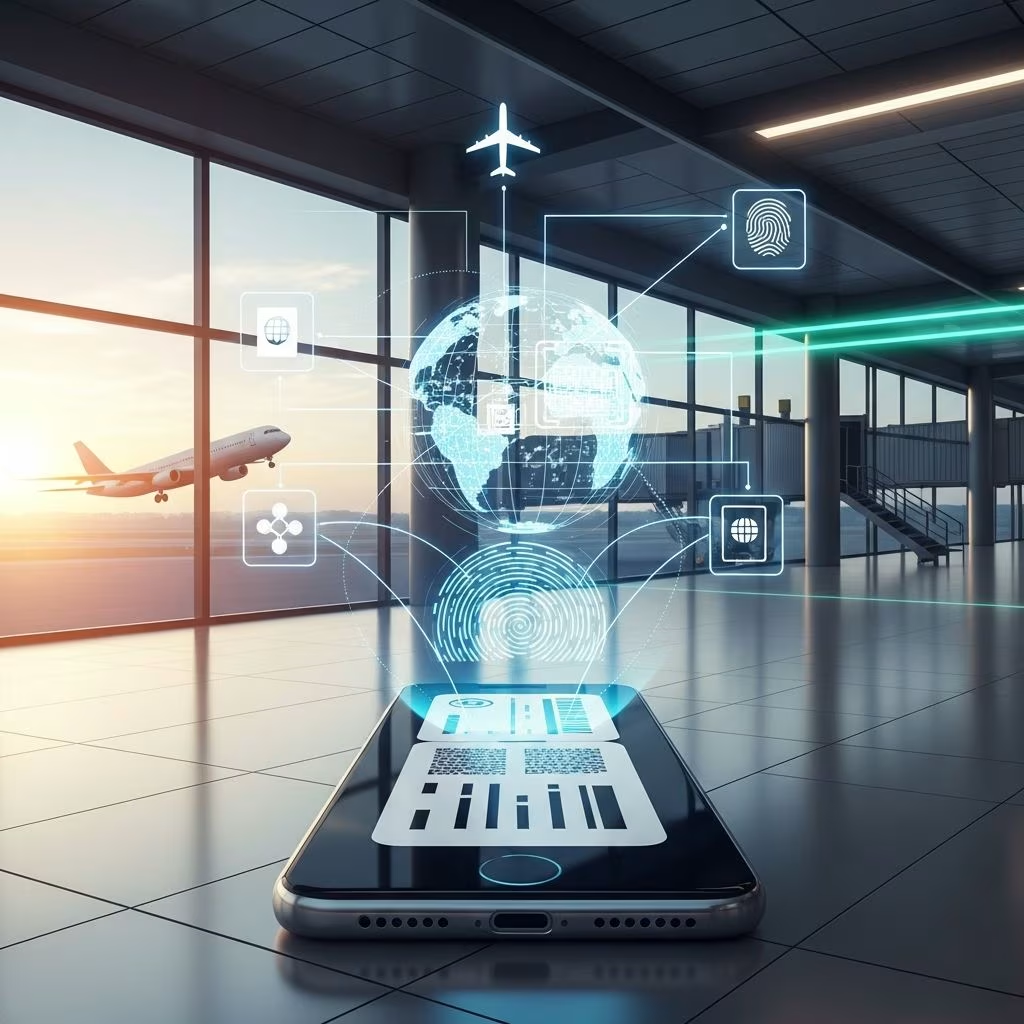
Modern air travel is undergoing a profound transformation through advanced digital technologies that eliminate the need for physical documents. Initiatives like IATA’s One ID and digital travel passes leverage biometrics and secure digital wallets to create fluid, secure passenger experiences from booking to landing.
The aviation sector has long relied on passports, boarding passes, and paper forms, leading to queues and contact points that slow down journeys. Digital credentials change this by storing essential travel data in encrypted mobile wallets, accessible via facial recognition or fingerprints. Passengers can verify identity at bag drop, security, immigration, and boarding without handing over documents.
This shift began accelerating during global health crises, when verifying test results and vaccination status became critical. Digital solutions emerged to securely link health data to verified identities, ensuring compliance with entry rules while minimizing touchpoints.
At the heart of these systems are interoperable standards developed by organizations like IATA and ICAO. Key elements include:
These components form an ecosystem where airlines, airports, governments, and health providers share only necessary data with passenger consent, enhancing security and efficiency.
Passengers download apps or use integrated airline platforms to create a digital profile. They upload passport details, add flight info, and receive tailored requirement alerts—such as tests or visas. At verified clinics, a scan links test results directly to the wallet, generating an ‘OK to Travel’ status.
At airports, biometrics replace document checks. A recent proof-of-concept between Hong Kong and Tokyo demonstrated this: travelers used wallets with ePassports, visas, company IDs, and boarding passes for end-to-end processing, including personalized offers and visa approvals[10].
| Journey Stage | Traditional Process | Digital Credential Process |
|---|---|---|
| Check-in | Present passport and boarding pass | Facial scan verifies digital credentials |
| Bag Drop | Show documents to agent | Biometric self-service kiosk |
| Security/Immigration | Multiple document scans | Seamless biometric gates |
| Boarding | Boarding pass barcode | Contactless facial recognition |
This table illustrates efficiency gains, reducing processing time by up to 50% in pilots.
Concerns over data breaches are valid, but modern systems employ data minimization: splitting passport info into separate encrypted ‘envelopes’ released only with consent. No full data sharing occurs; verifiers see just what’s needed.
IATA’s One ID framework ensures interoperability across borders, with trust registries verifying credential issuers. Live biometrics add a dynamic layer, preventing fraud since static photos can’t be reused.
Singapore Airlines pioneered integration, allowing passengers to book tests via app, receive results digitally, and confirm fly status using Timatic. This evolved into full digital health verification within their mobile app.
Pegasus Airlines adopted the pass for international flights, letting users store tests and health docs digitally, tracking results live. A landmark 2024 demo with Cathay Pacific, Hong Kong and Narita airports proved round-trip viability using multiple wallets and seven VCs.
Domestic examples include facial recognition apps linked to government IDs, setting precedents for international expansion.
While technology is ready, data protection laws vary globally. Some regions demand full data disclosure, clashing with minimization principles. IATA advocates for standards allowing selective sharing.
Interoperability remains key: not all airports or governments support the same biometrics or wallets yet. Ongoing pilots address this, with technical guidance for admissibility digitalization ensuring compatibility.
By 2026, experts predict widespread rollout as standards mature. IATA’s One ID aims for a document-free world, integrating health, visas, and loyalty data for hyper-personalized travel.
Benefits extend beyond passengers: airlines cut costs on manual checks, airports boost throughput, governments streamline immigration. Enhanced security via biometrics reduces risks.
Industry-wide, these tools support recovery to pre-pandemic volumes with better efficiency.
Check if your airline partners with IATA solutions—many like Singapore Airlines and Pegasus do. Download the app, verify passport via scan, input flights, and connect to authorized labs. Always carry physical passport as backup during transitions.
One ID is IATA’s framework for biometric-based, document-free travel, digitizing admissibility and enabling contactless processing.
Yes, using encrypted envelopes and consent-based sharing; only minimal data is released per verification.
Singapore Airlines, Cathay Pacific, Pegasus, and others in pilots; adoption is expanding.
Currently yes, for initial verification and as backup, but fully digital trips are emerging.
Integrates Timatic for auto-checks, links test/vaccine proofs to your digital ID.
