

 Travel Essentials
 Travel Essentials

Discover how the Dominican Republic turns shipwrecks and Taino sculptures into underwater museums that preserve heritage and support marine conservation.
 Travel Essentials
The Caribbean nation of the Dominican Republic has emerged as a pioneering destination for underwater cultural experiences, transforming its coastal waters into open-air galleries that blend historical preservation, artistic expression, and environmental stewardship. These submerged museums represent innovative approaches to tourism development, offering visitors unparalleled opportunities to engage with maritime heritage and indigenous history while contributing to marine ecosystem protection.
The Dominican Republic’s underwater museum initiatives represent a paradigm shift in how nations approach cultural preservation and sustainable tourism. Rather than extracting artifacts from their original contexts, these institutions maintain historical materials in situ, creating living exhibits that evolve alongside their surrounding ecosystems. This philosophy emerged from collaborative efforts between academic researchers, governmental agencies, and cultural organizations seeking to protect irreplaceable maritime heritage while generating economic benefits through responsible tourism development.
The establishment of these underwater museums reflects recognition that traditional museum models often fail to adequately preserve or contextualize maritime archaeological sites. By maintaining shipwrecks and artifacts in their original underwater locations, the Dominican Republic has pioneered a conservation model that simultaneously protects cultural treasures and educates the public about maritime history and indigenous cultures.
The Dominican Republic hosts multiple underwater archaeological preserves developed through collaborative initiatives between Indiana University’s Center for Underwater Science and local governmental bodies. These projects began in 2004 with the establishment of the Guadalupe Underwater Archaeological Preserve in Samana Bay, which protects two Spanish galleons that sank during a 1724 hurricane. This pioneering effort demonstrated the viability of in situ preservation and set the template for subsequent underwater museum development throughout the region.
The most recent addition to this network is the Nuestra Señora de Begoña exhibit, established within La Caleta Underwater National Park along the island’s southern coast. This Spanish merchant vessel sank during a storm in 1725 and now serves as the centerpiece of an underwater archaeological museum. Rather than removing the entire wreck, researchers have strategically preserved the vessel and associated artifacts in place, allowing visitors to experience the shipwreck much as it has existed for nearly three centuries.
The approach taken with these archaeological museums emphasizes sustainable cultural tourism. According to project directors, this model enables communities to benefit from historical resources repeatedly through visitor engagement, contrasting sharply with treasure hunting economies that exhaust cultural resources in singular transactions. The museums remain accessible to the public through snorkeling and scuba diving, with recovered artifacts housed in terrestrial institutions such as the Museo de las Atarazanas Reales for those unable to visit underwater sites.
Modern underwater museums employ sophisticated documentation technologies to ensure long-term preservation and research capabilities. Research teams utilize three-dimensional photogrammetric rendering to create comprehensive digital records of archaeological sites, enabling detailed monitoring of conditions, artifact deterioration, and environmental changes over extended periods. These technological approaches facilitate adaptive management practices that can address emerging conservation challenges while maintaining public access to cultural heritage.
The collaborative framework supporting these museums involves multiple Dominican governmental ministries alongside international academic institutions. Partnerships encompass the Ministry of Culture, Ministry of Tourism, Ministry of Environment and Natural Resources, and the Dominican Republic Navy, ensuring that preservation efforts align with national development priorities while maintaining rigorous archaeological standards.
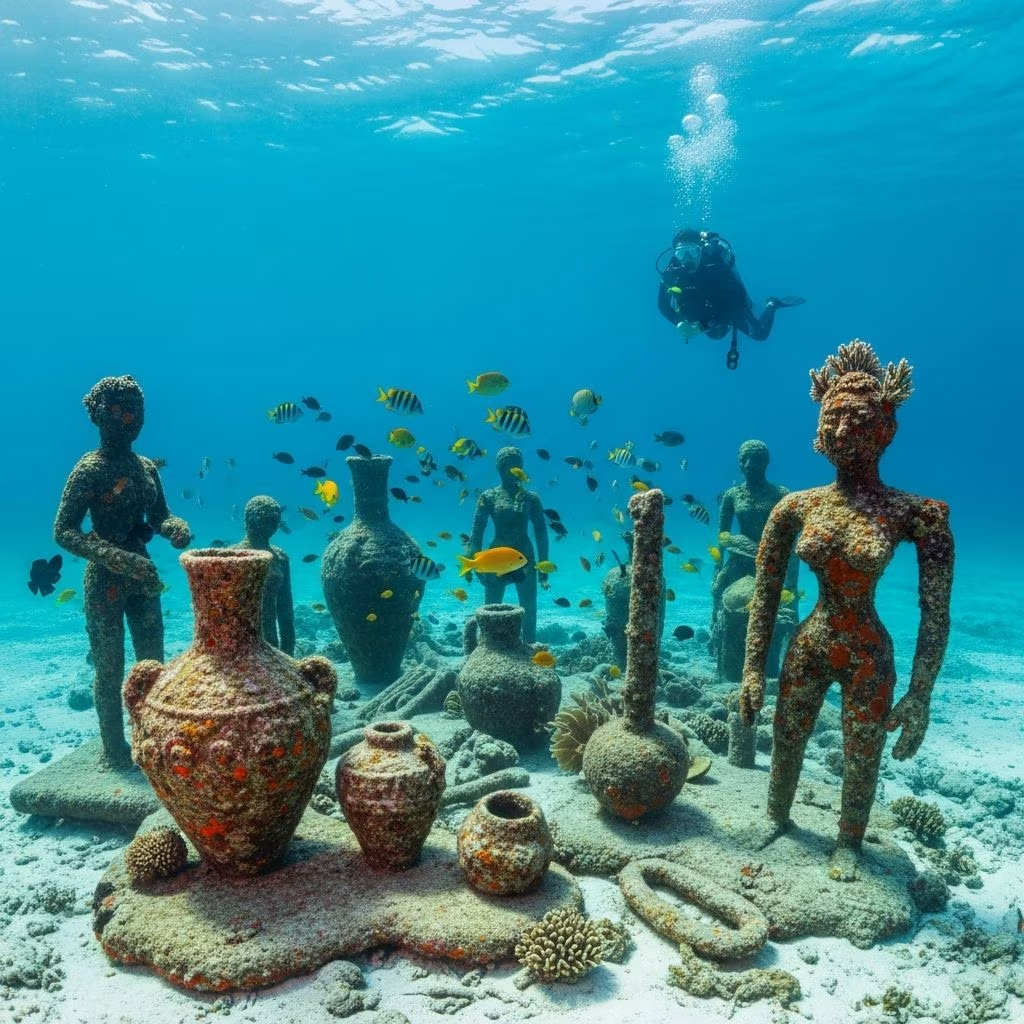
Beyond archaeological preservation, the Dominican Republic has developed a distinctive underwater museum dedicated to indigenous Taino culture through artistic sculpture. The Igneri Caribe Taino Underwater Museum, located between Playa Blanca and Playa Serena in Punta Cana, features twenty-two underwater sculptures created by renowned Dominican artist Thimo Pimentel. These works depict various Taino figures and deities worshipped by the island’s pre-Columbian inhabitants, including Aumatex, the god of hurricanes, and Atabeira, the goddess of waters.
The sculptures exist at depths of three to seven meters, making them accessible to snorkelers as well as scuba divers. The artistic ensemble extends beyond purely representational human figures to include marine animals such as turtles and crabs, creating thematic coherence between indigenous spiritual traditions and contemporary oceanic ecosystems. This curatorial approach transforms the underwater environment into a multidimensional space where artistic expression intersects with cultural education and marine biology.
The Igneri Caribe Taino Museum represents an ambitious long-term vision, with plans to eventually house more than five hundred sculptural works, potentially establishing the world’s largest underwater sculpture complex. This expansion trajectory reflects growing recognition of underwater museums as culturally significant institutions capable of generating both academic interest and tourism revenue.
Contemporary underwater artistic installations in Punta Cana serve dual functions as aesthetic expressions and artificial reef systems. These submerged sculptures provide essential substrate for coral attachment and marine organism colonization, transforming artistic spaces into functioning ecological habitats. The combination of artistic intent and ecological functionality has established underwater museums as models for integrating cultural development with environmental restoration objectives.
The emergence of underwater museums coincided with increased awareness of reef degradation caused by tourism pressures and climate-driven environmental changes. By establishing underwater attractions that simultaneously function as marine habitat, the Dominican Republic has addressed conservation imperatives while creating new tourism opportunities. This approach redirects diving and snorkeling activities toward sites designed to accommodate recreational pressure while supporting rather than degrading marine ecosystems.
| Museum Type | Location | Primary Focus | Depth Range | Accessibility |
|---|---|---|---|---|
| Archaeological Preserve | La Caleta (Begoña) | Spanish shipwreck | Variable | Scuba diving primary |
| Igneri Caribe Taino | Punta Cana | Indigenous sculptures | 3-7 meters | Snorkeling accessible |
| Guadalupe Archaeological | Samana Bay | Colonial galleons | Variable | Certified diving required |
The Dominican Republic’s underwater museums accommodate varying skill levels and physical capabilities. The Igneri Caribe Taino Museum’s relatively shallow depths make it suitable for beginner snorkelers, including children and individuals without diving certification. In contrast, archaeological preserves typically require scuba certification due to greater depths and specialized equipment needed for safe underwater archaeology observation.
For non-diving visitors, terrestrial museums complement underwater experiences. The Museo de las Atarazanas Reales displays conserved artifacts from shipwrecks studied by research teams, providing historical context and detailed examination of materials that remain on the seafloor. This dual-access model ensures that cultural resources reach broader audiences regardless of diving capability or interest levels.
The development of underwater museums has generated substantial economic benefits for Dominican coastal communities through employment creation, equipment rental services, and tourism spending. Beyond immediate financial impacts, these institutions have elevated international perceptions of the Dominican Republic as a culturally sophisticated destination rather than merely a beach resort location. This rebranding has attracted culturally motivated travelers seeking meaningful engagement with history and indigenous heritage.
The sustainable tourism model embedded within underwater museums provides economic incentives for environmental protection. Unlike extractive resource economies that reward habitat destruction, underwater tourism revenue increases as marine ecosystems remain healthy and visually appealing. This economic realignment creates alignment between conservation objectives and community prosperity, addressing the perennial tension between development and environmental protection.
Requirements vary by location. The Igneri Caribe Taino Museum accommodates snorkelers without certification. Archaeological preserves typically require Open Water scuba certification or supervised diving with qualified instructors. Visitors should confirm requirements with specific museums before scheduling visits.
The Dominican Republic offers year-round diving and snorkeling opportunities. However, calmer seas and better visibility typically occur during spring and fall months, though conditions remain generally favorable throughout the year.
Modern preservation techniques include photogrammetric documentation for monitoring, specialized corrosion prevention methods, and regulated visitor access to minimize damage. Environmental monitoring ensures that conservation strategies adapt to changing conditions.
Yes. The Igneri Caribe Taino Museum remains accessible to snorkelers. Additionally, terrestrial museums display recovered artifacts and provide educational context about underwater sites.
The Dominican Republic’s underwater museum initiatives have established templates that other Caribbean nations are beginning to adopt. As climate change and tourism pressures intensify threats to maritime heritage, in situ preservation models gain relevance and urgency. The Dominican experience demonstrates that cultural preservation need not conflict with economic development when properly designed and managed.
Ongoing research and technological advancement continue expanding possibilities for underwater heritage management. Emerging technologies including virtual reality documentation, remotely operated vehicles for deep-water preservation, and advanced materials science offer possibilities for extending underwater museum approaches to more challenging environments and greater depths.
The establishment of underwater museums reflects fundamental recognitions that cultural heritage exists not merely within terrestrial institutions but remains embedded within landscapes and seascapes where historical events occurred. By preserving this heritage in place while facilitating public engagement, the Dominican Republic has created a model demonstrating that conservation, education, and economic development need not exist in opposition but rather can advance simultaneously when guided by thoughtful planning and commitment to sustainability principles.
