

 Travel Essentials
 Travel Essentials

Explore Ecuador's Andean region where millennia of civilizations left indelible marks on culture, architecture, and tradition across breathtaking highlands.
 Travel Essentials
The Andean highlands of Ecuador represent one of South America’s most compelling destinations for travelers seeking to understand how human civilization evolved across millennia. Unlike many mountain regions that serve primarily as outdoor recreation destinations, Ecuador’s highlands function as an open-air museum where contemporary life intertwines seamlessly with archaeological evidence, colonial architecture, and indigenous traditions that have persisted for thousands of years. This convergence of past and present creates an environment where history is not merely studied but lived and experienced by both residents and visitors.
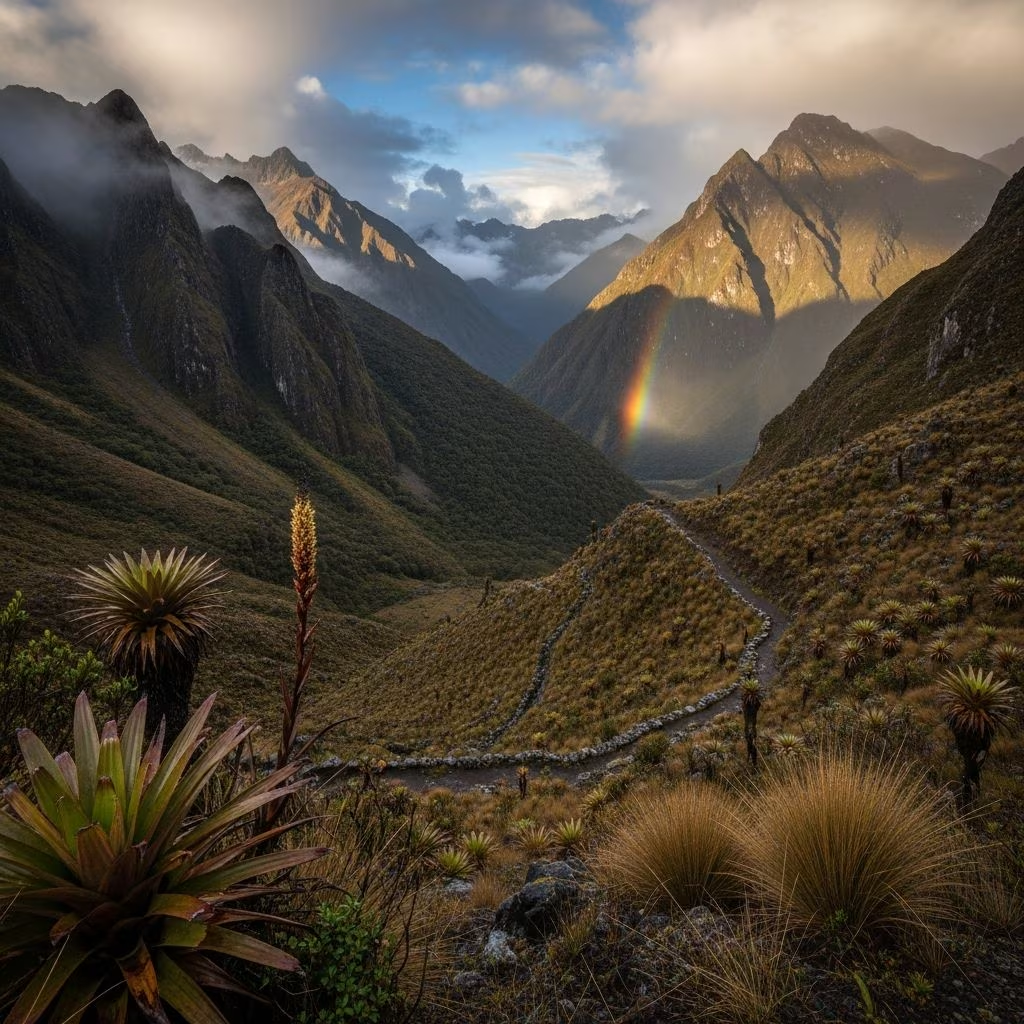
Ecuador’s Andean region comprises two distinct mountain chains with fertile valleys nestled between them, creating a landscape that 19th-century explorer Alexander von Humboldt famously termed the ‘Avenue of Volcanoes.’ This evocative description captures the essence of the terrain: towering peaks including the imposing Chimborazo Volcano at 6,310 meters and the active Cotopaxi Volcano at 5,890 meters dominate the skyline, flanking verdant valleys below. The region’s unique geography extends beyond these dramatic volcanic formations to encompass specialized ecosystems found nowhere else on Earth.
The paramo—a high-altitude tropical ecosystem—represents one of Ecuador’s most distinctive environmental features. This specialized vegetation zone stretches across approximately 35,000 square kilometers throughout northern South America, with Ecuador hosting the largest concentration at 51% of the total paramo area. These ecosystems support flora and fauna species endemic to high alpine regions, creating biodiversity hotspots that attract ecologists and nature enthusiasts from around the globe. The relationship between geography and human settlement in the Andes created natural corridors for trade, warfare, and cultural exchange that would shape the region’s historical trajectory.
Long before the Inca expanded northward into Ecuador, the region supported sophisticated societies with complex social organizations and technological capabilities. Anthropological evidence suggests that human settlement in Ecuador began over 14,000 years ago when Asian nomads migrated across the landmass. For millennia, diverse cultural groups developed independently, creating distinct artistic traditions, agricultural systems, and governance structures adapted to Ecuador’s varied ecosystems.
Among the most prominent ancient cultures that flourished in the Ecuadorian highlands and coastal regions were the Chorrera, Valdivia, and Bahia civilizations, which maintained flourishing societies for thousands of years before the arrival of the Incas around 1500 CE. These cultures developed:
The Duchichelas, another significant highland power, had consolidated substantial territorial control across much of present-day Ecuador by the time Incan expansion reached the region. Though these indigenous peoples mounted determined resistance to Incan invasion, the military superiority and organizational sophistication of the expanding empire eventually overwhelmed local resistance, despite the admirable efforts of established authorities to maintain independence.
The Inca Empire, known as the Children of the Sun and celebrated as master builders and administrators, incorporated Ecuador into its vast territorial system during the 15th century. The Inca called this northern region Tahuain Tinsuyu, literally meaning the northern quarter of their empire. Remarkably, despite the Incas’ prominence in South American history, their rule in Ecuador proved relatively brief. The empire expanded northward only shortly before Spanish conquistadores arrived, making the Incan presence in Ecuador geographically distant from their power base in Peru and administratively challenging to maintain.
The Incan contribution to Ecuador extended beyond political control to encompass infrastructure and cultural integration. The empire constructed the Qhapaq Ñan (Inca Trail) and other road systems connecting Ecuador to the broader imperial network, facilitating trade, communication, and military movement. However, this period of Incan rule was truncated by internal conflicts and regional divisions that weakened the empire’s cohesion. By the time Spanish forces arrived, the Incan state was already fractured by dynastic struggles and factional disputes that would prove catastrophic when confronted with European military technology and disease.
The only substantially intact Incan ruin remaining in Ecuador—the remarkable Ingapirca archaeological complex—testifies to the engineering prowess of Incan architects and the sophistication of their construction techniques. Despite limited physical remains, Incan cultural influences permeate contemporary Ecuadorian society, with traditions visible in textile patterns, agricultural practices, spiritual beliefs, and language elements that persist among highland communities.
General Pizarro and his Spanish forces reached the Ecuadorian coast in the early 16th century, encountering an Incan Empire already weakened by internal strife and territorial fragmentation. The Spanish conquistadores, armed with firearms, horses, and steel armor, found subjugating the indigenous population comparatively straightforward given the political chaos undermining Incan unity. Atahualpa, the Inca leader during this period, was captured, tried, and executed—a symbolic end to indigenous political authority. In a final act of defiance, Atahualpa’s general Ruminahu destroyed the Incan capital, modern-day Quito, rather than permit its wealth to fall into Spanish hands.
The Spanish established Kito as the capital of the Audiencia de Kito, a colonial administrative division that would persist for centuries, fundamentally shaping Ecuador’s political structure and cultural identity. Spanish colonizers developed the “hacienda” system—large landed estates worked by indigenous labor under conditions approaching servitude. These vast agricultural enterprises became the foundation of colonial economic power, generating wealth for Spanish elites while institutionalizing indigenous exploitation through labor coercion and land dispossession.
Colonial architecture emerged as a physical manifestation of Spanish cultural dominance. The Spanish rebuilt Quito on top of the destroyed Incan capital in 1532, establishing the city as a center of colonial administration, religious authority, and commercial activity. Quito’s historic center would eventually become recognized as a UNESCO World Heritage Site, preserving colonial-era structures including churches, convents, and aristocratic residences that reflected both Spanish architectural traditions and indigenous artistic influences. Many hacienda buildings, originally symbols of Spanish colonial oppression, have been restored to their original architectural grandeur and converted into luxury hotels offering contemporary visitors opportunities to experience colonial life while supporting local economies.
The first decades following Ecuador’s break from Spain were marked by political instability, presidential assassinations, and governmental dysfunction that threatened the nascent nation’s viability. The fundamental tension between liberal coastal inhabitants and conservative inland landowners created ideological divisions that manifested in violent political confrontation and civil unrest for decades following independence. Independence was formally declared by Simón Bolívar on May 24, 1822, with military forces led by Antonio José de Sucre, after whom the administrative capital city of Sucre is named.
Before achieving full independence, the uprising of 1809 when Quito secured a self-governing junta, followed by Guayaquil’s similar achievement in 1820, ignited rebellious sentiment across the territory. These rebellions, though short-lived individually, sparked a cascade of events inspiring widespread commitment to independence among diverse segments of the population. The pivotal Battle of Pichincha, commanded by Simón Bolívar and Antonio José de Sucre, secured Ecuador’s freedom and represented a decisive turning point in the struggle for autonomy from Spanish colonial authority. Ecuador subsequently became integrated into Gran Colombia, a short-lived federal republic that also encompassed present-day Colombia, Venezuela, and Panama, before eventually establishing itself as an independent nation-state.
The late 19th century witnessed Ecuador gradually establishing governmental stability and economic systems, yet persistent poverty among lower social classes continued generating periodic unrest and political instability. The most significant territorial challenge emerged in 1941 through a land dispute with neighboring Peru over Amazonian regions, highlighting ongoing tensions regarding sovereignty and resource control in the border regions.
Contemporary Ecuador has emerged as a key player in South American geopolitics and cultural discourse. The nation has transformed from a post-colonial territory struggling with internal division into a destination attracting millions of visitors annually seeking to experience the convergence of natural beauty, cultural authenticity, and historical significance that characterizes the Andean region.
Historical Sites Worth Exploring:
Cultural Experiences:
Contemporary highland communities maintain traditional practices including textile production using ancestral techniques, agricultural systems based on pre-Columbian principles, and spiritual ceremonies blending indigenous and Catholic traditions. The Pampamesa—a traditional communal meal reflecting Andean community values and agricultural cycles—offers visitors opportunities for authentic cultural engagement. Markets in highland towns display indigenous textile arts, traditional foods, and crafts that represent living cultural traditions rather than museum artifacts.
When to Visit:
Ecuador’s equatorial location provides relatively consistent climate year-round, though the Andean region experiences distinct wet and dry seasons. The growing season in the highlands demonstrates Ecuador’s agricultural capacity and the relationship between climate patterns and human settlement decisions made centuries ago.
Ecuador’s Andean highlands represent far more than a collection of historical sites documenting past civilizations. The region embodies a continuous human narrative spanning millennia, with contemporary residents carrying forward cultural traditions, spiritual practices, and social structures with roots extending deep into pre-Columbian times. The geological drama of volcanic peaks and fertile valleys that attracted human settlement thousands of years ago continues shaping daily life, agricultural patterns, and spiritual beliefs among highland communities.
Visitors to Ecuador’s Andes encounter history not as a distant academic subject but as an integrated element of contemporary existence. Indigenous languages persist alongside Spanish, traditional textile patterns continue reflecting ancestral designs, agricultural practices maintain elements of pre-Columbian irrigation and cultivation techniques, and spiritual worldviews incorporate indigenous cosmology with Catholic religious frameworks. This cultural continuity, maintained despite centuries of colonial domination and post-colonial marginalization, testifies to the resilience of Andean peoples and the profound adaptability of human cultures.
The transformation of colonial hacienda buildings into luxury hotels symbolizes broader changes in how Ecuador presents its historical heritage to international audiences. Yet beneath this contemporary tourism infrastructure, the fundamental historical reality persists: the Andes shaped human civilization in Ecuador, and that civilization continues expressing itself through landscapes, architecture, artistic traditions, and daily practices that link contemporary residents to ancestors separated by centuries yet connected through geography, culture, and shared humanity. Understanding this historical depth enriches any visit to Ecuador’s highlands, transforming a mountain vacation into an educational journey through one of South America’s most significant cultural regions.
