

 Travel Essentials
 Travel Essentials

Explore the Eiffel Tower's remarkable construction, towering dimensions, visitor statistics, and the fascinating engineering that makes it the world's most visited paid monument.
 Travel Essentials
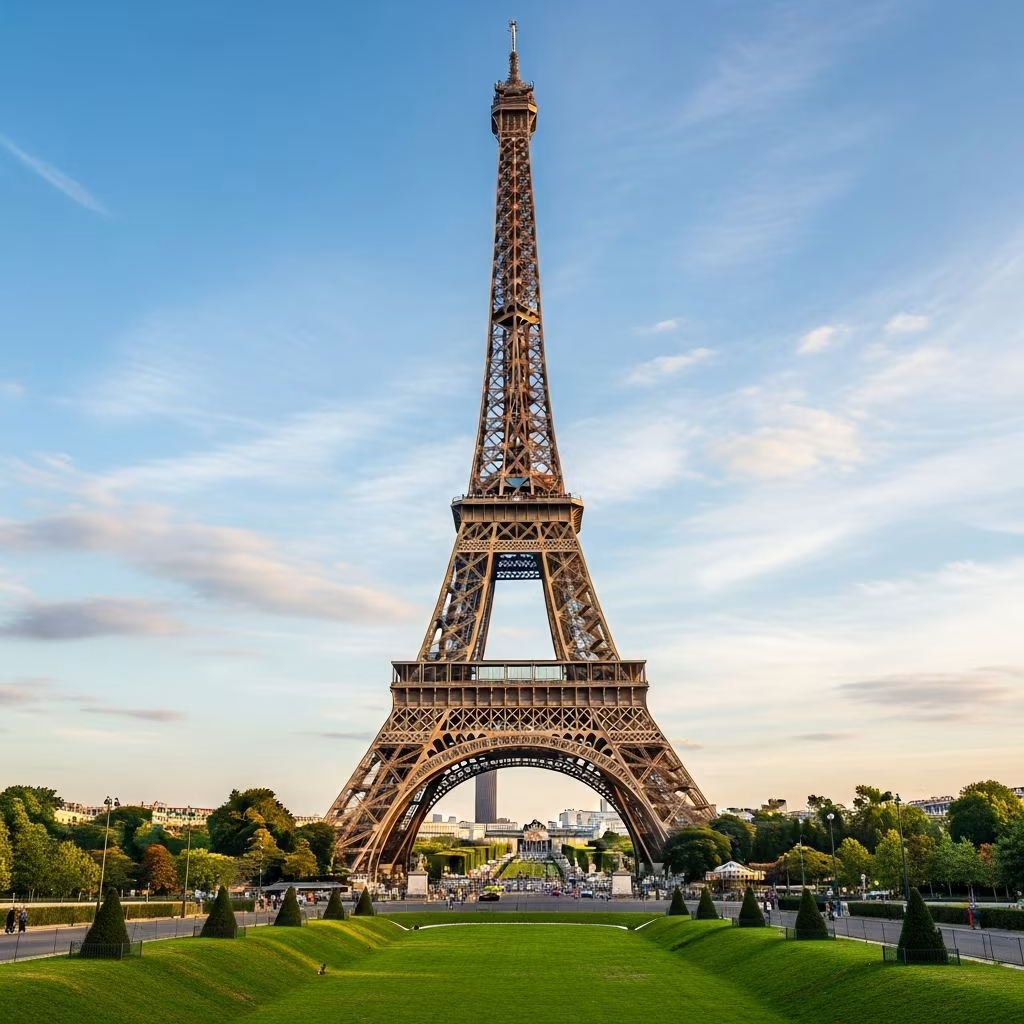
Standing majestically on the Champ de Mars in Paris, the Eiffel Tower represents one of humanity’s greatest engineering achievements. Built to commemorate a significant milestone in French history, this lattice iron structure has evolved from a temporary exhibition centerpiece into the most recognizable landmark on Earth. Understanding the tower’s construction, dimensions, and cultural significance provides insight into why millions of travelers visit this monument annually.
The decision to construct the Eiffel Tower emerged from Paris’s selection to host the Exposition Universelle in 1889. The French government recognized this international event as an opportunity to celebrate the centennial of the French Revolution while simultaneously showcasing the nation’s technological prowess. Rather than leaving this momentous occasion to chance, city officials organized a design competition that attracted numerous proposals from engineers and architects across Europe.
Among 107 submitted designs, the visionary concept presented by Gustave Eiffel and his engineering team emerged victorious. Eiffel’s proposal captured judges’ imaginations by promising a structure that would be both functionally sophisticated and architecturally daring. The competition victory granted Eiffel’s company the prestigious contract to transform his ambitious blueprint into reality.
Gustave Eiffel initially estimated that constructing the tower would require twelve months of intensive labor. However, the complexity of coordinating such an unprecedented project extended the timeline substantially. Work commenced on January 28, 1887, and continued for approximately two years, two months, and five days before completion on March 31, 1889. This acceleration from the original estimate demonstrated exceptional project management, as the tower had to be operational before the Universal Exhibition’s opening.
The assembly process required unprecedented coordination and precision. Workers utilized over 18,000 individual metal components, which were painstakingly connected using approximately 2.5 million rivets. Additionally, 13,000 bolts provided structural reinforcement throughout the framework. This assembly methodology represented a revolutionary approach to large-scale metal construction during the late 19th century.
The Eiffel Tower’s remarkable dimensions continue to inspire awe among visitors and engineers alike:
| Measurement | Specification |
|---|---|
| Current Height | 1,083 feet (330 meters) |
| Original Height (without antenna) | 1,024 feet (312 meters) |
| Base Width | 410 feet (125 meters) per side |
| Individual Pillar Width | 82 feet (25 meters) |
| Metal Frame Weight | 7,300 tons |
| Total Weight | 10,100 tons |
| Number of Iron Parts | 18,038 |
| Rivets Used | 2,500,000 |
The tower’s square base measures 125 meters on each side, establishing a foundation capable of supporting the immense weight above. Four pillars rise from these corners, each measuring 82 feet in width at ground level. These pillars form the structural skeleton that carries the entire monument’s weight while distributing it evenly across the foundation.
The tower comprises three distinct visitor levels, each offering unique perspectives of Paris:
Ascending the tower presents visitors with multiple options. The original infrastructure included three hydraulic elevators, considered marvels of 19th-century engineering. The modern tower operates five elevators connecting the esplanade to the second floor, supplemented by specialized dual-lift systems ascending from the second floor to the summit. For those preferring physical exertion, approximately 1,665 steps provide an alternative route to the top, with historical records indicating that Gustave Eiffel himself climbed 1,710 steps during the tower’s inauguration to raise the French flag.
One of the most counterintuitive characteristics of the Eiffel Tower relates to its response to temperature fluctuations. The structure experiences dimensional changes throughout the calendar year, expanding during warmer months and contracting during colder periods. Between the year’s warmest and coldest days, the tower fluctuates by approximately six inches (15 centimeters). This thermal expansion and contraction occurs because iron, the tower’s primary material, responds predictably to temperature variations by increasing volume when heated and decreasing when cooled.
While these measurements remain imperceptible to the human eye during casual observation, they represent significant engineering considerations for maintenance crews. The tower’s designers anticipated this phenomenon and incorporated mechanical allowances to accommodate these natural fluctuations without compromising structural integrity.
Few contemporary observers anticipated that the Eiffel Tower would achieve permanent status. The original exposition agreement stipulated that the structure would be demolished after twenty years, following the 1889 Universal Exhibition. The tower faced significant opposition from prominent Parisians who considered it an eyesore—a skeletal iron framework that clashed with the city’s classical architectural traditions.
Gustave Eiffel’s strategic response ensured the monument’s survival. He proposed assigning scientific functions to the tower, emphasizing its potential for meteorological observations, astronomical research, physics experiments, and strategic surveillance. This pragmatic reframing transformed perceptions of the structure from a temporary curiosity into an institution of scientific value. The tower was subsequently designated a historic monument in 1964 and recognized as part of a UNESCO World Heritage Site—the “Paris, Banks of the Seine”—in 1991.
The Eiffel Tower dramatically altered the landscape of human achievement upon its completion. Before 1889, the Washington Monument held the distinction of being the world’s tallest structure at 555 feet. Gustave Eiffel not merely exceeded this record; he essentially doubled the previous height benchmark. The tower’s original height of 984 feet (later increased to 1,083 feet with antenna installation) positioned France at the forefront of engineering innovation during the industrial era.
This supremacy endured for four decades. The tower maintained its status as the world’s tallest human-made structure until 1930, when New York’s Chrysler Building claimed the title. However, the installation of broadcasting aerials atop the Eiffel Tower in 1957 restored its height advantage, resulting in the tower standing approximately 5.2 meters (17 feet) taller than the Chrysler Building.
The Eiffel Tower’s transformation from controversial structure to beloved symbol represents a remarkable cultural evolution. Since its inauguration in 1889, approximately 300 million visitors have traveled to Paris specifically to experience this monument. Current visitor statistics demonstrate the tower’s undiminished appeal: the structure welcomes nearly 7 million visitors annually, with approximately 75 percent originating from international destinations.
In 2022 alone, the tower received 5.89 million visitors. These numbers establish the Eiffel Tower as the most visited paid-admission monument globally. The tower’s universal appeal transcends cultural, linguistic, and generational boundaries, attracting tourists ranging from young children to elderly travelers from every inhabited continent.
Modern enhancements have amplified the tower’s visual impact beyond daylight hours. Each evening, the structure is adorned with golden illumination that creates a shimmering effect against the night sky. Notably, the tower sparkles for five minutes at the top of each hour throughout the evening, a tradition that has become synonymous with Parisian nightlife. Additionally, rotating beacon lights sweep across the city, creating a dynamic visual landmark visible from numerous vantage points throughout Paris.
Recent sporting events have further elevated the tower’s cultural prominence. During the Paris 2024 Olympics, the Eiffel Tower served as a focal point for opening ceremonies, featuring spectacular light displays that captivated global audiences. The structure hosted unique athletic competitions, including beach volleyball and blind football played on the Champ de Mars, providing an iconic backdrop for international sporting excellence.
Construction required two years, two months, and five days, from January 28, 1887, to March 31, 1889. This timeline exceeded the initially estimated twelve months but remained remarkable for a project of such magnitude.
Approximately 7 million visitors ascend the tower each year, with roughly 75 percent being international tourists. The structure holds the distinction of being the world’s most visited paid-admission monument.
Iron expands when heated and contracts when cooled. Between summer and winter extremes, the tower experiences height fluctuations of approximately six inches (15 centimeters).
No. The initial agreement stipulated demolition after twenty years. Gustave Eiffel preserved the structure by proposing scientific functions, which ultimately saved it from destruction.
The tower represents the first structure to surpass both the 200-meter and 300-meter height thresholds. Its lattice design, utilizing 18,000 metal components held together by 2.5 million rivets, exemplified revolutionary construction techniques for its era.
