

 Travel Essentials
 Travel Essentials

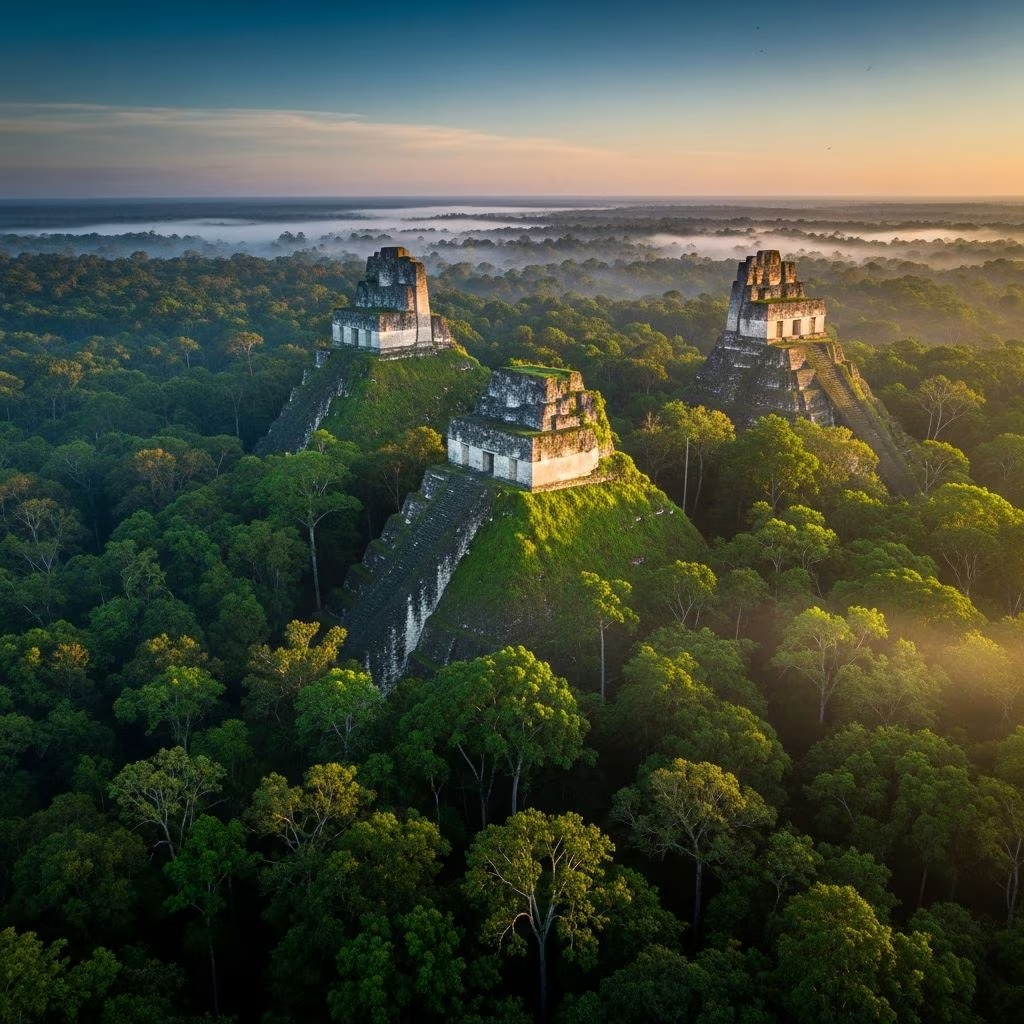
Discover El Mirador, a remote Maya ruin in Guatemala's jungle with massive pyramids like La Danta. Learn about its history, trek details, and why it's a must for adventurers.
 Travel Essentials
Deep within Guatemala’s Petén region lies El Mirador, a sprawling Preclassic Maya city that challenges everything we know about ancient Mesoamerican civilizations. Spanning thousands of hectares, this site features some of the largest pyramids ever built by the Maya, including La Danta, which rises to 72 meters—making it one of the biggest man-made structures on Earth by volume. Rediscovered after centuries of jungle overgrowth, El Mirador offers a glimpse into a thriving metropolis from 1000 BCE to 150 CE, long before the fame of sites like Tikal.
El Mirador emerged during the Middle and Late Preclassic periods, earning acclaim as the “Cradle of Maya Civilization” due to its early urban sophistication. Unlike later Classic-era cities, this site showcased advanced architecture from as early as 600 BCE, with structures rivaling those of the Olmec culture in complexity. Archaeological evidence points to a planned urban layout, with alignments between temples possibly tied to solar observations, suggesting deliberate sacred geometry from the city’s founding.
At its peak, El Mirador controlled a basin of over 2,000 square kilometers, influencing nearby sites like Nakbe and Tintal. The city’s elite constructed triadic pyramid groups—massive platforms topped with three temples—symbolizing cosmic order in Maya cosmology. Yet, its decline around the end of the Preclassic era remains puzzling, marked by violence: recent digs uncovered skeletons with embedded arrow points, hinting at a brutal end as Classic powers rose.
El Mirador’s structures dwarf many famous Maya pyramids. The star is La Danta Pyramid, a behemoth of layered platforms reaching 72 meters high and covering 31,000 cubic meters—larger in volume than Egypt’s Great Pyramid. Climbers ascend steep wooden stairs to a summit offering panoramic jungle views.
Stucco friezes steal the show, such as the 300 BCE depiction of the Hero Twins from the Popol Vuh myth—Hunahpú and Ixbalanqué battling underworld lords. Flanking pools likely symbolized their watery trials, channeling rainwater into cisterns. These finely preserved artworks highlight masterful artistry amid resource scarcity—no nearby rivers sustained this arid-zone powerhouse.
Forget chicle gum harvesters in the 1920s; surveys began in 1885 with Claudio Urrutia noting basin ruins. Aerial photos in 1926 and 1930 confirmed the site’s scale, but Ian Graham’s 1962 mapping ignited real interest. The Mirador Basin Project (1978-1983) under Ray Matheny and Bruce Dahlin revealed Preclassic dominance, upending timelines. Today, Richard Hansen leads excavations, braving rainy seasons with 400-person teams. Only a fraction of 850+ structures is uncovered, threatened by looters and deforestation.
| Milestone | Date | Key Figure/Event |
|---|---|---|
| First Survey | 1885 | Claudio Urrutia spots ruins |
| Aerial Discovery | 1926/1930 | Photos reveal extent |
| First Map | 1962 | Ian Graham |
| Major Project | 1978-1983 | Matheny & Dahlin |
| Ongoing Digs | 2003-Present | Richard Hansen |
Reaching El Mirador demands grit—a multi-day hike from Carmelita village, 82 km into the rainforest. No roads penetrate this UNESCO-threatened basin; mules carry gear while hikers battle mud, heat, and vines. Tours span 4-6 days, visiting en route ruins like Tintal and La Muerta. Expect howler monkeys, toucans, and jaguar tracks amid pristine trails.
Costs run $1,200-$1,800 USD, covering guides, cooks, mules, and permits. Dry season (November-April) is prime; rainy months halt digs due to water needs. Pack insect repellent, sturdy boots, and rain gear—cell service vanishes.
Visiting demands preparation. Start in Flores, fly to Carmelita airstrip. Licensed guides are mandatory; outfits like Lokal Travel offer all-inclusive packages. Hydrate relentlessly—the jungle saps energy. Wildlife spotting adds thrill: scarlet macaws, coatis, even tapirs. Respect no-trace principles; the basin’s 26+ sites face looting.
El Mirador’s remoteness saved it, but threats loom: logging roads enable plunder, deforestation erodes 30+ undiscovered sites. Hansen’s team pushes conservation, but funding lags. Tourism funds protection—your trek supports excavations. Compare to Calakmul across the border: both vast, abandoned sisters.
Absolutely—for ruin enthusiasts, it’s unparalleled. Fewer than 5,000 visitors yearly ensure solitude atop world-class pyramids.
Typically 5-6 days round-trip, covering 160+ km total with overnight camps.
La Danta at 72m tall, with massive volume rivaling global ancient wonders.
No—permits and guides required for safety and preservation.
November to April; avoid rainy season floods.
This site’s Preclassic primacy rewrites Maya origins, blending myth, might, and mystery. From Hero Twins carvings to towering temples, El Mirador whispers of a forgotten empire sustained by ingenuity. As excavations creep forward, it beckons daring explorers to its jungle heart. Plan your trek—history awaits atop La Danta.
