

 Travel Essentials
 Travel Essentials

Discover how Elena Ferrante's Neapolitan Novels brought fictional Naples to life, with a detailed guide to real neighborhoods, historical sites, and urban spaces that inspired the literary sensation.
 Travel Essentials
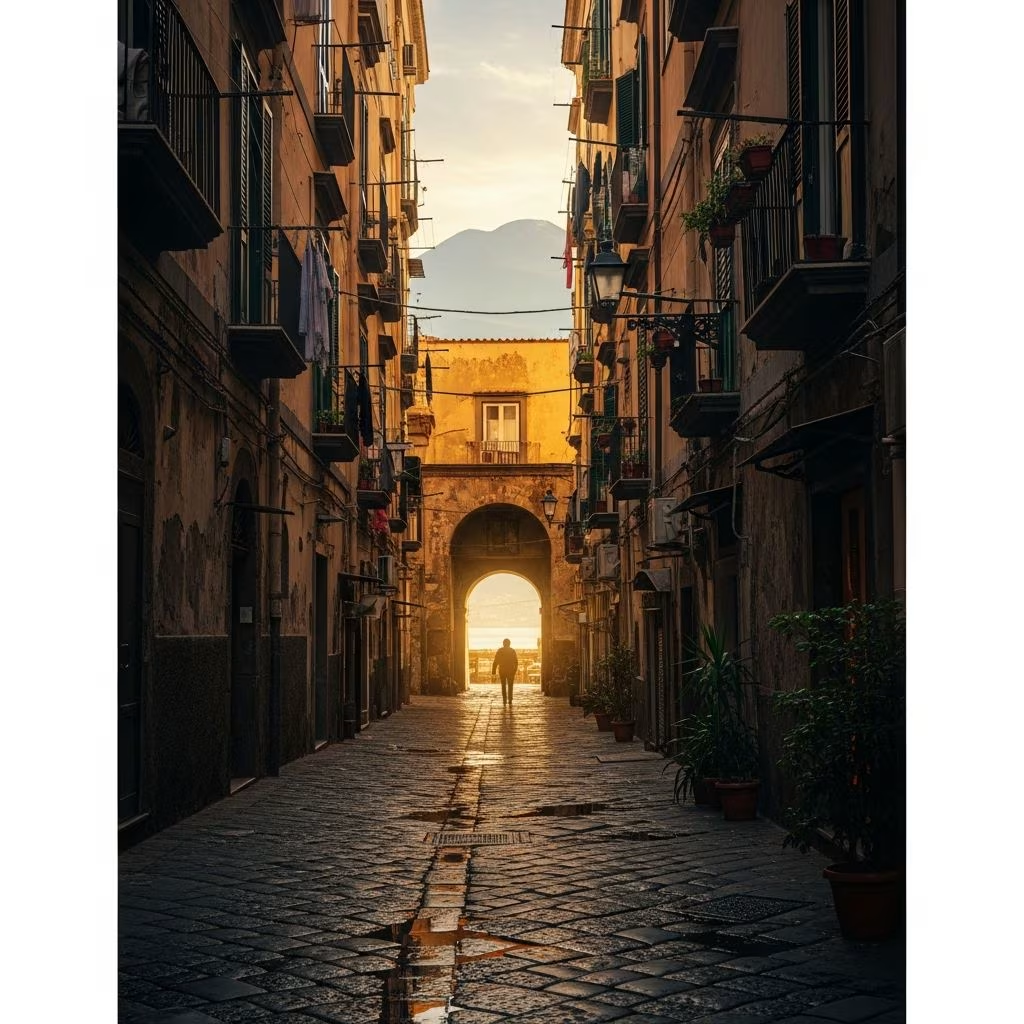
The international acclaim surrounding Elena Ferrante’s tetralogy has transformed Naples into a destination for literary pilgrims seeking to walk the same streets as the novels’ central characters. What began as intimate narratives of two childhood friends evolved into a cultural phenomenon that has redefined how readers engage with urban settings in contemporary fiction. The city itself becomes a character in these narratives, shaped by historical circumstances and social realities that continue to define the Neapolitan experience.
Elena Ferrante’s four-novel sequence traces the complex friendship between Elena Greco and Lila Cerullo across several decades of social and personal transformation. Set against the backdrop of post-World War II Naples, the narrative begins in a working-class neighborhood where the two girls navigate poverty, family dynamics, and the tension between staying and escaping their circumstances. The author’s meticulous attention to geographical detail transforms the city from mere setting into an active force shaping the characters’ choices and identities. As readers have discovered, many of the locations referenced in the novels correspond to actual neighborhoods and landmarks throughout Naples, creating a tangible bridge between fiction and reality.
The novels’ opening volumes deliberately obscure the neighborhood’s specific identity, referring instead to generic landmarks like “the parish church” and “the public gardens.” However, geographic scholars and devoted readers have pinpointed Rione Luzzatti, a residential area developed between 1914 and 1929, as the neighborhood where the childhood experiences unfold. This housing project, located east of the city center, contains the characteristic four-story white apartment buildings that feature prominently in the early narrative descriptions.
The journey to Rione Luzzatti begins at Gianturco metro station on Line 2, where visitors emerge into a landscape that mirrors textual descriptions with remarkable precision. The murky graffiti-adorned tunnel through which passengers pass echoes the physical geography of the girls’ early adventures. Upon crossing the “stradone”—the broad avenue that bisects the neighborhood—visitors encounter a quieter Naples than what the city center offers, with blocks of uniform apartment buildings arranged around interior courtyards reminiscent of working-class Neapolitan housing patterns.
Within this neighborhood lies Bar Parisi, a social hub where locals gather for coffee and conversation, preserving the communal rhythms described in the novels. Nearby, the Pasticciello bakery continues a tradition of producing sfogliatella pastries, the beloved pastry of Naples that carries cultural significance throughout the narrative. These establishments function not merely as tourist attractions but as living repositories of neighborhood culture, maintaining practices and traditions that have sustained Neapolitan working-class life through decades of social change.
The physical environment of Rione Luzzatti itself speaks to the historical conditions from which the novels emerged. Built during the early twentieth century to house the expanding working population, the neighborhood represents a particular moment in Naples’ urban development. The stark geometry of the apartment blocks, the interior courtyards, and the narrow streets reflect architectural choices that prioritized dense housing for industrial and working-class populations. Walking these streets today provides visceral understanding of the spatial constraints and communal intimacy that shaped the characters’ early relationships.
North of Naples’ central train station extends the Vasto district, a neighborhood where market commerce continues to animate daily life much as Ferrante depicts in her narratives. The street markets that occupy the perpendicular avenues present a living portrait of neighborhood commerce as it has existed for generations. Old-fashioned shops selling undergarments and confectionery items displaying boiled sweets and medicinal herbs in glass jars create a sensory landscape that connects contemporary visitors to the historical setting the novels describe.
For readers of the Neapolitan tetralogy, the Vasto market represents the commercial world in which the characters’ mothers and aunts conducted daily business. The second-hand clothing stalls and produce grocers with their original Art Deco signboards provide material evidence of the economic strategies through which working-class families navigated limited resources. These establishments were not peripheral to the narratives but central to understanding how characters survived economically and how social status expressed itself through access to goods and fashion choices.
The persistence of these markets and their traditional character speaks to the resilience of Neapolitan neighborhood culture. Despite decades of economic transformation and urban change, the Vasto district retains commercial patterns and architectural features that connect contemporary visitors to the temporal moment when the novels’ early scenes unfold. Experiencing these markets directly allows readers to understand the material conditions and social hierarchies that shaped the characters’ consciousness and aspirations.
Naples maintains a long tradition of intellectual culture extending back to 1224, when Holy Roman Emperor Frederick II established what is recognized as the world’s first public, non-religious university in the city. This historical foundation of academic life provided the cultural context within which characters like Elena could envision educational escape from neighborhood constraints. The presence of a substantial student population continues to shape the city’s cultural character and intellectual vitality.
Within this tradition of learning, the area around Piazza Dante represents a nexus of literary and intellectual activity. Caffè Mexico, situated in this piazza, has established itself as a preferred destination for espresso and intellectual conversation. The nearby Port’Alba neighborhood houses numerous bookstores occupying cavernous interior spaces where Elena Greco-type characters—earnest, intellectually ambitious individuals—staff establishments selling recycled guides, worn literary classics, and political manifestos. This literary landscape reflects the intellectual hunger and political engagement characteristic of post-war Neapolitan intellectual life.
The bookstores and cafés around Port’Alba and Piazza Dante represent spaces where characters like Elena could access the intellectual resources necessary for social ascension. The availability of literary materials and engagement with ideas distinguished these urban zones from the working-class neighborhoods of childhood. For contemporary visitors, these spaces embody the possible worlds of intellectual aspiration that the novels present as pathways to transformation and escape.
Hidden within a bougainvillea-clad courtyard of the once-opulent Palazzo Marigliano in central Naples operates the Ospedale delle Bambole, or Dolls’ Hospital, an institution dedicated to the restoration and preservation of dolls. This unique museum and workshop space holds particular resonance for readers of the Neapolitan novels, as the doll figures prominently in the narrative’s opening sequences as an object that crystallizes the friendship between the two main characters.
Within the workshop, visitors encounter dangling body parts, buckets of miniature clothing, and rows of dolls in various states of restoration. The meticulous restoration work conducted at the hospital mirrors the narrative’s attention to material preservation and the persistence of childhood objects into adulthood. Ferrante’s descriptions of Lila’s doll with its “yellowish cloth body filled with sawdust” and the references to plastic eyes and plastic hair find material correlates within the hospital’s collection. The Ospedale delle Bambole thus functions as a historical archive preserving the material culture of childhood, connecting abstract narrative descriptions to tangible objects that readers can encounter.
The existence and continued operation of this restoration workshop testifies to broader Neapolitan practices of preservation, maintenance, and making do with existing resources. Rather than discarding damaged items, the dolls’ hospital represents an ethos of restoration and recovery. This same ethos suffuses the Neapolitan novels, where characters continually repair, maintain, and salvage from their limited material circumstances. Visiting the hospital thus provides insight into material practices and value systems embedded in Neapolitan culture and reflected throughout Ferrante’s narrative.
As the narrative progresses beyond childhood, Ferrante’s descriptions become increasingly specific, naming individual streets and neighborhoods with precision that allows contemporary readers to trace the characters’ movements through the city. One pivotal moment occurs when Elena and Lila walk along Via dei Mille, a street located in the affluent section of Naples, where they encounter girls from wealthy families and become acutely aware of the economic and social distance separating them from the urban elite.
This encounter along Via dei Mille crystallizes the novel’s central concern with geographical mobility as a marker of social possibility. The street itself becomes a symbol of the urban geography they inhabit, where wealth concentrates in particular neighborhoods while poverty characterizes others. For contemporary visitors, walking Via dei Mille provides experiential understanding of the spatial dimensions of social inequality that animated the characters’ consciousness and shaped their aspirations.
When the narrative requires respite from the urban pressures and confined spaces of the city center, Ferrante depicts characters seeking the Marechiaro seaside, a sleepy fishing village situated at the base of the wealthy Posillipo peninsula. This location represents geographical and psychological escape, offering sensory relief from “the boisterous din of Naples’ city centre” through the prospect of sea bathing and temporary retreat from neighborhood social dynamics.
Marechiaro embodies the possibility of movement beyond the urban core, demonstrating how geographical mobility—even temporary—could provide psychological respite and perspective. The descent from the piazza toward the sea enacts a literal and figurative descent into different social spaces and material conditions. For visitors, the journey to Marechiaro replicates the characters’ experience of seeking spatial escape from the pressures and constraints of urban working-class life.
Beyond the boundaries of Naples proper, the island of Ischia emerges as a crucial setting where character transformation becomes palpable and visible. Positioned in the Gulf of Naples, Ischia appears in the narrative as a location where bodily change becomes observable, where the physical metamorphosis of adolescence and young adulthood appears magnified by the isolated island setting. Maronti Beach features specifically as the site where Elena experiences sea bathing and discovers sensual pleasures previously unavailable in the urban context.
Yet Ischia simultaneously represents dislocation and disorientation. Elena’s first extended stay on the island provokes anxiety and identity confusion; separated from Lila and the familiar urban landscape, she experiences profound uncertainty about her own identity and place. This emotional geography—where physical distance from Naples paradoxically provokes distress rather than pleasure—illuminates the psychological geography that shapes the characters’ possibilities. The island becomes a site where the impossibility of genuine escape from Naples becomes evident; geographic distance does not produce the freedom or autonomy that characters anticipate.
As the narrative progresses, Elena experiences opportunities for sustained geographic mobility, obtaining scholarships to study in Pisa and later moving to Florence following marriage. Yet despite apparent success and material comfort in these northern cities, Elena experiences persistent dislocation and homesickness. The novels suggest that Naples functions simultaneously as a protective reference point and an impediment to complete transformation or escape. Geographic movement does not automatically produce psychological liberation or identity formation; instead, the character remains entangled with her place of origin, continuously returning to Naples and unable to permanently establish herself elsewhere.
Lila, by contrast, remains tied to Naples and the family shoemaking business, becoming increasingly enmeshed in the criminal networks and dark economies that characterize the neighborhood. Yet this geographic immobility does not preclude forms of power and influence; Lila exercises considerable agency within the constrained geography of the neighborhood, even as she lacks the mobility that Elena achieves. The novels thus complicate simple narratives equating geographic escape with freedom or success, demonstrating instead the complex ways that place, family, and social networks structure possibility.
For contemporary visitors drawn to Naples through the Neapolitan novels, walking the streets described in the narrative provides an opportunity to understand the spatial dimensions of the characters’ experiences. The working-class neighborhoods, the markets, the literary cafés, and the seaside locations create a coherent urban geography that readers can traverse physically. This embodied engagement with setting deepens comprehension of how place shapes consciousness, possibility, and identity formation.
The literary tourism emerging around these novels demonstrates how fiction can transform urban landscapes into sites of pilgrimage and meaning-making. Contemporary Naples, with its persisting social inequalities, its neighborhood-based social structures, and its continued engagement with historical memory, provides a landscape that resonates with the novels’ historical setting even as the city has transformed dramatically over the decades. Walking these literary geographies allows readers to inhabit imaginatively the spatial constraints and social hierarchies that shaped the characters’ experiences and choices.
