

 Travel Essentials
 Travel Essentials

Discover how to plan successful electric vehicle road trips across America, including charging networks, cost savings, and time management strategies.
 Travel Essentials
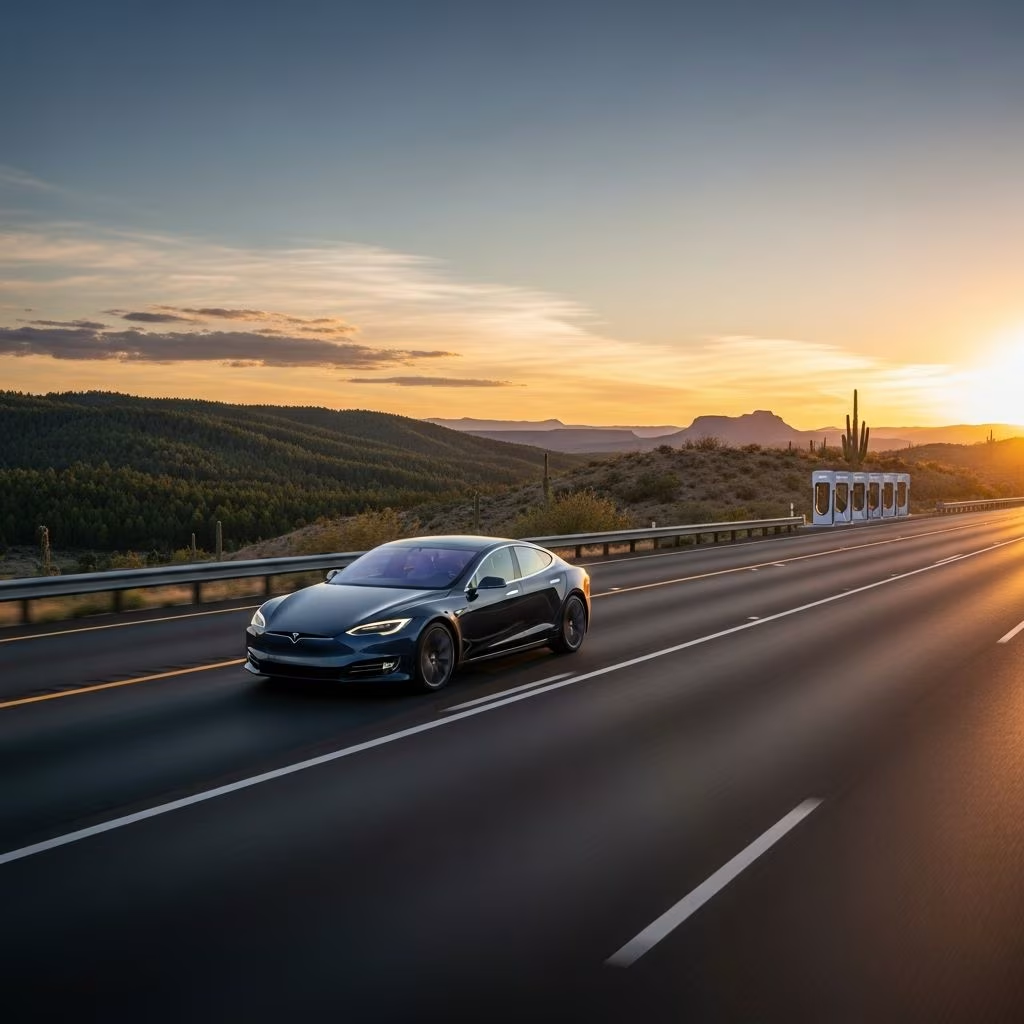
The landscape of long-distance travel in America has undergone a significant transformation in recent years. What was once considered impractical or impossible—embarking on a multi-state journey in an electric vehicle—has become not only feasible but increasingly popular among eco-conscious travelers. The proliferation of public charging infrastructure has fundamentally changed the equation, making EV road trips a viable and often economically superior alternative to traditional gasoline-powered vehicles.
The foundation of any successful electric vehicle road trip rests on understanding the charging network landscape. As of late 2024, the United States boasts over 200,000 public charging ports distributed across the country. This massive expansion represents a crucial milestone in EV adoption, with significant concentrations along major travel corridors. The I-95 corridor, stretching from Maine to Florida, exemplifies this infrastructure development, now featuring DC fast chargers from multiple network operators including Tesla, Electrify America, and EVgo.
The distribution of charging infrastructure varies considerably by region and corridor type. Approximately 59% of heavily traveled U.S. corridors now offer DC fast chargers spaced at intervals of 50 miles or less. This density fundamentally changes trip planning, allowing drivers to rely on frequent, quick charging sessions rather than extended waits. However, recognizing that coverage remains uneven in certain regions ensures travelers can prepare appropriately for their specific routes.
Beyond environmental considerations, the economic case for EV road trips proves compelling. Research analyzing five iconic American road trips reveals significant cost differentials between electric and gasoline-powered vehicles. On average, EV drivers save approximately $0.11 per mile traveled. This advantage compounds over longer distances, potentially resulting in savings exceeding $350 on transcontinental journeys.
A concrete example illustrates these savings: the Pacific Coast Highway route (approximately 523 miles) costs $95.74 in gasoline but only $29.95 in electricity charges—a reduction of nearly 70%. Even on shorter routes like the Los Angeles to San Francisco drive, EV travelers pocket $65.79 in savings. These figures demonstrate that while EV charging takes longer per session, the overall cost advantage remains substantial enough to justify the time investment for budget-conscious travelers.
| Route Type | Gas Vehicle Time | EV Travel Time | Time Difference | Gas Cost | EV Charging Cost | Savings |
|---|---|---|---|---|---|---|
| Pacific Coast Highway (523 miles) | 11 hours 37 minutes | 13 hours 45 minutes | +2 hours 8 minutes | $95.74 | $29.95 | $65.79 |
| Route 66 (2,400+ miles) | ~40 hours | ~50 hours | ~10 hours | ~$410 | ~$152 | $257.58 |
| Cross-country (3,000+ miles) | ~42 hours | ~55+ hours | +13+ hours | ~$410 | ~$53 | $356.50 |
Strategic route planning transforms potential EV road trip anxiety into confident travel. The key principle involves matching daily driving distances to vehicle range while prioritizing corridors with established charging infrastructure. For vehicles with under 160 miles of range, limiting daily driving to 250-350 miles on well-covered corridors like the Boston-Washington D.C. route proves manageable and stress-free.
Modern electric vehicles, particularly newer crossover models and premium sedans, typically offer usable ranges between 250-350 miles on a single charge. Understanding your specific vehicle’s real-world range under typical travel conditions—accounting for highway speeds, weather, and driver behavior—remains essential for accurate trip planning. Conservative range estimates prevent the predicament of searching for available chargers with minimal battery reserve.
Several established routes demonstrate the viability of extended EV journeys while showcasing America’s diverse landscapes and attractions. These corridors benefit from mature charging networks and proven logistical frameworks developed by early EV road trip pioneers.
The Portland, Maine to Miami, Florida route represents approximately 1,750-1,800 miles of predominantly coastal driving. This journey, recently validated by a major charging network’s demonstration drive to Key West, requires seven to ten days of relaxed travel when incorporating sightseeing opportunities. The route follows the I-95 corridor through the most densely populated and well-charged regions of the United States, providing maximum infrastructure support throughout the journey.
This route particularly suits newer electric vehicles with 220 or more miles of usable range and families seeking a once-in-a-lifetime coastal experience. The progression from New England’s rocky shores to Florida’s sandy beaches offers significant cultural and environmental variety while maintaining reliable charging availability.
For travelers with time constraints or shorter-range vehicles, the Northeast urban circuit connecting Boston, New York City, Philadelphia, Baltimore, and Washington D.C. offers a compelling alternative. This 800-1,000 mile round-trip typically requires three to six days and features exceptionally dense charging infrastructure with multiple network options at nearly every location.
The route proves particularly suitable for older or used electric vehicles with more limited range capabilities. Urban charging hubs provide not only practical charging access but also extensive entertainment and dining options, transforming charging stops from mere mechanical necessities into legitimate destination activities. Travelers can structure this as a linear journey followed by train return or as a complete loop.
The route from Washington D.C. through the Outer Banks of North Carolina, continuing through Wilmington, Charleston, and Savannah encompasses 1,000-1,300 miles of scenic coastal driving. This five to eight-day journey particularly suits spring and fall travel when temperatures moderate and charging infrastructure experiences lighter demand.
This route specifically appeals to beach-focused travelers seeking natural coastal attractions rather than primarily metropolitan centers. The gradual southward progression allows gradual acclimation to warmer climates while maintaining reliable charging access through a mix of I-95 and coastal US highway routes.
Successful EV road trips depend heavily on effective daily charging protocols. Rather than attempting complete battery recharge cycles from near-empty to full, experienced EV road trippers employ strategic partial charging sessions. Charging from 20-80% takes considerably less time than 0-100%, with diminishing returns in charging speed as battery capacity fills.
The Portland to Miami corridor exemplifies optimal daily progression: Day 1 involves short hops through New England with dense charging around Boston and Providence, requiring minimal DC fast charging intervention; Days 2-3 traverse the intensively charged metropolitan corridor from Providence through New York to Washington D.C. with multiple shorter charging sessions; Days 4-7 navigate increasingly rural sections while maintaining strategic charging stops to preserve battery safety margins.
Maintaining a minimum 20-25% battery reserve in less-developed regions protects against unexpected charging station unavailability or operational issues. This conservative approach, while requiring slightly longer total trip duration, substantially reduces stress and ensures reliable progress.
Successful EV road trips begin with thorough preparation before departure. Downloading and familiarizing yourself with multiple charging network applications proves essential, as no single provider dominates all regions. Major networks including Electrify America, EVgo, and ChargePoint require separate apps, yet each provides critical functionality unavailable through others.
Google Maps has evolved to provide reliable charging location identification along planned routes. However, supplementing this with PlugShare, a community-driven charging verification platform, confirms charger functionality and provides real-time user feedback. Setting up payment methods in advance for all networks eliminates the frustration of weak internet connections during the road trip itself.
Hotel and lodging selection significantly impacts trip economics and overall experience quality. Prioritizing accommodations offering Level 2 charging dramatically reduces reliance on expensive DC fast charging and ensures vehicles arrive fully charged each morning. Many modern hotels, particularly those targeting business travelers and upscale properties, now provide charging access as standard amenities.
Short-term rental properties with charging access, EV-friendly campgrounds with adapter-compatible outlets, and friends’ residences with standard electrical outlets all provide viable overnight charging solutions. Starting each travel day with a full battery substantially optimizes highway driving segments and minimizes daily charging expenses.
Time additions vary by trip distance and vehicle efficiency. Short trips (under 600 miles) typically add 2-3 hours total, while transcontinental journeys may add 13+ hours spread across multiple days, translating to roughly 15-20 additional minutes per 500 miles.
Vehicles with limited range should prioritize densely charged corridors like I-95 between Boston and Washington D.C., limit daily driving to 200-300 miles, and rely heavily on Level 2 overnight charging. Shorter daily distances reduce daily charging frequency.
Rural and mountain regions with sparse charging infrastructure present challenges. However, with proper planning utilizing strategic charging locations and conservative daily distance targets, most routes remain feasible.
Prioritize accommodations offering Level 2 charging when possible. In areas without charging access, research nearby public charging options and plan arrival times to complete charging during your activity period or overnight.
The EV road trip landscape continues rapidly evolving. Charging network expansion, particularly in previously underserved regions, accelerates annually. Battery technology improvements consistently increase vehicle range and reduce charging times. These developments make increasingly ambitious EV road trips practical for broader audiences.
Real-world road trip data from early adopters continues informing infrastructure investment and route optimization. As more travelers successfully complete long-distance EV journeys, detailed feedback guides future charging network development toward highest-impact locations.
Electric vehicle road trips have transitioned from novelty experiments to mainstream travel options. With proper planning, realistic expectations about charging time allocation, and strategic route selection, American road trips in electric vehicles offer compelling combinations of environmental responsibility, economic savings, and practical feasibility.
