

 Travel Essentials
 Travel Essentials

Science-backed boarding methods like WILMA and the Steffen sequence can cut plane boarding times dramatically and reduce aisle congestion.
 Travel Essentials
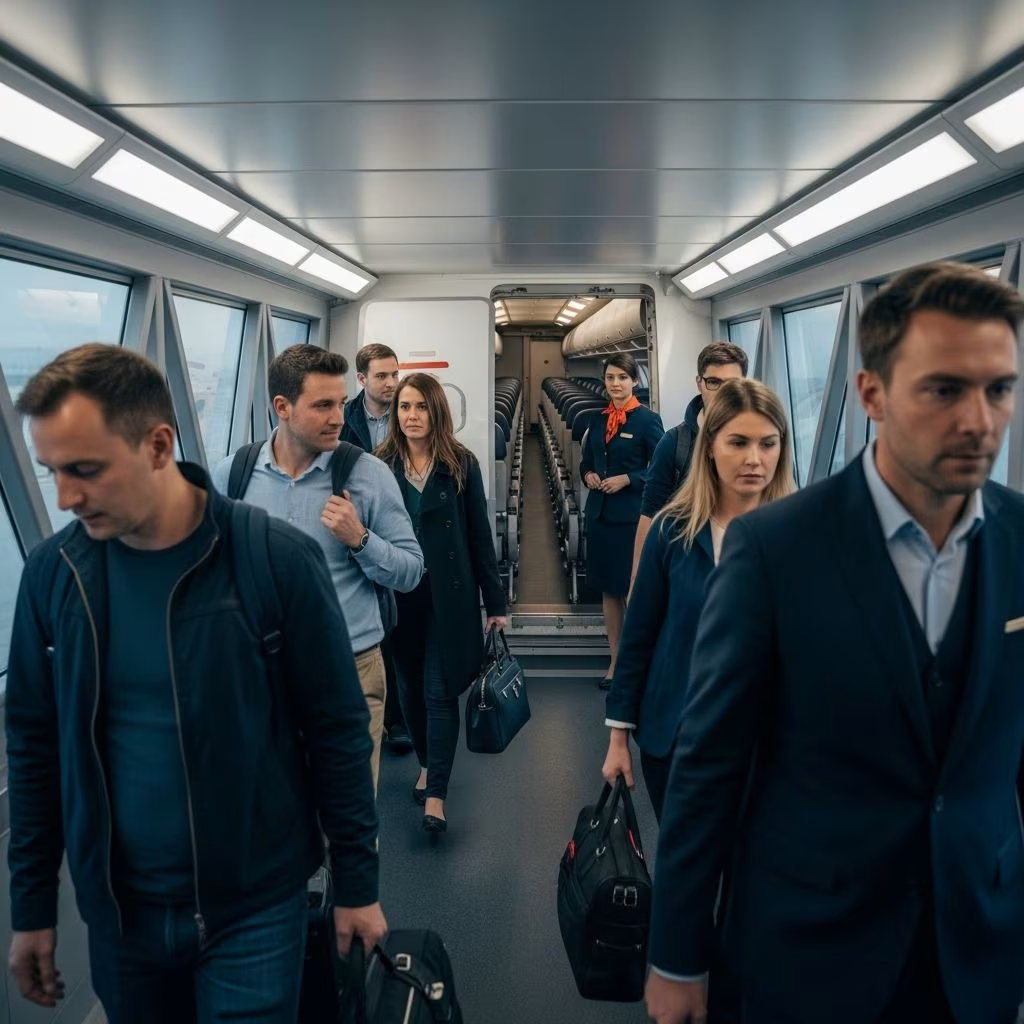
Airplane boarding remains a frustrating bottleneck in air travel, often turning efficient flights into delays. Traditional methods create congestion in aisles and overhead bins, but research reveals smarter alternatives that can halve boarding times. This article delves into the physics, simulations, and real-world tests behind the quickest boarding techniques, helping travelers understand what works best.
Every minute spent boarding delays departure, fueling passenger frustration and airline costs. Congestion arises when passengers block aisles while stowing luggage, creating a chain reaction of waits. Studies show standard back-to-front boarding, used by most carriers, takes over 20 minutes for mid-sized jets, far slower than optimized sequences.
Key bottlenecks include luggage interference and group clustering. When passengers board row-by-row from rear to front, those ahead must clear paths repeatedly, amplifying delays. Simulations incorporating human variability—like slower stowing for 5% of passengers—highlight how small inefficiencies compound.
Several methods have emerged from experiments, each targeting different pain points. Here’s a comparison based on controlled tests with realistic setups, including overhead bin loading and seat access.
| Method | Average Time | Satisfaction Score | Key Advantage |
|---|---|---|---|
| Back-to-Front | 24m 29s | 19 | Familiar but congested |
| WILMA (Window-Middle-Aisle) | 14m 55s | 102 | Parallel seating |
| Reverse Pyramid | 15m 10s | 113 | Edge-to-center flow |
| Random (Assigned Seats) | 17m 15s | 12 | Less clustering |
| Random (No Assigned Seats) | 14m 07s | -5 | Fastest but chaotic |
Data from MythBusters episode and simulations show WILMA and random unassigned outperforming blocks by up to 40%. Satisfaction dips in random due to seat scrambles.
Astrophysicist Jason Steffen engineered the gold standard in 2008, optimizing passenger order to minimize aisle interference. Passengers board in a precise sequence: window seats from back rows alternate sides, followed by middles and aisles, ensuring clear paths ahead.
Published in the Journal of Air Transport Management, Steffen’s model proved twice as fast as back-to-front and 20-30% quicker than random on a 72-seat plane. It accounts for luggage by spacing boarders so no one blocks another. Real tests confirmed these gains, though critics note challenges with groups and imperfect lines.
Window-Middle-Aisle (WILMA) prioritizes windows first from the rear, then middles, aisles last. This allows multiple passengers to settle simultaneously without crossing. United Airlines adopted a variant, boarding rear windows alternately.
Tests clocked WILMA at 14-17 minutes, with high satisfaction from reduced waits. Pitfalls include family separations, but overall, it’s a strong real-world contender.
Surprisingly, unstructured entry—especially without seat assignments—yields top speeds. Passengers spread naturally, enabling parallel progress. MythBusters found it fastest at 14m 7s, though satisfaction suffered from competition.
With assigned seats, random still beats blocks by dispersing crowds. Airlines avoid pure random to sell priorities, but it outperforms organized groups.
Reverse Pyramid builds on WILMA, filling from outer rear edges inward like an inverted triangle. It scored highest in satisfaction at 113 points, just behind WILMA in time.
Simulation software like Simul8 models variables: walking speed, bin loading (modeled with distributions), and outliers blocking for extra time. Results: WILMA at 17.47 minutes, random at 21.09, back-to-front at 25.07. These tools predict scalability to larger jets.
Despite evidence, carriers cling to back-to-front or variants for revenue: priority boarding sells perks. Organized groups simplify gate control, but create the slowest flow. Cultural habits and contracts lock in traditions.
Steffen’s precision demands perfect compliance, impractical amid families and delays. WILMA offers a compromise, adopted by some like United.
TV experiments like MythBusters used full-scale mockups with 173 seats, validating lab findings. Steffen tested on actual 72-seaters.
Emerging ideas: numbered priority for accessibility, alternating rows. AI simulations could refine further, factoring biometrics or bin sensors.
Random without assigned seats hit 14m 7s in tests, but Steffen’s method promises even better in theory, nearly twice back-to-front speed.
It separates groups temporarily but speeds overall; satisfaction remains high at 102 points.
Requires exact sequencing and uniform behavior, challenging with real passengers.
Follow window-first intuitively to mimic WILMA, reducing personal delays.
They model human variability like slow luggage handlers, outperforming simple averages.
Adopting proven methods could save airlines billions yearly in delays. As data mounts, expect shifts toward efficiency.
