

 Travel Essentials
 Travel Essentials

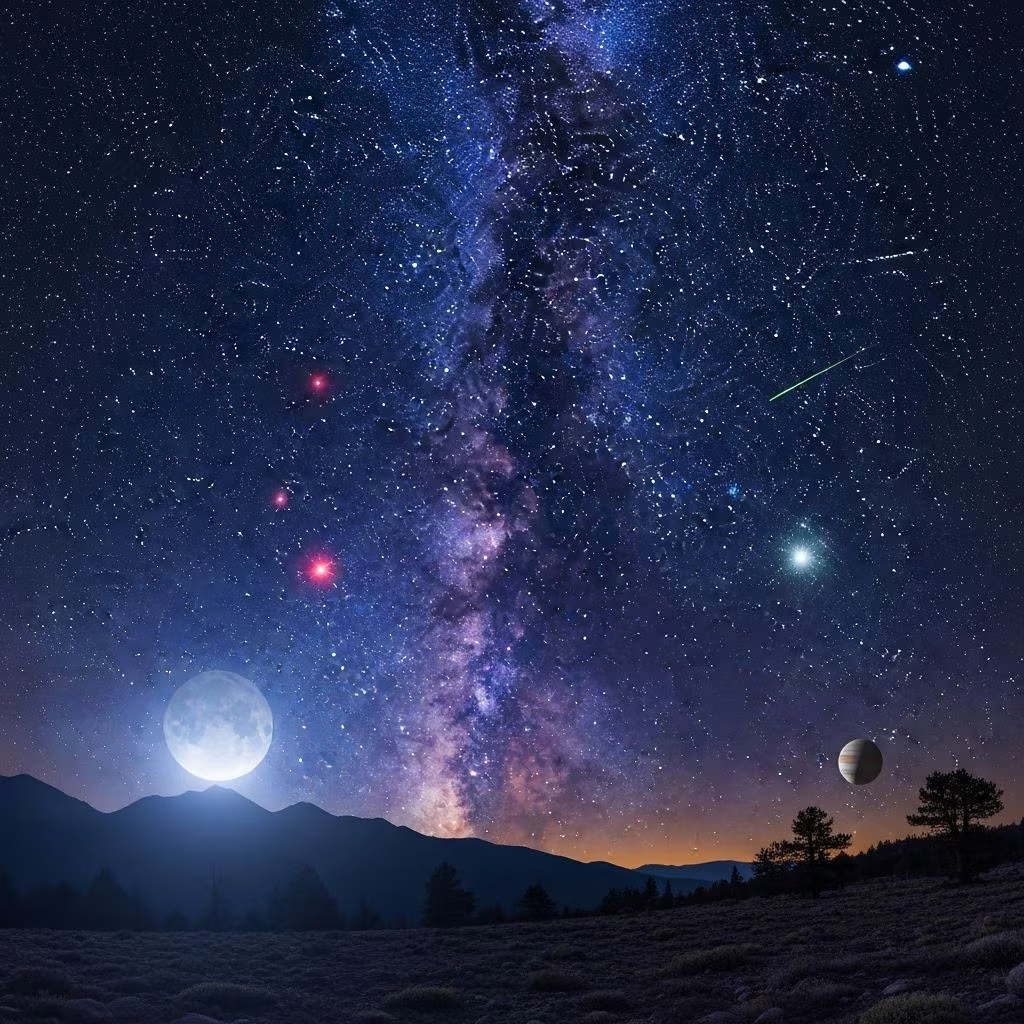
Explore February 2026's night sky highlights: planetary parades, Jupiter-Moon conjunctions, Saturn's farewell, and Orion's prominence. Perfect for beginners and experts.
 Travel Essentials
February 2026 offers a treasure trove of celestial wonders, making it an ideal month for stargazers. With clear winter skies in the Northern Hemisphere, observers can enjoy prominent constellations, fleeting planetary views, and a rare lineup of worlds. This guide breaks down the key events, optimal viewing times, and equipment needs to maximize your experience.
The month kicks off with Saturn’s low southwestern appearance, providing one last chance to spot it before its seasonal hiatus. Orion dominates the evening sky, its belt and sword gleaming brightly. Jupiter shines as the brightest planet, especially during its close encounter with the waxing Moon on February 26-27. The grand finale is a six-planet alignment on February 28, visible shortly after sunset.
February features dynamic planetary action, from inner worlds hugging the horizon to Jupiter’s all-night dominance.
Mercury peaks at greatest eastern elongation on February 19, setting over an hour after sunset. At magnitude -1.1, it’s naked-eye visible low in the west from February 10 onward. Pair it with binoculars near Lambda Aquarii on the 13th. By February 28, it dims to magnitude 1.5 but joins the parade in Pisces.
The evening star emerges higher each night, reaching 4° altitude by February 23. Conjunct Mercury on the 23rd (6° apart) and again on the 26th (less than 5° north). On the 28th, it’s 4.8° from Mercury in Aquarius, setting an hour post-sunset. Naked-eye bright at magnitude -3.9.
Early February offers Saturn at magnitude 1.0 in the southwest, low but discernible as twilight fades. It sinks toward the horizon mid-month, vanishing by late February except in the parade. Telescopes reveal its iconic rings; expect non-visibility until June pre-dawn.
Post-opposition, Jupiter glows at magnitude -2.7 in Gemini, rising east and visible all night. Its 46-arcsecond disk shows equatorial belts and Galilean moons through modest scopes. Track moon transits and shadows for dynamic views. Moon proximity on 26-27th aids spotting.
Uranus in Taurus (south) and Neptune near Saturn (southwest) require binoculars or telescopes. Magnitude challenges demand dark skies; 8-inch scopes detail Uranus/Neptune on the 28th.
| Planet | Constellation (Feb 28) | Magnitude | Best Viewing Gear |
|---|---|---|---|
| Mercury | Pisces | 1.5 | Naked eye / Binoculars |
| Venus | Aquarius | -3.9 | Naked eye |
| Saturn | Pisces | 1.0 | Binoculars / Telescope (rings) |
| Jupiter | Gemini | -2.7 | Telescope (moons/belts) |
| Uranus | Taurus | 5.8 | Telescope (8"+) |
| Neptune | Pisces | 7.9 | Telescope (8"+) |
Orion stands high south from dusk, unmistakable with its three-belt stars and Betelgeuse/Rigel. The Orion Nebula (M42) in the sword dazzles in binoculars as a fuzzy patch, resolving to stellar nurseries in telescopes. Visible all February on moonless nights.
The Seven Sisters cluster in Taurus sparkles early evenings. Gemini hosts Jupiter amid Castor and Pollux. Look for zodiacal light post-twilight: a faint ecliptic cone through Aquarius-Pisces-Aries, rivaling the Milky Way in dark sites.
Full Moon on February 1 illuminates the sky. Waxing gibbous Moon pairs with Jupiter on 26-27th. Check local occultation of Mercury by the Moon in southern U.S. states around mid-month for a rare treat.
Start with naked eyes for bright objects, but gear elevates views.
Tips: Seek dark, horizon-clear sites. Observe post-sunset for parades (Feb 28: setup early). Apps/starcharts aid location. Bundle up—winter nights are cold. Zodiacal light best under moonless conditions.
| Date | Event | Time/Location | Visibility |
|---|---|---|---|
| Feb 1 | Full Moon | All night | Naked eye |
| Feb 10+ | Mercury emergence | 30 min post-sunset, West | Naked eye |
| Feb 13 | Mercury near λ Aqr | Evening, West | Binoculars |
| Feb 19 | Mercury elongation | 1hr post-sunset, West | Naked eye |
| Feb 23 | Venus-Mercury 6° | Evening, West | Naked eye |
| Feb 26 | Mercury N of Venus | Evening, West | Naked eye |
| Feb 26-27 | Moon-Jupiter | Evening, East/South | Naked eye |
| Feb 28 | 6-Planet Parade | Post-sunset, West-South | Eye/Optics |
Chase Jupiter’s Galilean moon events: shadows/transits visible in 15x+ scopes. Probe zodiacal light’s dust glow. From southern U.S., anticipate Mercury’s lunar occultation—timing via specialized predictors. Antarctica hosts an annular solar eclipse on the 17th, but impractical for most.
This month’s parade—Mercury through Neptune—is rare, spanning ecliptic post-sunset. Jupiter’s opposition freshness and Orion’s clarity make it beginner-friendly yet rewarding for pros. Clear skies amplify visibility.
Shortly after sunset; Mercury/Venus/Saturn/Neptune hug horizon—act fast. Jupiter/Uranus linger longer.
Mercury, Venus, Jupiter, Saturn yes (naked eye); Uranus/Neptune need optics.
South from dusk, all night. Belt points to Sirius/Aldebaran.
Yes, early evenings in telescopes before it sets.
Dark-sky sites away from light pollution, clear western/southern horizons.
