

 Travel Essentials
 Travel Essentials

Navigate Fes's UNESCO-protected medina, experience traditional leather craftsmanship, explore Islamic architecture, and immerse yourself in Morocco's most authentic medieval city.
 Travel Essentials
Nestled in northern Morocco, Fes stands as one of the world’s most captivating medieval cities, offering visitors an unparalleled journey through centuries of Islamic civilization and North African heritage. The city has earned its place as a UNESCO World Heritage Site not merely through its architectural splendor but through its living, breathing character as a thriving urban center where tradition remains integral to daily life. Unlike sanitized heritage sites found elsewhere, Fes pulses with authentic activity—locals conducting business, craftspeople practicing ancestral trades, and communities maintaining customs that have persisted for generations.
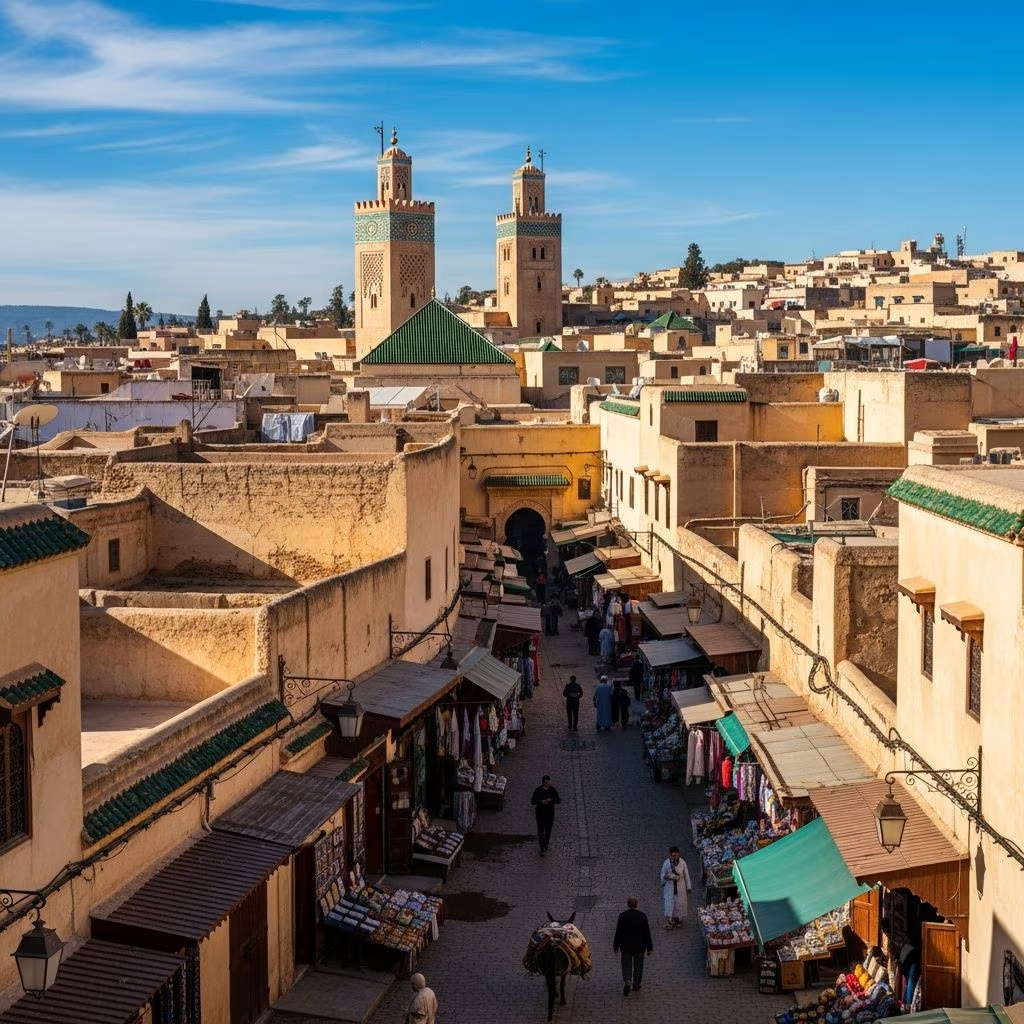
At the core of Fes lies Fes el-Bali, one of the world’s oldest and most expansive medinas, comprising an intricate network exceeding 9,000 winding alleyways that challenge the navigation skills of even the most seasoned travelers. This medieval quarter represents the world’s largest car-free urban space, a designation that fundamentally shapes the experience of moving through its passages. Donkeys serve as the primary transport for goods, sharing narrow corridors with pedestrians, creating a sensory landscape that transports visitors across temporal boundaries.
The medina’s vastness and complexity present both challenge and opportunity. First-time visitors often discover that becoming lost within these passages becomes not an inconvenience but an adventure, with each unexpected turn revealing hidden courtyards, family workshops, and neighborhood squares. The maze-like configuration has prompted significant infrastructure investment—Morocco’s government undertook a comprehensive 95-million-dollar renovation initiative in 2014 that included installing over 214 color-coded directional markers throughout the medina, complemented by five distinct heritage routes designed to assist navigation while maintaining the area’s authentic character.
The built environment throughout Fes el-Bali showcases Islamic architectural principles refined across centuries. The Bou Inania Madrasa, constructed during the 14th century, exemplifies the sophisticated design aesthetic characteristic of Moroccan Islamic structures. Its interior reveals intricate zellij tilework—the traditional mosaic technique using precisely cut ceramic pieces arranged in geometric patterns—combined with masterfully carved cedar wood and a tranquil central courtyard that serves as both functional and spiritual anchor.
Religious and educational structures throughout the medina demonstrate the historical centrality of Islamic learning and devotion within Moroccan urban planning. These buildings, many still functioning in their original capacities, feature ornamental details that reflect both practical engineering and artistic vision. Visitors traversing the medina encounter these structures organically integrated into the urban fabric rather than isolated as museum pieces, reinforcing how seamlessly religious and secular life interweave within the city’s culture.
Bab Bou Jeloud, popularly known as the Blue Gate, functions as the primary entrance to Fes el-Bali and serves as the most immediately recognizable landmark for arriving visitors. The gate’s distinctive aesthetic features blue mosaic tiles adorning one face, symbolizing Fes itself, while the opposing side displays green tiles representing Islam. This dual-colored treatment creates striking visual contrast and encapsulates the cultural synthesis defining Moroccan identity.
Architecturally, the gate anchors the division between the modern city and the medieval medina. Passing through its passage creates an immediate psychological and sensory transition—the contemporary urban environment gives way to historical authenticity as visitors enter the narrower streets beyond. The Blue Gate serves simultaneously as photograph subject, orientation point, and symbolic threshold between temporal worlds.
Among Fes’s most distinctive attractions are its leather tanneries, particularly the renowned Chouara Tannery, recognized as the world’s oldest continuously operating leather-working facility. The tannery experience presents visitors with comprehensive insight into traditional leather production processes, demonstrating techniques largely unchanged across centuries. The characteristic imagery of circular vats containing jewel-toned dyes—ranging from deep indigo to vibrant scarlet—provides the visual signature associated with Fes throughout global travel media.
The sensory experience within tanneries proves complex and multifaceted. While the visual spectacle captivates photographers and aesthetes, the olfactory dimension presents considerable intensity, as natural dyes and processing materials create powerful odors that challenge visitor expectations. This olfactory challenge, paradoxically, authenticates the experience—these smell precisely because artisans employ traditional methods rather than industrial substitutes. Tannery visits typically operate on informal economic models where entry remains free but guides expect gratuities for providing access and explanation.
The medina’s organization reflects functional specialization, with distinct neighborhoods dedicated to particular crafts and trades. Copper-working quarters concentrate traditional metalsmithing activities, while textile specialists operate in adjacent corridors. This geographical organization creates natural circuits for visitors interested in specific crafts—those fascinated by woodworking can trace paths through carpentry neighborhoods, while textile enthusiasts discover concentrated weaving operations and carpet merchants.
Beyond Fes el-Bali, the newer Fes El Jdid district extends exploration possibilities while presenting markedly fewer tourists relative to the primary medina. The Grand Rue of Fes El Jdid functions as a substantial market street where souk culture reflects local commercial patterns rather than tourist-oriented economics. Adjacent features include the historic Jewish Quarter and peaceful gardens offering respite from the intense sensory stimulation of the primary medina.
Traditional riads—residential compounds organized around central courtyards—comprise the predominant accommodation style throughout the medina. These restored historic residences offer intimate connections to the architectural heritage, with many featuring beautiful tilework, fountain-centered courtyards, and rooftop terraces providing panoramic city perspectives. Positioning accommodation strategically near the Blue Gate provides convenient access to major attractions, dining establishments, and transportation infrastructure like taxi stations.
Riad accommodation embodies the medina experience, permitting visitors to inhabit the same spatial organization their predecessors occupied across preceding centuries. Awakening within these compounds to call-to-prayer echoing across rooftops creates profound cultural immersion impossible to achieve through hotel accommodations in the modern city quarters.
Travel communities recommend varying duration itineraries based on individual interests and exploration styles. A fundamental three-day framework allows comprehensive medina navigation, encompassing major attractions including the Bou Inania Madrasa, Chouara tanneries, and the Blue Gate while accommodating personal wandering and discovery. Extended five-day visits permit deeper engagement with artisanal neighborhoods and nearby attractions including day trips to Meknes and the ancient Roman ruins of Volubilis.
Day trips from Fes expand experiential possibilities. The nearby market towns of Azrou and Sefrou offer distinctive commercial experiences, particularly when timed to coincide with traditional market days when rural residents converge to conduct commerce. These excursions illuminate broader regional patterns while offering respite from the medina’s sensory intensity.
While the medina’s labyrinthine character initially intimidates, strategic approaches facilitate successful navigation. Beginning exploration from established gates like Bab Mahrouk—the historical western entrance constructed in 1204—provides contextual anchoring. The recently installed color-coded signage system substantially aids orientation without compromising authentic character.
Guided walking tours prove particularly valuable for initial medina explorations, permitting visitors to understand spatial relationships and neighborhood functions before independent wandering. Local guides provide contextual historical information and cultural interpretation that enriches otherwise passive observation. Many travelers employ hybrid approaches, combining initial guided orientation with subsequent independent exploration once directional confidence develops.
Ascending to the Marinid Tombs situated on elevated terrain north of the medina rewards visitors with comprehensive panoramic perspectives of the entire city sprawl. This vantage point dramatically contextualizes the medina’s expansiveness and reveals urban organization patterns visible only from elevated positions. The approach traverses historic Islamic cemetery grounds, adding architectural and cultural dimensions beyond the visual spectacle. The sunset timing from this position creates particularly compelling photographic and meditative opportunities, though visitors should anticipate informal site custodians occasionally requesting entrance fees.
Fes’s medina distinguishes itself from other Moroccan counterparts, particularly Marrakesh, through the substantial presence of local residents relative to tourist populations. While Marrakesh’s medina has experienced increasing commercialization and tourist orientation, Fes el-Bali remains fundamentally a living community where residents conduct their quotidian activities regardless of visitor presence. This demographic composition creates notably different atmospheres—Fes visitors encounter genuine community life rather than performative heritage tourism.
Meaningful Fes engagement requires attunement to the city’s temporal rhythms. Mornings bring the medina’s most intense commercial activity, with merchants opening stalls and craftspeople commencing daily work. Afternoon hours frequently witness reduced foot traffic as locals retire from midday heat, presenting optimal opportunities for unhurried exploration and photography. Evening periods animate differently, with families emerging for promenade activities and café culture intensifying.
Religious observance structures the temporal framework, with call-to-prayer punctuating each day at prescribed intervals. These moments, broadcast through amplified speakers from minarets, create an auditory reminder of the Islamic spiritual dimensions permeating the city. Respectful observation during prayer times—avoiding loud activities and permitting prayer-attending individuals priority passage through narrow corridors—demonstrates appropriate cultural sensitivity.
Several practical factors merit advance consideration for Fes visitors. The medina’s steep topography and narrow passages present physical demands unsuitable for mobility-impaired travelers despite recent accessibility improvements. Appropriate footwear—closed-toe shoes with substantial grip—proves essential given uneven surfaces and potential moisture from water channels integrated into street designs.
Currency arrangements require attention, as small neighborhood businesses frequently lack electronic payment infrastructure, necessitating cash transactions. Modest dressing aligns with local customs and reduces unwanted commercial attention from vendors targeting obviously foreign visitors.
Optimal visiting periods coincide with shoulder seasons—April through May and September through October—when temperatures remain moderate without the extreme summer heat that renders outdoor exploration physically challenging. Winter months bring lower tourist volumes and potentially affordable accommodation rates, though some days involve rain that transforms the medina’s ancient passages into water channels requiring navigation adaptation.
