

 Travel Essentials
 Travel Essentials

Explore FestPAC 2024, the 13th Festival of Pacific Arts and Culture celebrating Oceanic heritage with performances, workshops, and cultural exchange across 28 island nations.
 Travel Essentials
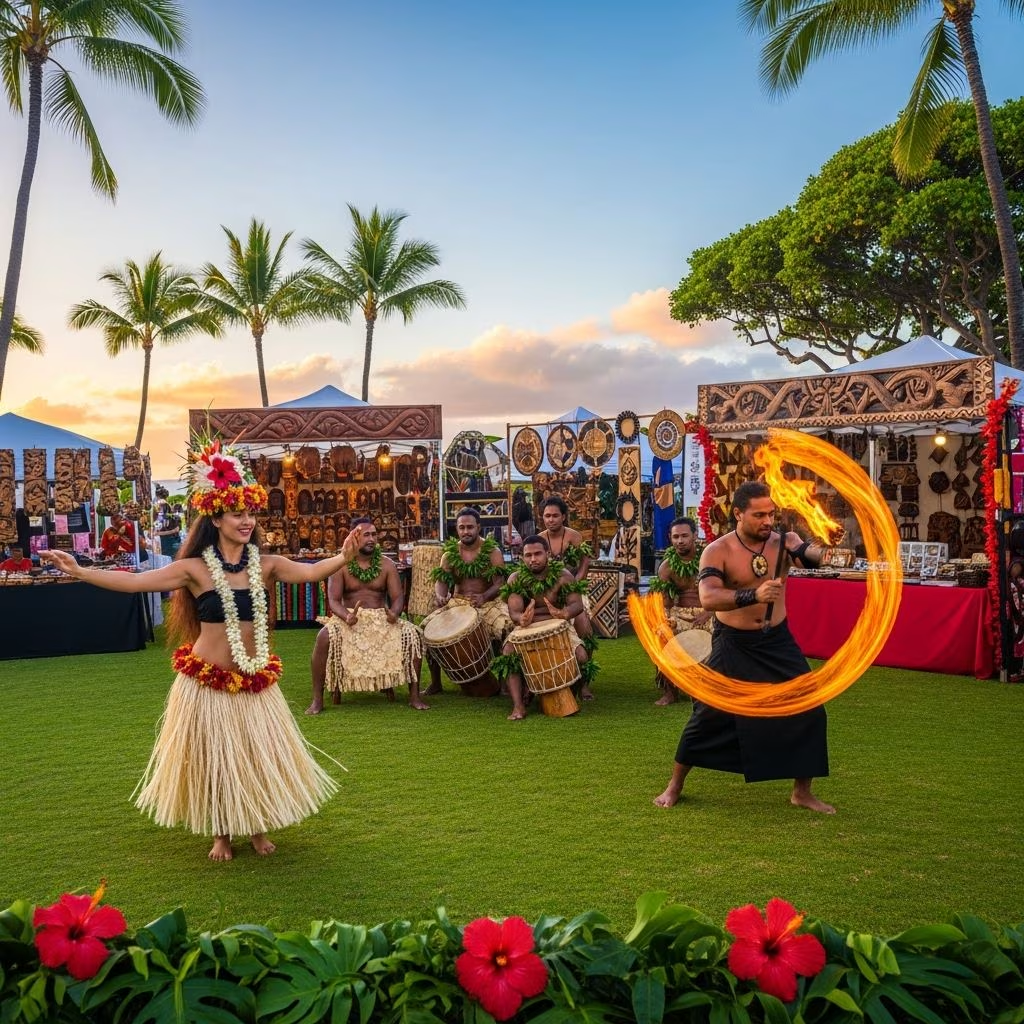
The island of Hawaii played host to one of the world’s most significant cultural gatherings in June 2024. The 13th Festival of Pacific Arts and Culture, commonly known as FestPAC, brought together delegations from 28 Pacific Island nations to celebrate the vibrant traditions, artistic expressions, and shared heritage of Oceania. This biennial event represents far more than a typical cultural festival; it serves as a vital platform for preserving indigenous practices while fostering unity among Pacific communities facing shared contemporary challenges.
The Festival of Pacific Arts and Culture holds the distinction of being the world’s largest celebration of indigenous Pacific Islanders. Established in 1972 by the South Pacific Commission, now known as The Pacific Community (SPC), FestPAC emerged from a critical mission: to arrest the declining practice of traditional cultural expression through organized international exchange. For over five decades, this festival has rotated among Pacific Island nations every four years, creating a cycle of cultural renewal and preservation.
The selection of Hawaii as the 2024 host represented a particularly meaningful choice for the indigenous Pacific community. The islands, themselves rooted in deep Polynesian traditions, provided an ideal setting for this monumental gathering. The decision to hold FestPAC in Hawaii underscored the recognition that Hawaiian culture remains an integral and vital component of Pacific Islander heritage.
FestPAC Hawaii 2024 unfolded over an eleven-day period from June 6 through June 16, representing an intensive schedule of cultural programming. The festival commenced with a traditional Waʻa (canoe) arrival ceremony on June 5, symbolically connecting participants to the ancient maritime heritage of Pacific navigation. The opening ceremony on June 6 marked the official beginning of festivities, while the festival village launched the following day on June 7, providing spaces for continuous cultural engagement.
Key milestones throughout the festival included a Governor and First Lady’s roundtable discussion on June 7, an ecumenical service honoring spiritual traditions on June 9, and a closing ceremony on June 16 that brought the celebration to a ceremonial conclusion. The opening and closing ceremonies were held at the Stan Sheriff Center at the University of Hawaiʻi Mānoa, positioning the university as a central venue for this historic event.
The organizing principle for FestPAC Hawaii 2024 was captured in the Hawaiian-language theme “Hoʻoulu Lāhui: Regenerating Oceania.” This powerful concept reflected both the festival’s commitment to perpetuating time-honored traditions and its forward-looking vision for Pacific Islander communities. The theme acknowledged that cultural preservation exists not in isolation but as a dynamic force capable of addressing contemporary challenges facing the Pacific region.
By embracing regeneration as a central concept, organizers emphasized that cultural traditions provide frameworks for understanding current environmental, social, and economic challenges. The theme connected ancestral knowledge systems with present-day realities, positioning Pacific Islander cultures as living, evolving responses to community needs rather than static historical artifacts.
The 2024 festival attracted participants from 28 distinct Pacific Island nations and territories, representing an extraordinary convergence of diverse cultures. Among the participating delegations were representatives from American Samoa, Cook Islands, Easter Island (Rapa Nui), Fiji, Kiribati, the Republic of the Marshall Islands, Nauru, New Zealand, the Commonwealth of the Northern Mariana Islands, Palau, Papua New Guinea, the Pitcairn Islands, Samoa, the Solomon Islands, Tokelau, Tonga, Tuvalu, and Vanuatu.
This remarkable gathering represented not merely a collection of separate island cultures but rather a recognition of the interconnected heritage binding Pacific Islander communities across vast ocean distances. Each nation brought unique artistic traditions, ceremonial practices, linguistic expressions, and contemporary cultural innovations, creating a comprehensive mosaic of Pacific Islander creativity and identity.
FestPAC Hawaii 2024 featured an extensive array of cultural experiences designed to engage both participants and audiences:
The Festival of Pacific Arts and Culture operates according to five primary objectives established through decades of cultural work:
First, FestPAC prioritizes the preservation and revival of traditional arts and cultural practices across the Pacific region. This mission acknowledges that without deliberate effort and institutional support, traditional knowledge systems and artistic practices face erosion through cultural assimilation and generational discontinuity.
Second, the festival explores contemporary cultural innovation suited to modern Pacific Islander communities. Rather than treating traditional culture as a historical artifact frozen in time, FestPAC recognizes that living cultures evolve and develop new forms of expression responsive to contemporary contexts.
Third, FestPAC seeks to amplify global awareness of the cultural richness residing within the Pacific region. International visibility helps ensure that Pacific Islander artistic traditions receive recognition and respect on the world stage, countering historical patterns of cultural marginalization.
Fourth, the festival fosters unity among Pacific Island nations and communities through shared celebration of artistic achievement and cultural excellence. This objective recognizes that Pacific Islander solidarity, built on recognition of common heritage and mutual respect, strengthens collective capacity to address regional challenges.
Fifth, FestPAC actively promotes the development and use of indigenous Pacific languages through festival programming. Language preservation remains critically important to maintaining cultural identity and transmitting traditional knowledge systems across generations.
While FestPAC celebrates cultural traditions, the 2024 festival also confronted urgent contemporary issues affecting Pacific Island communities. The festival programming illuminated the serious environmental, social, and economic challenges facing the region, including rising sea levels, coral reef degradation, and widening social inequality.
This integration of cultural celebration with acknowledgment of contemporary crises reflected a sophisticated understanding that Pacific Islander cultures possess wisdom and frameworks relevant to addressing present-day challenges. By connecting ancestral knowledge with contemporary problem-solving, FestPAC positioned cultural traditions as resources for community resilience and sustainable development.
The Bishop Museum, Hawaii’s premier institution dedicated to Pacific Islander heritage, played a pivotal institutional role in hosting and supporting FestPAC 2024 programming. The museum’s mission to honor and preserve the rich history of Hawaii and the broader Pacific aligned naturally with festival objectives. Through hosting cultural events, workshops, and exhibitions, institutions like Bishop Museum provided essential infrastructure for the festival’s success while advancing their ongoing commitment to cultural preservation and public education.
The involvement of University of Hawaiʻi campuses, particularly UH Mānoa and UH West Oʻahu, further demonstrated how educational institutions actively participate in supporting indigenous cultural work. Universities provided venue space, technical support, and intellectual resources that enabled comprehensive festival programming.
A fundamental objective of FestPAC involves fostering cultural exchange and mutual understanding among participating nations. The festival provides concentrated opportunities for artists, cultural practitioners, scholars, and officials to interact, share expertise, and develop professional relationships. These connections often extend beyond the festival period, generating lasting collaborations in artistic creation, cultural documentation, and community-based cultural work.
Through intensive cultural exchange, FestPAC participants gain deeper appreciation for the diversity of artistic traditions, ceremonial practices, and cultural values characterizing different Pacific Island communities. This understanding builds foundations for ongoing cooperation and mutual respect among Pacific Island nations.
The 13th Festival of Pacific Arts and Culture represented a significant affirmation of the importance of safeguarding unique cultural identities of the Pacific while simultaneously promoting unity and mutual respect among diverse cultures. By bringing together thousands of cultural practitioners, artists, scholars, and officials, FestPAC demonstrated the vitality and continued relevance of Pacific Islander cultural traditions in the contemporary world.
The festival also provided economic benefits to Hawaii through tourism, employment, and increased visibility of Hawaiian cultural institutions. This economic dimension, while secondary to cultural objectives, nevertheless demonstrated how cultural celebration can support community development and institutional sustainability.
FestPAC is held every four years in a different Pacific Island nation, ensuring that the festival rotates among participating communities and distributes the benefits and responsibilities of hosting across the region.
The 2024 festival welcomed delegations from 28 distinct Pacific Island nations and territories, each bringing unique cultural traditions and artistic expressions.
Both the opening and closing ceremonies took place at the Stan Sheriff Center at the University of Hawaiʻi Mānoa, positioning the university as the ceremonial heart of the festival.
The theme reflects the festival’s dual commitment to perpetuating traditional practices while envisioning how Pacific Islander cultures contribute to addressing contemporary regional challenges and building sustainable futures.
The festival programming illuminated urgent challenges including rising sea levels, coral reef degradation, and social inequality, positioning cultural traditions as relevant resources for community resilience and problem-solving.
The 13th Festival of Pacific Arts and Culture in Hawaii established important precedents for future cultural celebrations and international cooperation among Pacific Island nations. By successfully bringing together thousands of participants from 28 nations, FestPAC demonstrated the enduring power of cultural tradition to unite diverse communities across geographic and political boundaries.
The festival’s emphasis on connecting cultural preservation with contemporary problem-solving offers valuable models for how indigenous communities worldwide can leverage cultural knowledge and practices to address pressing challenges. As Pacific Island nations face an uncertain future marked by climate change and economic pressures, the reassertion of cultural identity and community solidarity through events like FestPAC provides essential psychological, social, and spiritual resources.
For travelers, cultural enthusiasts, and those committed to indigenous rights and cultural preservation, FestPAC Hawaii 2024 represented a remarkable opportunity to witness and participate in the world’s largest celebration of indigenous Pacific Islander heritage. The festival affirmed that Pacific Islander cultures remain vital, dynamic, and central to the identity and future of millions of people across the vast Pacific Ocean region.
