

 Travel Essentials
 Travel Essentials

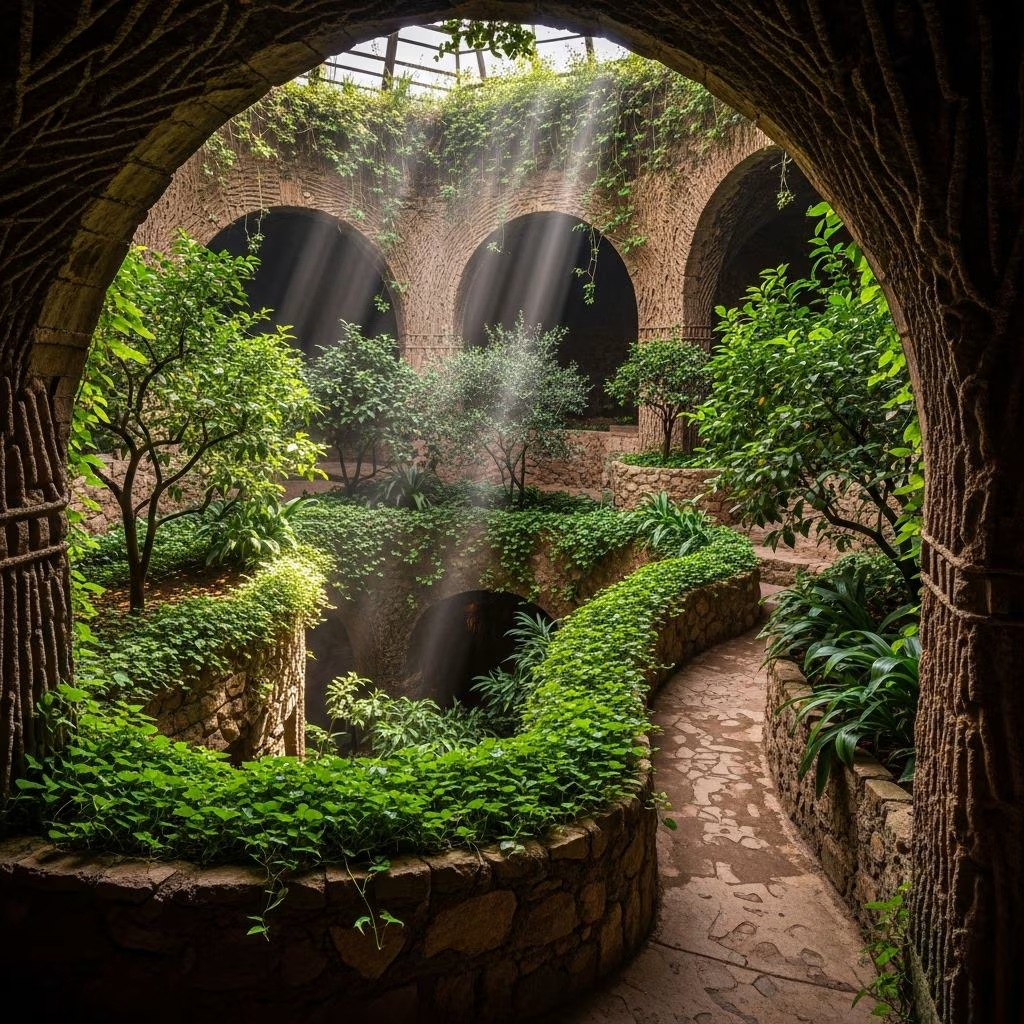
Discover the Forestiere Underground Gardens in Fresno, California—a unique 10-acre subterranean complex hand-built by Sicilian immigrant Baldassare Forestiere.
 Travel Essentials
Beneath the scorching surface of California’s Central Valley lies one of the most extraordinary examples of personal vision and architectural ingenuity ever created in North America. The Forestiere Underground Gardens represent a singular achievement in vernacular architecture—a vast network of chambers, grottos, and cultivated spaces that sprawls across approximately ten acres in Fresno, California. This subterranean wonder was conceived and executed entirely by one man, Baldassare Forestiere, a visionary who spent four decades transforming seemingly worthless farmland into an underground paradise.
Baldassare Forestiere arrived in America in 1901 from Sicily, seeking to fulfill his ambition of becoming a citrus farmer. Like many immigrants of his era, Forestiere brought with him memories of his homeland—including recollections of ancient Roman catacombs and the wine cellars he had known in Italy. These childhood impressions would prove foundational to his later creative endeavors.
During his early years in Fresno, Forestiere encountered a problem common to agricultural workers throughout the San Joaquin Valley: the brutal summer heat. The surface temperatures regularly soared to unbearable levels, making outdoor work exhausting and dangerous. Rather than simply accepting this natural challenge, Forestiere conceived an unconventional solution. He began by excavating a modest cellar beneath his property—a cool refuge where he could escape the oppressive heat. This initial project proved so successful and comfortable that it inspired him to expand his underground domain considerably.
Beginning in 1906, Forestiere embarked on what would become a lifelong project of remarkable proportions. Armed only with shovels, picks, and other hand tools, he methodically carved his way through three to five feet of hardpan sedimentary rock. His workforce consisted of himself and a pair of mules, demonstrating the labor-intensive nature of his undertaking.
What sets Forestiere’s achievement apart from other mining or excavation projects is the absence of any formal blueprint or architectural plan. Instead, he created the intricate network of pathways section by section over his ten-acre parcel, relying entirely on his intuition and vision. This organic approach resulted in a complex that feels more like a natural cave system that has been refined for human habitation rather than a rigidly engineered structure.
The underground complex encompasses three distinct levels descending to varying depths. The shallowest level reaches approximately ten feet below ground, while deeper sections extend to twenty feet and twenty-three feet respectively. Some portions of the structure reach depths of up to twenty-five feet.
Throughout this vertical expanse, Forestiere incorporated architectural elements reminiscent of classical design. The complex features Roman-inspired arches, stone-built vaults, and carefully constructed walls that demonstrate considerable skill in load-bearing design. These structural choices were not merely decorative; they served the practical purpose of maintaining the stability and longevity of the excavated chambers.
The overall layout encompasses more than 800 feet of interconnecting pathways. These passages link multiple living quarters with three expansive courtyards, an ingenious auto tunnel that allowed vehicle access, and even an aquarium-like structure. The incorporation of open-air skylights throughout the design provided illumination and ventilation—features that proved essential for the botanical experiments Forestiere was planning.
Perhaps the most remarkable aspect of Forestiere’s creation is the successful cultivation of fruit-bearing trees and grapevines deep underground. After discovering that vegetation could thrive in his subterranean chambers when provided with proper light and care, Forestiere conducted extensive horticultural experiments. He planted fruit trees and vines up to twenty feet underground, defying conventional assumptions about plant growth requirements.
The varieties Forestiere cultivated demonstrate both ambitious scope and careful selection. He grew standard citrus varieties including oranges, lemons, and grapefruits throughout the gardens—sometimes grafting multiple varieties onto single trees. Beyond these conventional crops, he experimented with more unusual species including kumquats, loquats, jujubes, carob, quinces, and dates, along with both wine and table grapes.
The success of this underground horticultural enterprise depended on several environmental advantages that the subterranean location provided. Underground spaces maintain relatively stable temperatures year-round, protecting tender plants from frost damage that regularly destroyed surface crops in the Central Valley. Additionally, the earth’s thermal mass created underground microclimates with temperature variations of ten to twenty degrees between different chambers, allowing Forestiere to cultivate species with varying requirements in appropriate zones.
Remarkably, many of these trees and vines continue producing fruit more than ninety years after their planting. Visitors to the gardens today can observe active fruit-bearing specimens growing in the same underground chambers where Forestiere originally planted them generations ago.
Forestiere’s underground complex transcended the function of a simple agricultural experiment or summer retreat. Rather, he fashioned it into a complete residential environment where he lived permanently. The underground home included all the necessities and even some unexpected amenities of a surface dwelling.
Beyond sleeping quarters and storage areas, Forestiere incorporated a chapel into his subterranean domain—a spiritual space reflecting his faith and cultural heritage. He also constructed a fishing pond within the underground complex, suggesting both practical protein production and recreational leisure. These additions transform the site from a merely utilitarian structure into a place of genuine livelihood and even pleasure.
The integration of courtyards and open-air spaces throughout the complex prevented the underground environment from feeling claustrophobic or oppressive. Instead, these spaces created pockets of natural light and airflow, giving sections of the underground domain an almost external character despite their subterranean location.
The Forestiere Underground Gardens were formally recognized by California as a significant cultural resource, receiving designation as California Historical Landmark No. 916 in 1978. The site was also listed on the National Register of Historic Places in 1977. These official recognitions acknowledge the structure’s importance to California’s architectural and cultural history.
The gardens are now operated and preserved by members of the Forestiere family through the Forestiere Historical Center, ensuring that Baldassare’s achievement remains accessible to future generations. This family stewardship represents a continuity of vision—the same commitment to preservation that Forestiere himself demonstrated through his decades of development and maintenance.
In recent years, the underground gardens have achieved broader popular recognition, appearing in major media outlets including The New York Times, HGTV’s Xtreme Gardens, and CNN’s coverage of the world’s coolest underground attractions. This contemporary visibility has transformed the site from a regional curiosity into a destination that draws visitors from around the world.
The Forestiere Underground Gardens remain open to visitors through guided tours that provide comprehensive education about Baldassare’s life and work. Located at 5021 W Shaw Avenue in Fresno, the gardens operate from 9 AM to 3 PM. Tours typically last approximately one hour and involve walking on earthen terrain through underground passageways, rooms, and courtyards.
Tour groups learn about Forestiere’s motivations, techniques, and daily life while exploring the subterranean network directly. Visitors gain firsthand experience of the temperature variations, observe the fruit-bearing specimens in their chambers, and appreciate the architectural craftsmanship evident throughout the complex.
The Forestiere Historical Center offers tours in multiple languages, including Spanish-language options, ensuring accessibility for diverse visitors. The facility also provides wheelchair accessibility through alternate routes for standard wheelchairs, with advance coordination available by calling ahead.
Baldassare Forestiere died in 1946 after completing forty years of dedicated labor. His passing marked the end of active development on the site, though maintenance and preservation have continued through subsequent generations. The gardens stand today as they existed at the end of his life, representing a remarkable snapshot of early twentieth-century innovation and personal determination.
The site’s significance extends beyond its architectural or horticultural achievements. The Forestiere Underground Gardens represent a testament to human creativity responding to environmental challenge. Rather than accepting the harsh climate of the Central Valley as an insurmountable obstacle, Forestiere invented a fundamental response—transforming what appeared to be unsuitable land into a thriving agricultural and residential space.
The gardens embody the spirit of vernacular architecture, which emphasizes local materials, practical concerns, and the builder’s personal vision over formal training or theoretical principles. Forestiere had no formal architectural education, yet he created a structure of genuine sophistication that successfully addressed multiple challenges simultaneously: climate control, structural integrity, aesthetic appeal, and horticultural productivity.
For contemporary visitors and researchers, the Forestiere Underground Gardens offer a unique window into early twentieth-century immigrant experience, agricultural innovation, and the possibilities of human determination. They demonstrate that remarkable achievements need not emerge from vast financial resources or institutional support—sometimes they arise from a single individual’s commitment to transforming a vision into reality, one handful of earth at a time.
