

 Travel Essentials
 Travel Essentials

Discover the Ghent Altarpiece, Van Eyck’s masterpiece of symbolism, realism, and drama—an art-history landmark still revealing new secrets.
 Travel Essentials
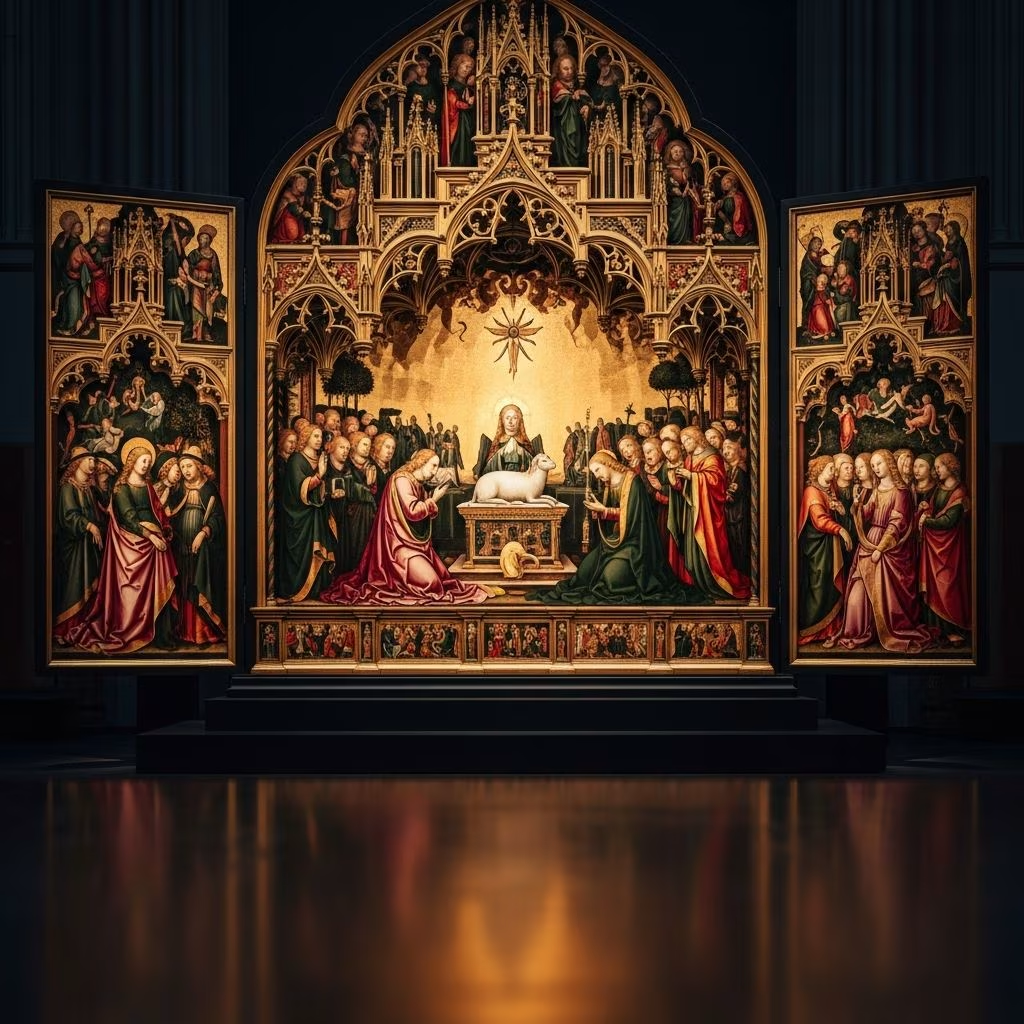
The Ghent Altarpiece stands as a monumental achievement in art history, a sprawling polyptych that captures the dawn of the Northern Renaissance with unprecedented realism and spiritual depth. Measuring approximately 12 feet high and 17 feet wide when fully opened, this intricate work draws visitors from around the world to Saint Bavo’s Cathedral in Ghent, Belgium. Commissioned in the early 15th century, it transcends mere painting, weaving theology, innovation, and human ambition into every brushstroke.
At the heart of this masterpiece are the brothers Hubert and Jan van Eyck, pioneering painters whose collaboration birthed a new era in European art. Hubert, the elder, is credited with initiating the project around 1425, though he passed away before its completion. Jan, often hailed as the more technically virtuoso of the two, finished the altarpiece by 1432, as inscribed on its original frame.
Hubert’s role remains somewhat enigmatic; historical records, including a lost inscription, describe him as maior quo nemo repertus—greater than anyone—while Jan styled himself arte secundus, second in art. Scholars debate the division of labor, with consensus leaning toward Hubert designing the overall structure and Jan executing most panels. Their use of oil paints allowed for luminous glazes and minute details, revolutionizing portraiture and landscape depiction.
The altarpiece was commissioned by Joos Vijd (also spelled Jodocus Vijdt), a prosperous Ghent merchant and mayor, alongside his wife Lysbette Borluut (or Elizabeth). They funded it for their family chapel in the Church of Saint John (now Saint Bavo’s Cathedral), dedicating it on May 6, 1432, during a grand ceremony attended by Philip the Good, Duke of Burgundy.
Positioned above the altar, the polyptych served as a focal point for worship, its wings opening during Mass to reveal inner splendor against the more subdued exterior. This design reflected medieval traditions while pushing boundaries toward Renaissance naturalism.
This is no ordinary painting but a polyptych with 24 panels arranged in a triptych format: a fixed central section flanked by movable wings. When closed, it presents a grisaille (monochrome) exterior, approximately 11 feet high and 15 feet wide, featuring somber tones for everyday viewing.
Opening the wings unveils the full glory: upper and lower registers teeming with figures. The upper tier boasts monumental panels nearly six feet tall, centering on Christ flanked by the Virgin Mary and John the Baptist. Below lies the iconic Adoration of the Mystic Lamb, surrounded by saints, apostles, and paradisal landscapes.
The original gilded frame, lost during the Reformation, likely included mechanisms for dramatic reveals on feast days.
Every element pulses with Christian symbolism, rooted in the Book of Revelation. The central Mystic Lamb embodies Christ sacrificing himself, blood flowing from a wound into a chalice as angels bear Passion instruments—cross, spear, sponge—evoking redemption.
Surrounding panels depict:
| Panel Group | Key Figures/Scenes | Symbolic Role |
|---|---|---|
| Upper Central | Christ, Mary, John the Baptist | Diesis group proclaiming salvation |
| Lower Central | Adoration of the Lamb | New Jerusalem, blood sacrifice |
| Singers & Nude Elders | Heavenly choirs | Eternal praise |
| Processions (Right) | Knights, Judges, Pilgrims | Faithful from all walks |
| Exterior | Annunciation, Donors | Incarnation prelude |
Frames brim with quotes from liturgy, prophets, and sibyls, their Roman numerals forming acrostics. Landscapes burst with naturalistic flora, distant cities, and wildlife, blending earthly realism with celestial vision.
The altarpiece’s history mirrors Europe’s turmoils. Looted by Napoleon in 1794, it adorned the Louvre before returning post-Waterloo. Hitler coveted it during WWII, hiding panels in Altaussee mines; the Just Judges panel remains missing since 1934.
Relocated multiple times for safety—from the Vijd Chapel to the cathedral’s main area, then the Villa Chapel in 1986—it underwent a major restoration starting 2012, completed phases revealing original colors by 2020s. Fires, Protestant iconoclasm, and vandalism tested its resilience, yet it endures.
Van Eyck’s techniques—layered oils, convex mirrors, atmospheric perspective—heralded realism. Figures show individualized faces, textured fabrics, and lifelike anatomy, departing from stylized medieval icons. The altarpiece bridges Gothic idealism and Renaissance empiricism, influencing Bosch, Memling, and beyond.
Its complexity invites endless study: infrared reveals underdrawings, proving meticulous planning.
Ghent’s Saint Bavo’s Cathedral welcomes visitors daily, with dedicated spaces like the Chapel of the Sacrament housing the restored Lamb panel. Tickets grant audio guides decoding symbols; book multimedia tours for close-ups.
Practical Tips:
Allow 1-2 hours; photography permitted without flash.
Beyond faith, the altarpiece fascinates with puzzles—like the identity of nude figures or mirror reflections showing viewers. It’s a portal to 15th-century mindset, blending devotion and discovery. Digital projects like Google Arts & Culture offer virtual dives.
Its role as a Northern Renaissance cornerstone, intricate symbolism, and history of thefts.
Primarily Hubert and Jan van Eyck, brothers from the Early Netherlandish school.
Saint Bavo’s Cathedral, Ghent, Belgium, in the Chapel of the Sacrament.
The Knights of Christ (Just Judges) was stolen in 1934 and never recovered.
Wings open on specific days; otherwise, high-res displays simulate it.
Begun c.1425, completed 1432—about seven years.
This polyptych endures as art’s ultimate enigma, rewarding every gaze with new revelations.
