

 Travel Essentials
 Travel Essentials

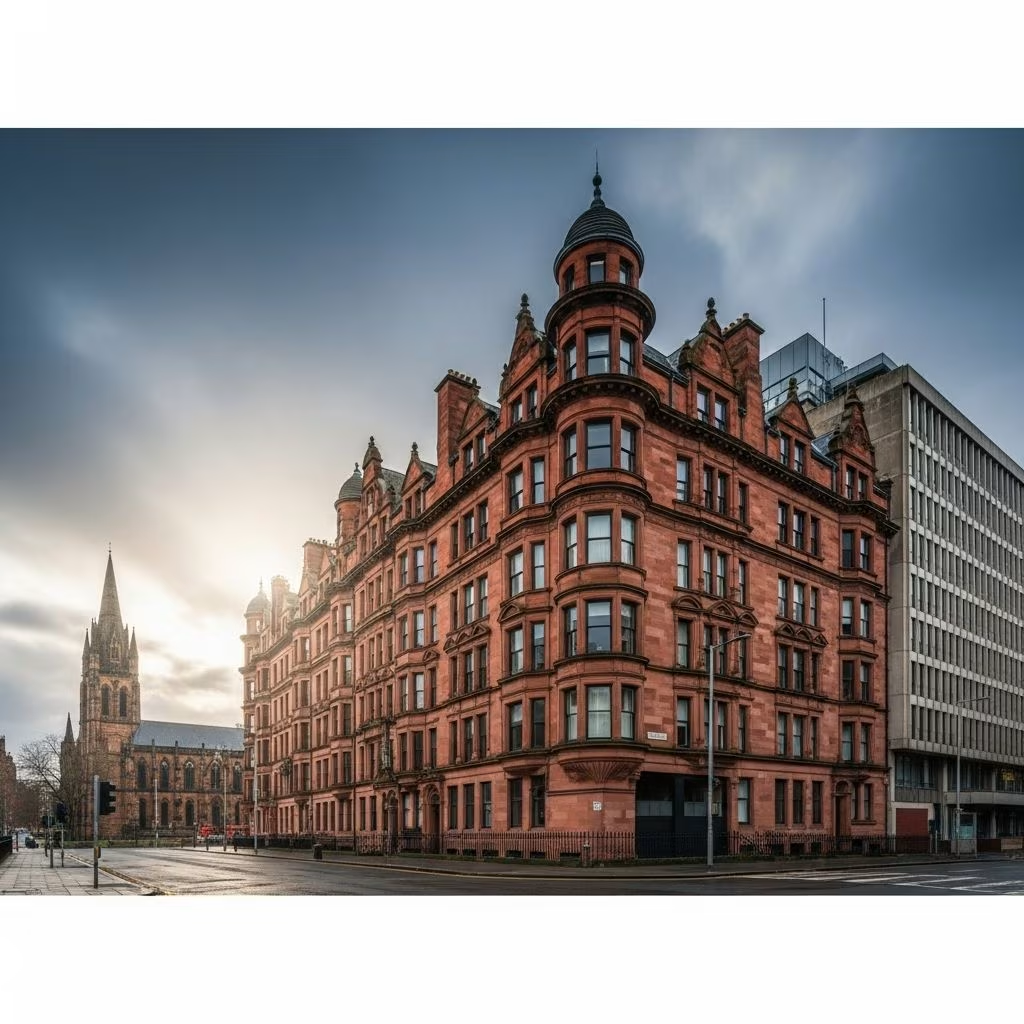
Explore Glasgow's evolution from medieval cathedral city to Victorian powerhouse and modern hub through its stunning architecture.
 Travel Essentials
Glasgow stands as a testament to Scotland’s dynamic past, where stone facades chronicle centuries of transformation. From humble medieval beginnings around a grand cathedral to the opulent Victorian era fueled by industrial wealth, and into bold modern expressions, the city’s buildings blend history with artistic flair. This guide delves into the layers of Glasgow’s built environment, highlighting key periods, influential figures, and must-see sites that reveal the soul of Scotland’s largest metropolis.
Glasgow’s story begins in the shadowy realm of the Middle Ages, centered on religious devotion and emerging trade. The standout survivor from this era is Glasgow Cathedral, a masterpiece of Gothic design completed in the 13th century. Its towering spires and intricate stonework drew pilgrims seeking the shrine of St. Mungo, the city’s patron saint, fostering early economic growth through commerce and faith.
Beyond the cathedral, medieval Glasgow was a modest settlement hugging the River Clyde. Life revolved around ecclesiastical power, with bishops wielding influence over markets and mills. The cathedral’s intact structure—rare on the Scottish mainland post-Reformation—features ribbed vaults and stained glass that evoke the era’s spiritual intensity. Nearby, the University of Glasgow, founded in 1451 by papal decree, marked the city’s ascent as a scholarly hub, its early buildings laying groundwork for intellectual pursuits amid the cloisters.
These foundations set Glasgow apart, transforming a riverside outpost into a vital node in Scotland’s medieval network.
As Glasgow entered the Georgian period before 1837, architecture shifted toward classical poise. Influenced by Enlightenment ideals, buildings emphasized balance, proportion, and subtle ornamentation drawn from Doric, Ionic, and Corinthian orders. Though fewer pre-1837 structures endure, they whisper of a city refining its civic identity.
Key figures like Robert Adam and local talent David Hamilton crafted townhouses and public edifices with clean lines and pediments. St. Andrew’s Church, designed by Allan Dreghorn in the 1740s-1750s, exemplifies this with its stuccoed ceilings, mahogany galleries, and a steeple echoing James Gibbs’ London inspirations. Travelers in the 17th century already hailed Glasgow as Scotland’s finest town, its panorama dominated by the cathedral yet graced by these harmonious additions.
Georgian Glasgow bridged medieval grit and coming prosperity, with warehouses along the Clyde supporting tobacco lords’ fortunes. Symmetry in facades mirrored the ordered society emerging from trade booms.
The Victorian age (1837-1901) catapulted Glasgow to global prominence, its shipyards and factories funding a riot of architectural splendor. Red and yellow sandstone structures erupted across the skyline, blending Gothic Revival, Italianate towers, and eclectic flourishes. This era’s wealth from Clyde-built ships and textiles adorned the city in high-pitched roofs, friezes, and elaborate trims.
Prominent architects included Alexander ‘Greek’ Thomson, whose Greek Revival and Egyptian motifs grace the Merchant City and Necropolis tombs; John Burnet, whose neoclassical designs defined public spaces; and William Young. George Square’s ensemble, the City Chambers (1880s with Victorian twists), and Kelvingrove Art Gallery and Museum (opened 1901) embody this grandeur. Kelvingrove, a red sandstone behemoth in its namesake park, houses treasures from Ancient Egypt to Scottish Colourists like Samuel John Peploe.
| Key Victorian Landmark | Architect/Influence | Highlights |
|---|---|---|
| City Chambers | Victorian with classical elements | Ornate interior, symbol of civic pride |
| Kelvingrove Art Gallery | Alexander Rhodes | Free entry, Mackintosh exhibits, diverse art |
| George Square | Various | Statues, gardens, Victorian ensemble |
| Holmwood House | Alexander Thomson | Greek pillars, south-side gem |
These edifices not only showcased wealth but also cultural ambition, with theaters, music halls, and football grounds reflecting a vibrant populace.
Spanning the Edwardian era into the early 1900s, Glasgow nurtured the ‘Glasgow Style,’ a precursor to Art Nouveau. Charles Rennie Mackintosh (1868-1928) led this charge, integrating modern materials like metal, glass, ceramics, and textiles into fluid, organic forms. His Glasgow School of Art, with its stark facades and intricate interiors, stripped Victorian excess for functional beauty.
Collaborators like James Salmon and James Miller pushed boundaries, from high Arts and Crafts details to sensual modernism. Mackintosh’s influence extended to Edinburgh, but Glasgow’s west end sandstone homes and spires at dusk capture his legacy. The era rejected uniformity, embracing 20th-century thinking amid industrial momentum.
Postwar Glasgow grappled with mediocre modernism and comprehensive developments that scarred the urban fabric. Yet, by the 1980s, a ‘Glasgow style’ revival emerged, earning the 1989 Europa Nostra Medal for conservation. Projects like Ingram Square (Elder and Cannon) and Italian Centre (Page and Park) harmonized old grids with new verve, coinciding with the 1990 European City of Culture title.
Contemporary icons include Zaha Hadid’s Riverside Museum (2011), its jagged, tooth-like facade evoking economic graphs along the Clyde. Housing transport relics from skateboards to locomotives, it nods to Glasgow’s shipbuilding heritage. Titanium, glass, and steel now mingle with Victorian sandstone and Mackintosh’s curves, proving the city’s enduring vitality.
The gridded plan, infused with Georgian manners, Victorian exuberance, and robust contextualism, makes Glasgow an architectural paradise—one of Europe’s most diverse urban treasures.
To experience Glasgow’s legacy:
Use public transport or bikes; many sites are free. Combine with Necropolis for panoramic Victorian vistas.
Victorian sandstone buildings dominate, known for ornate details and colors, seen in Kelvingrove and City Chambers.
A pioneering architect-designer (1868-1928) whose Art Nouveau works, like Glasgow School of Art, blend modernity and craft.
Yes, its 13th-century Gothic structure is Scotland’s finest surviving medieval church.
Zaha Hadid’s Riverside Museum exemplifies bold 21st-century design on the Clyde.
1980s conservation won awards; new builds contextualize historic grids.
