

 Travel Essentials
 Travel Essentials

Explore Glass Mountain's massive selenite crystals and the dramatic Temple of the Sun and Moon in Capitol Reef's remote Cathedral Valley. Essential guide for adventurers.
 Travel Essentials
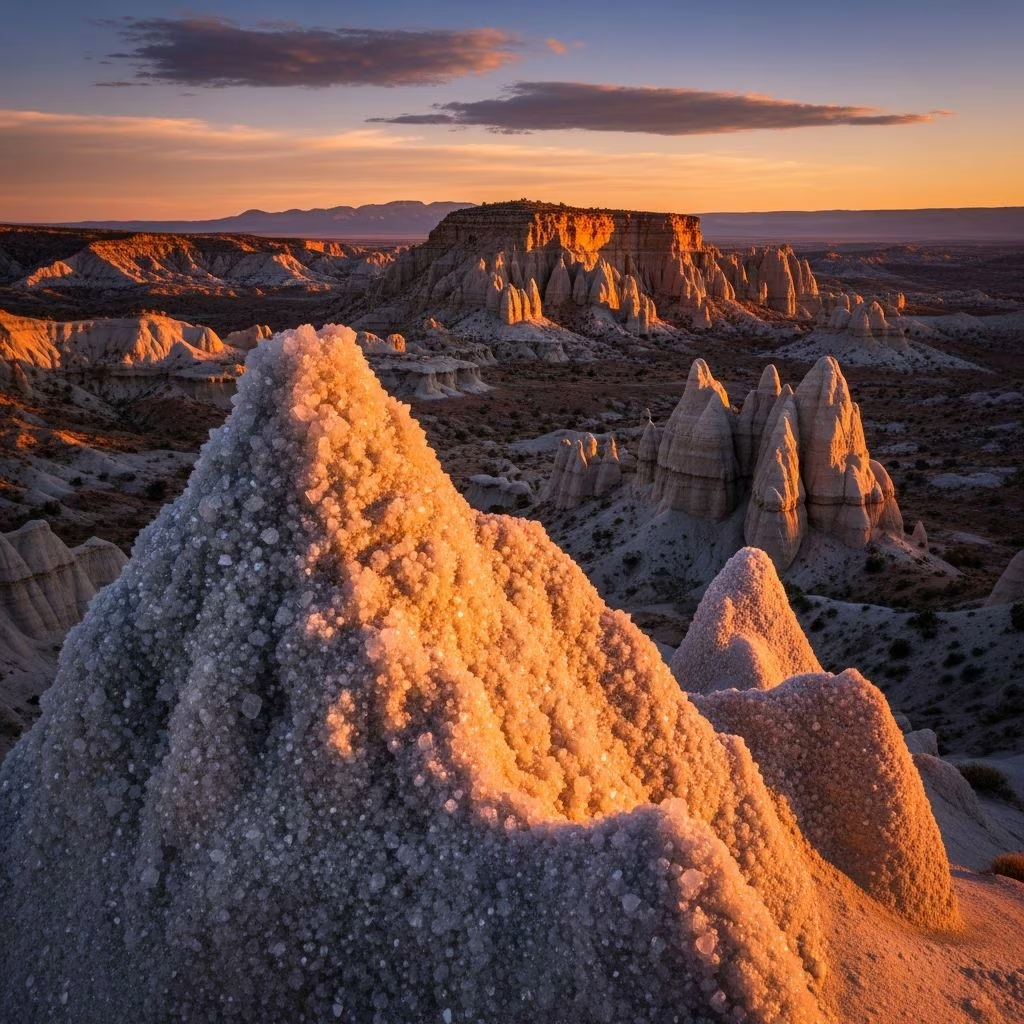
Hidden in the vast expanse of Capitol Reef National Park lies a realm of natural artistry where ancient geological forces have sculpted breathtaking landscapes. **Glass Mountain**, a shimmering mound of selenite crystals, stands as a highlight alongside the majestic **Temple of the Sun** and **Temple of the Moon** in **Cathedral Valley**. This remote corner offers intrepid explorers towering sandstone spires, sparkling mineral deposits, and serene isolation amid Utah’s colorful desert terrain.
Glass Mountain emerges as a rare geological phenomenon, a 15-foot-high dome composed of large, translucent selenite crystals, a crystalline variety of gypsum. Formed around 165 million years ago during the Middle Jurassic period, this feature originated from evaporating seawater in vast tidal flats that blanketed the region. The gypsum precipitated out, was buried under subsequent sediments, and later migrated upward through fractures in the overlying Entrada Sandstone, creating a ‘gypsum plug’ or dome.
Today, erosion of the softer Entrada Sandstone—famous for forming hoodoos in nearby parks—reveals the top of this plug, which may represent just the visible tip of a much larger underground deposit. Groundwater carrying dissolved gypsum crystallized within the sandstone pores, building this massive structure over eons. Unlike typical gypsum occurrences, the crystals here achieve unusual size and density, giving the mound its glassy, reflective allure that sparkles under sunlight.
Gypsum’s slight solubility means precipitation will gradually dissolve Glass Mountain, potentially forming a sinkhole in the future. Visitors are reminded that collecting rocks or crystals is strictly prohibited to preserve this unique feature for future generations.
Lower Cathedral Valley, in the northeastern section of Capitol Reef National Park, showcases dramatic monoliths shaped by differential erosion. The Entrada Sandstone, deposited 160 million years ago as sandy mud in tidal environments, forms the slender spires and cathedrals. Without protective caprock from the Curtis Formation—eroded away here—these formations rise like steeple-shaped towers against the sky.
These landmarks, preserved since President Franklin D. Roosevelt’s 1937 designation of the area as a national monument (expanded in 1968 and made a park in 1971), highlight the 242,000-acre park’s Waterpocket Fold—a 100-mile warp in the Earth’s crust.
Reaching Cathedral Valley demands preparation, as rough dirt roads traverse washes and require high-clearance or 4WD vehicles. No park entrance fee applies for this access point outside the main boundaries, but conditions vary with weather—flash floods can close roads abruptly.
Start from Highway 24 near Caineville, heading north on Caineville Wash Road for about 18 miles to the junction. Turn right (northeast) for Glass Mountain (0.5 miles) or left (west) for the Temples (under 0.5 miles further). Allow 1-2 hours each way from pavement, plus exploration time. Check NPS alerts for road status.
| Route Segment | Distance | Vehicle Requirement | Highlights |
|---|---|---|---|
| Caineville Wash Rd to Junction | 18 miles | High-clearance recommended | Remote desert vistas |
| Junction to Glass Mountain | 0.5 miles | 4WD advised | Selenite dome sparkle |
| Junction to Temple of Sun/Moon | 0.5-1 mile | High-clearance | Towering monoliths |
Full loops like Cathedral Valley Drive involve river crossings and extend 18+ miles, suiting experienced off-roaders. Carry water, snacks, and a spare tire; cell service is absent.
Spring (April-May) and fall (September-October) offer mild temperatures (50-80°F) and fewer crowds. Summers scorch above 100°F; winters bring cold snaps and possible snow. Dawn or dusk yield the best light for Glass Mountain’s iridescence and the Temples’ dramatic shadows.
Photographers favor wide-angle lenses for the Temples’ scale and macro for selenite details. Night skies in this low-light pollution area are stellar—plan stargazing, but note light painting bans. Drones are prohibited in national parks.
Capitol Reef safeguards delicate ecosystems amid its colorful cliffs and canyons. Stay on trails to avoid cryptobiotic soil crusts vital for desert stability. No camping outside designated sites; pack out all waste. The park’s remoteness enhances solitude but underscores Leave No Trace principles.
No—its surface is slippery, and climbing risks damage. Observe from below.
About 1.5-2 hours one-way via dirt roads; confirm conditions first.
High-clearance 2WD may suffice in dry conditions, but 4WD is safer.
Around 5,500 feet; flat valley floor with sandy/gravel paths.
None—nearest in Caineville or Torrey; plan self-sufficiency.
Beyond Cathedral Valley, explore the Waterpocket Fold’s folds via Scenic Drive, Hickman Bridge hikes, or Burro Wash petroglyphs. Combine with Goblin Valley for a multi-park itinerary.
