

 Travel Essentials
 Travel Essentials

Explore fascinating lesser-known facts about the Golden Gate Bridge, from its distinctive color to engineering marvels and historical milestones.
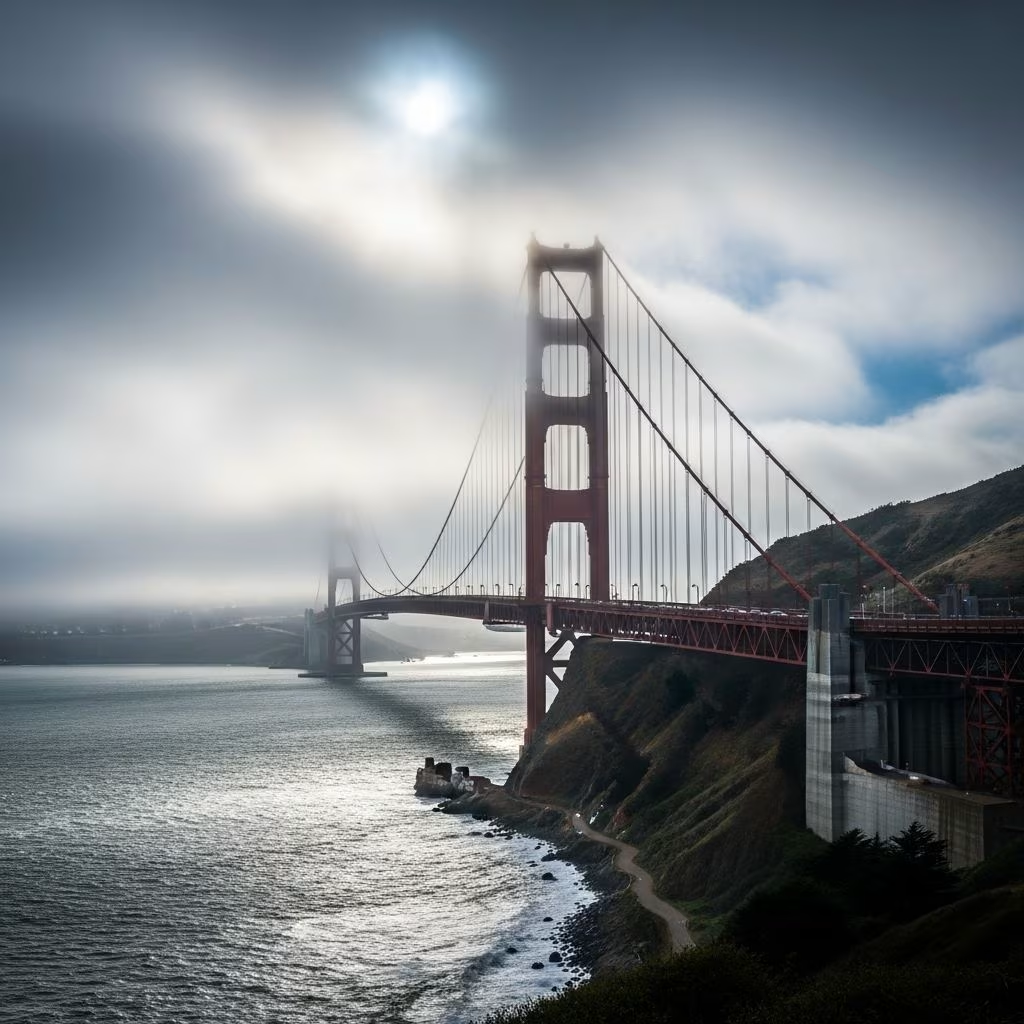 Travel Essentials
Since its inauguration on May 27, 1937, the Golden Gate Bridge has captivated millions of visitors and residents alike, becoming one of the world’s most recognizable architectural achievements. Spanning the Golden Gate Strait that connects San Francisco Bay to the Pacific Ocean, this suspension bridge represents not only a triumph of engineering but also a symbol of human ambition and resilience. Yet beneath its iconic status lies a wealth of fascinating details that often escape public attention. Understanding these lesser-known aspects reveals the complexity, ingenuity, and historical significance of this remarkable structure.
One of the most common misconceptions about the Golden Gate Bridge involves the source of its name. Many assume the structure was named after its distinctive burnt-orange hue, which is officially known as “International Orange.” In reality, the bridge draws its name from the Golden Gate Strait, the waterway it traverses between the San Francisco Peninsula and the Marin Headlands. This geographical feature received its evocative designation long before the bridge’s construction. In 1846, explorer John C. Frémont christened the strait “Chrysopylae,” meaning “Golden Gate,” inspired by Istanbul’s renowned Golden Horn. The timing proved fortuitous, as gold would be discovered at Sutter’s Mill in California just two years later, adding another layer of meaning to the name.
The landscape itself inspired Frémont’s choice. On clear autumn days, visitors standing at the bridge’s southern terminus can observe the golden-hued hills of the Marin Headlands rising beyond the northern approach. This natural phenomenon—the interplay of light on the terrain—created the visual impression that prompted Frémont’s poetic nomenclature.
The bridge’s striking coloration represents one of the most successful design accidents in architectural history. When steel components arrived at the construction site during the 1930s, they were coated in a standard orangey-red primer—a protective coating applied during manufacturing to prevent rust during transit and storage. Rather than obscuring this utilitarian coating with a different color, project supervisors recognized that the primer’s warm hue beautifully harmonized with the surrounding landscape and atmospheric conditions. The decision to retain this color proved inspired, as the International Orange shade now distinguishes the bridge from its urban surroundings while remaining visible in San Francisco’s famously dense fog.
This particular shade serves practical purposes beyond aesthetics. International Orange is now employed in various applications, including astronaut spacesuits and safety equipment, where visibility in challenging conditions proves critical. The bridge’s adoption of this color predates these modern applications, yet demonstrates the principle that functional choices often yield aesthetic benefits when thoughtfully implemented.
Upon completion, the Golden Gate Bridge held the distinction of being the world’s longest and tallest suspension bridge, a remarkable achievement that reflected decades of planning and innovation. The structure’s main towers rise 746 feet above water level, with each tower standing 500 feet above street level. The bridge’s total length spans approximately 8,981 feet, with the main span covering 4,200 feet—measurements that seemed almost impossible to achieve given the engineering constraints of the 1930s.
This record-holding status persisted until 1964, when the Verrazano-Narrows Bridge opened in New York City. Notably, the same engineer who designed and built the Golden Gate Bridge—Othmar Hermann Ammann—subsequently oversaw construction of the Verrazano-Narrows, which stretches approximately 60 feet longer than its California predecessor. Today, the Golden Gate Bridge ranks as the ninth-longest suspension bridge globally, though this ranking diminishes neither its engineering significance nor its cultural importance.
The bridge’s physical composition reflects extraordinary engineering precision. The entire structure weighs approximately 887,000 tons, making it one of the heaviest bridges ever constructed. During the 1980s, when vehicle lanes underwent modernization, engineers removed approximately 12,000 tons of material, slightly reducing the total weight while improving structural efficiency and safety.
The suspension cables represent engineering marvels in themselves. These massive cables, approximately 3 feet in diameter, were spun onsite rather than manufactured elsewhere and transported, because their anticipated weight would have exceeded transportation capacity. Each cable comprises 27,472 individual wires, each approximately the thickness of a pencil. The redundancy and complexity of this design ensure exceptional load distribution and safety throughout the structure.
The bridge’s width spans approximately 90 feet, with roadway lanes occupying more than two-thirds of this dimension. This relatively narrow profile, relative to the span length, required innovative design solutions to ensure stability and flexibility during high winds and seismic events.
The Golden Gate Bridge’s four-year construction period (1933-1937) stands as a testament to human determination amid extraordinary obstacles. Workers faced constant battles against fog, wind, and strong tidal currents that characterize the Golden Gate Strait. In 1935, while construction remained incomplete, a significant earthquake struck the region. Although the incomplete structure endured the seismic event, a construction elevator malfunctioned, trapping a dozen workers on one tower. Miraculously, no fatalities resulted from this emergency.
Throughout the entire construction process, 11 workers lost their lives, representing a lower fatality rate than typically expected for projects of this scale and expense. Civil engineering convention historically assumed one worker death per $1 million spent; the Golden Gate Bridge cost $35 million, making the actual death toll notably lower than statistical models would have predicted. This favorable outcome resulted partly from innovative safety measures, particularly an expansive safety net suspended beneath the work areas.
The safety net proved instrumental in preventing additional tragedies. During one catastrophic scaffold collapse, the net prevented workers from plummeting into the bay. Approximately 20 construction workers fell into this net and survived, becoming members of the informal “Halfway to Hell Club”—a designation reflecting their brush with deadly consequences and their fortunate rescue.
Perhaps the most remarkable threat the Golden Gate Bridge faced during its over-75-year operational history occurred not during construction or subsequent to an earthquake, but during a celebratory milestone: the bridge’s 50th anniversary in 1987. The celebration attracted an unprecedented surge of pedestrians—approximately 300,000 people crossing the span simultaneously—representing far more foot traffic than original design specifications anticipated. The bridge’s roadway visibly flattened under this extraordinary weight load, approximately 30 million pounds of concentrated humanity distributed across the structure.
While the visible deformation alarmed observers, structural engineers confirmed that the bridge sustained no permanent damage or dangerous stress. This resilience reflected the bridge’s robust design and the structural reinforcements completed just one year before the anniversary celebration. The incident demonstrated both the strength of the original engineering and the importance of periodic maintenance and upgrades to preserve structural integrity.
Since opening to the public in 1937, the Golden Gate Bridge has served as a vital transportation corridor connecting San Francisco to communities north of the Golden Gate Strait. On opening day alone, approximately 200,000 pedestrians crossed the bridge, overwhelming initial capacity estimates and necessitating traffic management adjustments. The bridge has achieved such iconic status that its closure remains extraordinarily rare.
Throughout its operational history, the bridge has closed to vehicular traffic on only eight occasions. Three closures resulted from dangerous wind conditions, one from scheduled construction work, and two for anniversary celebrations. These minimal disruptions underscore both the bridge’s structural reliability and its critical role in regional transportation infrastructure.
The Golden Gate Strait, which the bridge spans, occupies a location of significant geological and meteorological importance. Approximately 10,000 years ago, at the conclusion of the last ice age, global sea levels were approximately 300 feet lower than present levels. An ancient river carved a 350-foot-deep canyon through what is now the Golden Gate, leaving geological evidence of prehistoric watercourses. This deep canyon formation contributes substantially to the powerful tidal currents, persistent winds, and dense fog that characterize the region.
The strait’s challenging maritime conditions have claimed numerous vessels throughout maritime history. Since San Francisco became a vital shipping center during the California Gold Rush, approximately 300 shipwrecks have occurred in the waters adjacent to and beneath the bridge. These losses resulted from treacherous currents, sudden fog banks that reduced visibility to near-zero conditions, and the demanding seamanship required to navigate the passage safely. The bridge’s foghorn, activated during periods of heavy fog, issues a distinctive warning signal to maritime traffic, helping prevent additional losses in these treacherous waters.
The Golden Gate Bridge exists within a landscape of significant military importance and historical defense infrastructure. Fort Point, the oldest continuously manned military installation on the Pacific Coast, was established in 1853, decades before bridge construction commenced. Beyond Fort Point, the Golden Gate Strait is guarded by two additional forts and 11 gun batteries strategically positioned to defend the approach to San Francisco Bay and its naval installations. This military infrastructure reflects both the strategic importance of San Francisco’s harbor and the historical emphasis placed on coastal defense.
Operating a structure of the Golden Gate Bridge’s scale and complexity demands perpetual maintenance and monitoring. The international orange color requires regular repainting to maintain both aesthetic appeal and protective qualities. Personnel patrol the bridge continuously, monitoring structural integrity, managing traffic flow, and ensuring public safety. The bridge’s fog horn sounds regularly during adverse weather, particularly during the fall and winter months when dense marine fog frequently obscures the structure.
The Golden Gate Bridge attracts approximately 10 million pedestrians annually, making it one of the world’s most traversed structures. Beyond its role as a vital transportation link, the bridge generates substantial economic activity through tourism, photography, and cultural events. The structure has been featured prominently in countless films, television programs, and artistic works, cementing its position in global popular culture and consciousness.
The bridge’s name derives from the Golden Gate Strait, the waterway it crosses, not from its color. John C. Frémont named the strait “Golden Gate” in 1846, inspired by the golden-hued hills visible from the water.
The distinctive International Orange color was originally a protective primer applied to steel during manufacturing. Engineers recognized that this utilitarian coating harmonized beautifully with the surrounding landscape and chose to retain it as the permanent color.
Eleven workers died during the bridge’s four-year construction period, a lower fatality rate than statistically expected for a project of this scale and cost, largely due to innovative safety measures including the protective net that saved approximately 20 additional workers.
No. While it held this distinction from 1937 to 1964, it now ranks as the ninth-longest suspension bridge globally. The Verrazano-Narrows Bridge in New York, built by the same engineer, surpassed it in length.
The bridge has closed only eight times since opening. Closures resulted from dangerous wind conditions, construction work, and anniversary celebrations. Such closures remain extraordinarily rare due to the bridge’s structural robustness.
