

 Travel Essentials
 Travel Essentials

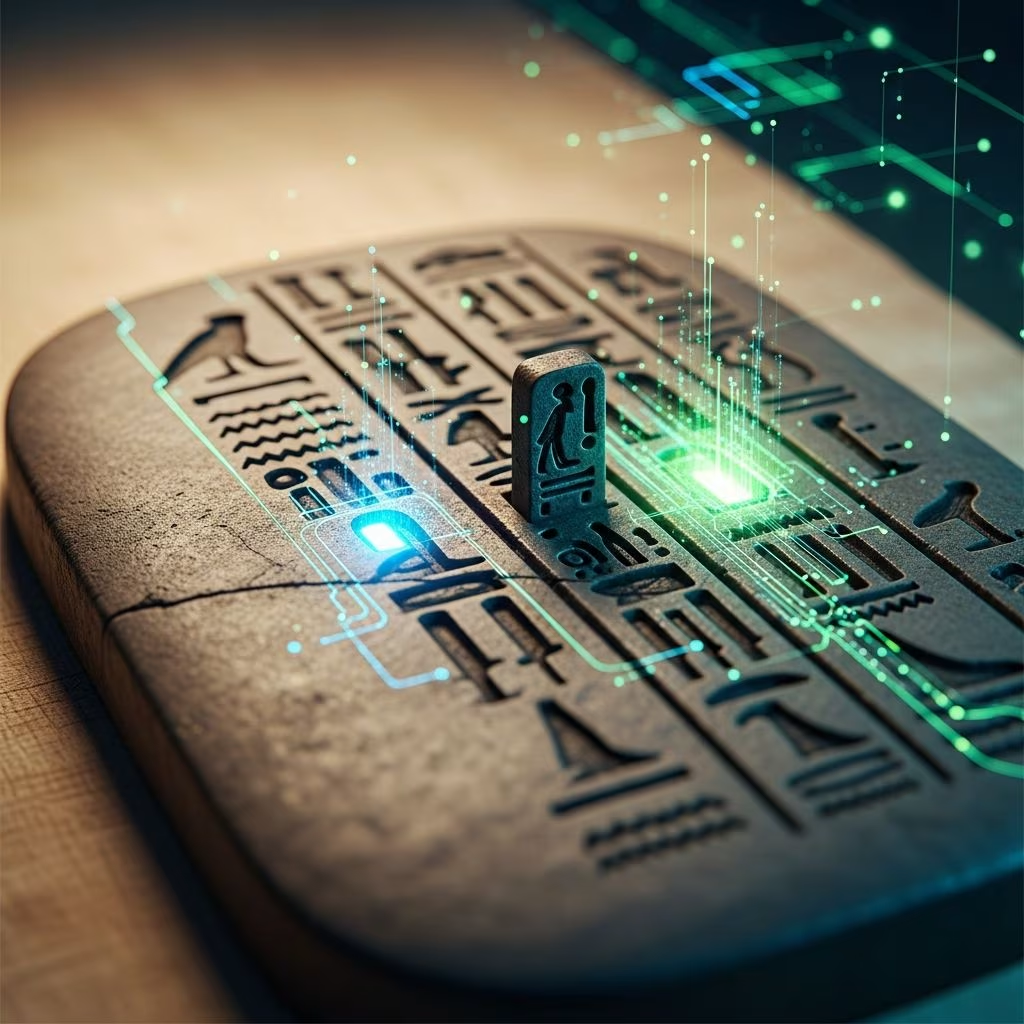
Google’s Fabricius tool uses AI to decode ancient Egyptian hieroglyphs, making Egyptology more accessible for travelers, students, and researchers.
 Travel Essentials
Ancient Egyptian hieroglyphs, those intricate pictorial symbols etched into temple walls and tomb interiors, have long captivated historians, archaeologists, and travelers. For centuries, decoding them required years of specialized training. Now, Google’s innovative Fabricius tool, integrated into the Arts & Culture app, leverages artificial intelligence to make this ancient script more approachable than ever. This breakthrough not only aids professionals but also invites casual explorers to engage with Egypt’s rich heritage in interactive ways.
Launched on the anniversary of the Rosetta Stone’s discovery—a pivotal artifact that unlocked hieroglyphic understanding—Fabricius represents a modern leap in linguistic technology. Developed by Google Arts & Culture, the tool employs machine learning algorithms trained on vast databases containing over 800 distinct hieroglyphs. This enables rapid identification and translation, drastically cutting down the time experts spend on manual transcriptions.
Unlike traditional methods reliant on physical dictionaries and expert intuition, Fabricius processes images of inscriptions, enhancing them digitally for clarity. Users can upload photos from Egyptian sites like Karnak Temple or Luxor, where hieroglyphs adorn colossal structures, and receive instant analyses. This feature proves invaluable for on-site archaeologists or museum visitors worldwide.
Fabricius structures its offerings into distinct modes: learning, playful experimentation, and professional workbench. Each caters to different users, from curious tourists snapping photos in the Valley of the Kings to dedicated scholars publishing peer-reviewed papers.
At its core, Fabricius uses convolutional neural networks, a type of deep learning suited for image recognition. Trained on digitized corpora from museum collections and excavation records, the system identifies glyphs by shape, context, and sequence. For instance, the owl symbol (Gardiner M17) denotes the ‘m’ sound, while a reed leaf (I10) signals ‘i’. The AI cross-references these against grammatical rules, suggesting readings like ‘ankh’ for life.
Users draw or photograph symbols, and the tool matches them to its library, offering confidence scores. This open-source aspect invites developers to refine models, potentially incorporating newly discovered variants from ongoing digs in Saqqara or Abydos. Such adaptability ensures the tool evolves with archaeological findings.
For globetrotters visiting Egypt, Fabricius turns passive sightseeing into active discovery. Standing before the obelisks of Luxor Temple, snap a photo of a cartouche—an oval enclosing a royal name—and watch the AI reveal pharaohs like Ramses II. This real-time decoding enhances tours, bridging the gap between guidebooks and personal insight.
Mobile integration via the Arts & Culture app means no bulky equipment; just a smartphone suffices. Enhance faded carvings with digital magnification, compare them to canonical forms, and even overlay historical reconstructions. Travelers report heightened immersion, transforming visits to the Egyptian Museum in Cairo into treasure hunts for hidden meanings.
| Site | Key Hieroglyph Features | Fabricius Utility |
|---|---|---|
| Abu Simbel | Ramesses II cartouches, divine symbols | Transcribe royal titles instantly |
| Karnak Temple | Pylons with battle scenes | Segment narrative sequences |
| Valley of the Kings | Tomb inscriptions | Enhance low-light photos |
| Rosetta Stone (British Museum) | Trilingual decree | Compare scripts side-by-side |
Beyond tourism, Fabricius empowers classrooms globally. Students experiment with glyph composition, understanding how Egyptians blended ideograms (ideas) and phonograms (sounds). Teachers assign projects like recreating the Palermo Stone, fostering creativity alongside history.
Its accessibility lowers barriers; no longer is Egyptology confined to ivory towers. Hobbyists join citizen science by contributing verified photos, expanding the database collaboratively. This crowdsourced evolution mirrors projects like Zooniverse, but tailored to pictorial languages.
While revolutionary, Fabricius isn’t infallible. Play mode sacrifices accuracy for fun, potentially misleading novices about nuances like variant writings or determinatives (non-phonetic classifiers). Experts emphasize cross-verifying AI outputs with standard references like Gardiner’s sign list.
Contextual interpretation remains human territory; a symbol’s meaning shifts by era—from Old Kingdom to Ptolemaic. The tool excels at segmentation and recognition but falters on damaged or unconventional inscriptions. Developers note ongoing improvements via user feedback.
Fabricius pioneers AI applications for other undeciphered scripts, like Linear A from Minoan Crete or Indus Valley signs. By open-sourcing its framework, Google invites adaptations for cuneiform or Mayan glyphs, accelerating philological breakthroughs.
In preservation, it aids digitizing fragile monuments threatened by pollution and tourism in Egypt. Virtual archives ensure knowledge endures, even if physical sites erode.
Early adopters rave about its intuitiveness. A researcher at the American Research Center in Egypt praised its speed for fieldwork logs. Social media overflows with user-generated hieroglyph memes, blending ancient aesthetics with modern humor.
Apps like third-party translators build on this, offering bidirectional English-hieroglyph conversion, though Google’s version stands out for depth.
Upcoming updates may integrate augmented reality, overlaying translations on live camera views during Nile cruises. Partnerships with UNESCO could standardize datasets, enhancing global heritage efforts. As machine learning advances, expect near-real-time full-text translations from temple friezes.
Yes, it’s available at no cost within the Google Arts & Culture app on iOS and Android, with desktop access for advanced features.
Play mode is for fun; academic mode offers reliable recognition but requires expert validation for full accuracy.
Basic functions require internet for AI processing, though downloaded lessons are accessible offline.
Over 800, covering standard Gardiner categories, with potential for expansion.
Absolutely—the learning and play sections engage young learners interactively.
