


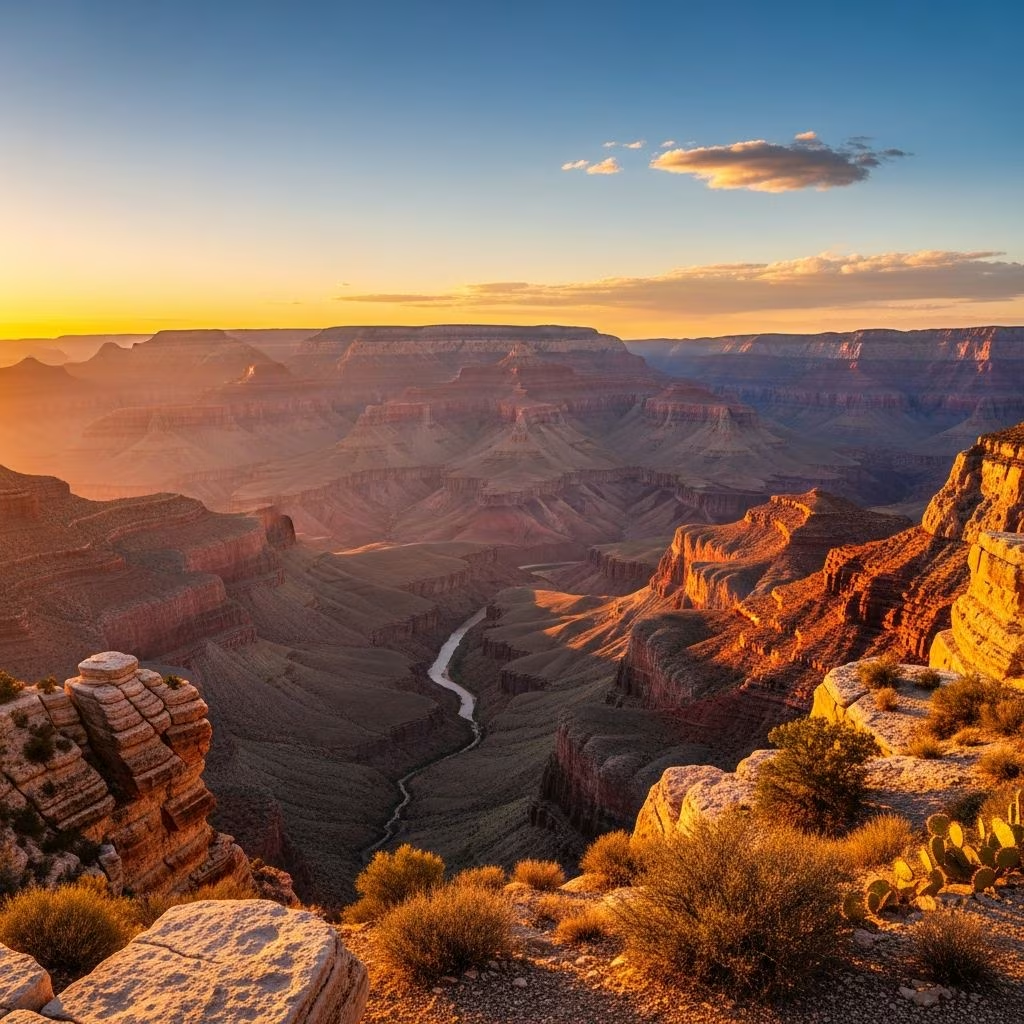
The Grand Canyon stands as one of Earth’s most extraordinary natural phenomena, a testament to millions of years of geological activity and natural erosion. Spanning 1,904 square miles across northwestern Arizona, this magnificent chasm presents visitors with unparalleled opportunities for exploration, education, and wonder. Whether you’re planning your first visit or returning for another adventure, understanding the canyon’s essential characteristics will enhance your experience significantly.
The Scale and Geographic Dimensions
Comprehending the Grand Canyon’s immense proportions helps visitors appreciate what they’re about to encounter. The canyon extends for 277 miles along the Colorado River, with widths ranging up to 18 miles at its broadest point. The depth exceeds one mile, making it a truly vertical landscape that demands respect and careful planning. To put this in perspective, the entire park encompasses an area larger than the state of Rhode Island, making it one of the most expansive protected landscapes in the United States.
The elevation changes dramatically throughout the park. Point Imperial on the North Rim reaches 8,803 feet above sea level, while Navajo Point on the South Rim stands at 7,498 feet. The Colorado River at Phantom Ranch, located at the canyon’s floor, sits at only 2,400 feet, creating a vertical difference of over 6,400 feet between rim and river.
Geological Significance and Ancient History
The Grand Canyon functions as a massive geological textbook, displaying nearly 2 billion years of Earth’s history within its layered rock formations. The exposed strata reveal 40 different sedimentary layers, with the oldest rocks dating back approximately 1.8 billion years. This exceptional geological record showcases the planet’s evolutionary timeline in ways found nowhere else on Earth.
One of the canyon’s most remarkable geological features is the Great Unconformity, where 1.2 billion-year-old rocks sit directly adjacent to 250 million-year-old rock strata. The hundreds of millions of years between these two time periods remain largely unexplained, representing a significant gap in the geological record.
The origin of the Grand Canyon itself has fascinated geologists for decades. While earlier theories suggested the Colorado River began its carving process approximately 6 million years ago, research published in 2012 proposed a dramatically different timeline. This groundbreaking study suggested that canyon formation may have commenced as far back as 70 million years ago, with smaller tributary canyons forming initially before the larger modern canyon structure developed.
Biodiversity and Ecological Zones
Despite its arid reputation, the Grand Canyon supports remarkable biological diversity. The presence of five distinct desert ecosystems creates a unique environment where organisms from dramatically different climate zones coexist. This convergence of ecological zones supports an astonishing array of wildlife species.
Fauna Present in the Park:
- 373 species of birds
- 91 species of mammals
- 57 species of reptiles and amphibians
- 17 species of fish
- 8,480 species of invertebrates
Among these creatures, the pink rattlesnake represents a species found exclusively within the Grand Canyon region. This uniquely adapted serpent’s coloration perfectly blends with the desert rocks, allowing it to remain virtually invisible to both predators and human observers.
Plant life also flourishes throughout the park, with more than 1,700 species of plants documented within its boundaries. The vegetation ranges from high-elevation pine forests to lower desert scrubland, creating distinct ecological zones as elevation decreases.
Climate Variations and Temperature Dynamics
Visitors often underestimate the Grand Canyon’s climate complexity. While the canyon is known for its arid conditions, temperature variations can be dramatic. The difference between rim and river temperatures can exceed 30 degrees Fahrenheit, with the deeper canyon sections maintaining noticeably cooler conditions.
The Grand Canyon’s unique geography literally creates its own weather patterns. Air movement patterns, thermal dynamics, and elevation changes combine to produce localized weather phenomena that distinguish the canyon from surrounding Arizona regions.
Seasonal Temperature Guide:
| Season | Rim Temperature | River Temperature | Precipitation |
|---|---|---|---|
| Spring | 50-75°F | 40-50°F | Moderate |
| Summer | 85-100°F | 60-75°F | Low |
| Fall | 60-80°F | 50-65°F | Moderate |
| Winter | 30-50°F | 35-50°F | High (snow possible) |
Optimal Visiting Timeframe
Timing your visit strategically ensures the most enjoyable experience. Spring and fall offer ideal conditions with moderate temperatures and manageable crowd levels. Summer attracts the highest visitor volume but brings intense heat, particularly at lower elevations. Winter transforms the rim into a quieter environment, though snow may limit access to certain areas.
Visitor Access and Activity Options
Only 10% of park visitors venture below the rim, meaning most tourism occurs from designated viewpoints along the rim roads. This concentration of activity at accessible locations creates both opportunities and challenges for different visitor preferences.
Popular exploration methods include:
- Rim walking and scenic overlook visits
- Mule-pack expeditions into the canyon
- River rafting excursions along the Colorado River
- Hiking trails of varying difficulty levels
- Helicopter and aircraft tours
Connected infrastructure supports visitor movement, with paved roads and established trails linking the North and South Rims, allowing multiple perspectives of the same geological marvel.
Historical Development and Protected Status
Grand Canyon National Park was officially established in 1919, three years after President Woodrow Wilson created the National Park Service. The park experienced significant expansion in 1975 under President Gerald Ford, when it absorbed Marble Canyon National Monument into its boundaries.
International recognition came in 1979 when the United Nations Educational, Scientific and Cultural Organization (UNESCO) designated the Grand Canyon as a World Heritage Site. Subsequently, in 2000, President Bill Clinton created the Grand Canyon-Parashant National Monument, protecting an additional one million acres along the North Rim.
Today, the Grand Canyon ranks as America’s second-most visited national park, attracting nearly five million visitors annually, surpassed only by Great Smoky Mountains National Park. It maintains recognition as one of the Seven Natural Wonders of the World.
Cultural Significance and Indigenous Heritage
The Grand Canyon holds profound cultural importance as the ancestral homeland of 11 present-day tribal communities. This sacred landscape represents far more than geological wonder; it embodies spiritual, historical, and cultural connections spanning thousands of years.
Lesser-Known Facts and Distinctive Features
Fascinating characteristics distinguish the Grand Canyon from other natural wonders. Approximately 1,000 caves exist within the canyon structure, though only 335 have been formally recorded and just one remains open to public access.
Paleontological evidence proves the canyon area was once submerged beneath an ancient sea. Fossils discovered near the rim document the presence of marine organisms from epochs predating dinosaur existence. While no dinosaur fossils have been discovered there—the canyon’s formations predate dinosaurs—marine fossils dating back 1.2 billion years confirm the dramatic environmental transformations the region has undergone.
The canyon continues its transformation today. The Colorado River, combined with wind and rain, perpetually reshapes the landscape. Although these changes occur too gradually for human observation during a typical visit, geological processes continue remolding the canyon at microscopic scales.
Impact on Aviation History
The Grand Canyon’s iconic status inadvertently shaped modern aviation. During the 1950s, commercial airlines frequently routed flights over the canyon to provide passengers with remarkable aerial views. This practice tragically culminated in 1956, when two aircraft collided over the park with no survivors. This catastrophic incident prompted the federal government to establish the Federal Aviation Administration (FAA), fundamentally transforming how airspace is managed and regulated.
Practical Considerations for Planning Your Visit
What to Bring:
- Substantial water supply (minimum 2-3 liters per person)
- Sun protection (sunscreen, hat, sunglasses)
- Proper footwear for varied terrain
- Layers for temperature fluctuations
- Snacks and energy-sustaining foods
- First aid supplies
- Navigation tools or trail maps
Physical Preparation:
Below-rim hiking demands significant physical conditioning. Trails descending into the canyon are invariably more demanding on the return journey. Even short excursions require good cardiovascular fitness and leg strength. Consider your physical capabilities honestly before committing to backcountry exploration.
Understanding Geological Layers
Walking from rim to river represents a journey backward through deep time. The exposed rock layers chronicle Earth’s transformations, with older formations appearing at lower elevations. This vertical arrangement allows visitors to literally walk through geological epochs, observing the physical evidence of planetary evolution.
Wildlife Observation Guidelines
The park’s biodiversity presents excellent opportunities for wildlife observation, but certain precautions ensure both visitor and animal safety. Maintaining appropriate distances from wildlife, avoiding feeding any animals, and staying on designated trails protects both human visitors and park inhabitants. The diverse animal populations, from soaring condors to elusive mountain lions, contribute to the canyon’s ecological significance.
References
- 8 Facts About the Grand Canyon You Never Knew — National Parks Conservation Association. Accessed via nationalparks.org. https://www.nationalparks.org/connect/blog/8-facts-about-grand-canyon-you-never-knew
- 25 Fun Facts About the Grand Canyon (You Probably Didn’t Know) — Grand Canyon Excursions. https://www.gcex.com/blog/grand-canyon-fun-facts
- Grand Canyon Facts — Maverick Helicopters. https://www.maverickhelicopter.com/grand-canyon-facts.aspx
- Grand Canyon National Park — U.S. National Park Service. https://www.nps.gov/GRCA
- Grand Canyon – Britannica Kids — Encyclopedia Britannica. https://kids.britannica.com/kids/article/Grand-Canyon/346126
- Grand Canyon National Park — World Heritage USA. https://worldheritageusa.org/sites/grand-canyon-national-park/
- History of the Grand Canyon: Icon of the American West — Natural Habitat Adventures. https://www.nathab.com/blog/history-of-the-grand-canyon
- 20 Amazing Grand Canyon Facts — Pink Adventure Tours. https://www.pinkadventuretours.com/blog/20-amazing-grand-canyon-facts

