

 Travel Essentials
 Travel Essentials

Navigate the Grand Egyptian Museum with practical tips, exhibition insights, and expert advice for maximizing your cultural experience in Cairo.
 Travel Essentials
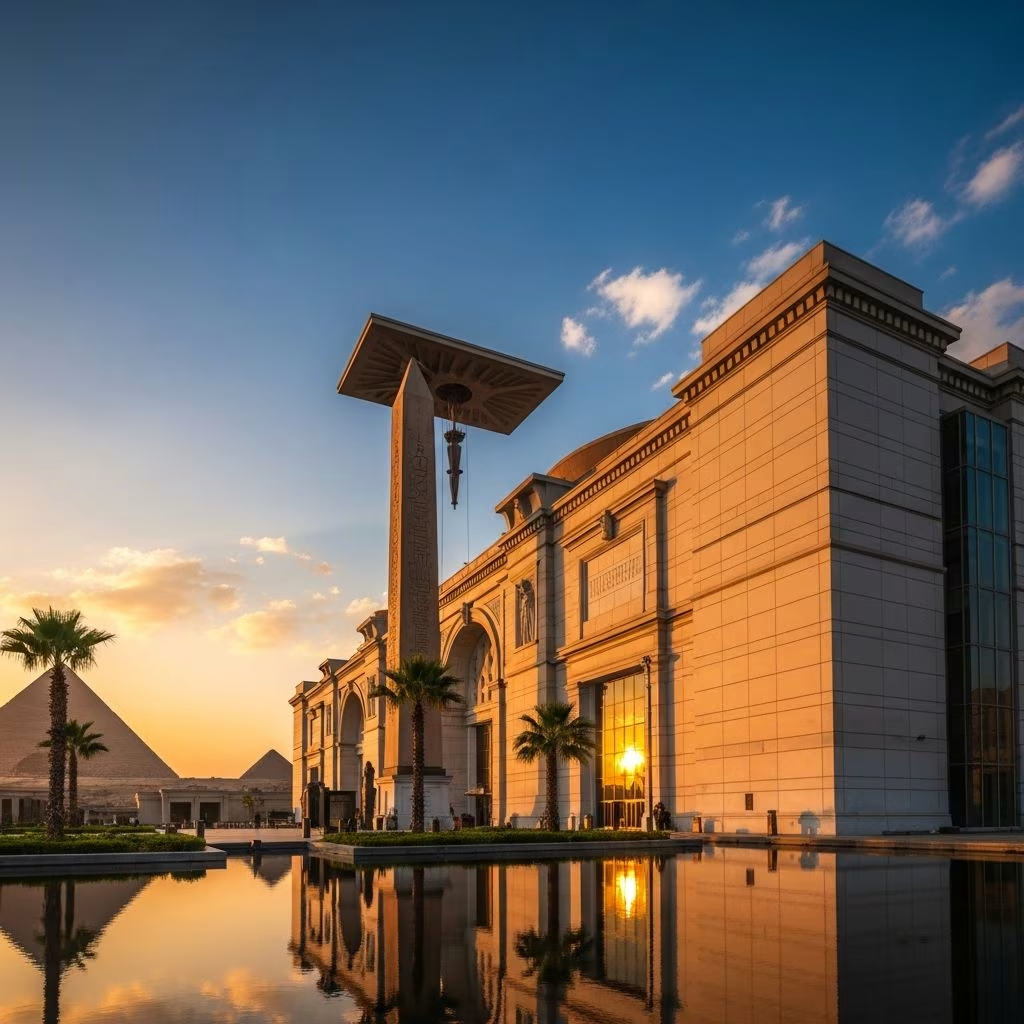
Located near the iconic Pyramids of Giza, the Grand Egyptian Museum (GEM) stands as the world’s largest archaeological museum complex dedicated to a single civilization. Spanning approximately 500,000 square meters—equivalent to roughly 70 soccer fields—this monumental institution houses over 100,000 artifacts representing millennia of Egyptian history. Since its complete opening to the public on November 4, 2025, the museum has become an essential destination for travelers seeking to understand and appreciate the grandeur of ancient Egyptian culture. This comprehensive guide provides visitors with essential information to plan and execute a memorable museum experience.
The GEM complex comprises multiple distinct sections, with 92,000 square meters dedicated to museum galleries and an additional 40,000 square meters reserved for commercial spaces. Rather than attempting to absorb everything in a single visit, savvy travelers recognize that the museum’s vastness demands strategic planning. The gallery system is thoughtfully organized around three primary conceptual frameworks: Society, Kingship, and Beliefs, with each category subdivided into four chronological groupings.
The first chronological section encompasses the period from approximately 700,000 to 2034 BCE, incorporating the Prehistoric, Predynastic, Early Dynastic, Old Kingdom, and First Intermediate periods. The second section covers 2034 to 1550 BCE, featuring the Middle Kingdom and Second Intermediate period. The third focuses on the New Kingdom era from 1550 to 1069 BCE, while the fourth section traces history from 1069 BCE through 394 CE, encompassing the Third Intermediate, Late, and Greco-Roman periods. This organization helps visitors navigate thousands of years of cultural development chronologically.
The GEM complex operates from 8:30 AM to 7 PM daily, with extended hours until 10 PM on Saturdays and Wednesdays, allowing visitors flexibility in scheduling their museum experience. The actual gallery spaces operate from 9 AM to 6 PM throughout the week. Understanding these hours ensures you allocate sufficient time for your exploration without rushing through exhibitions.
An important procedural detail for prospective visitors: tickets must be purchased online in advance rather than at the physical location. This system ensures efficient crowd management and allows the museum to regulate visitor flow throughout its expansive galleries. Planning your visit ahead of time by securing tickets online eliminates potential disappointment from sold-out sessions and provides certainty for your travel itinerary.
Upon arrival, visitors should obtain a physical map of the premises or download the official museum application. Given the complex’s enormous size and the labyrinthine arrangement of galleries, having access to navigational tools significantly enhances the experience. The app provides real-time information about exhibit locations, highlights specific collections, and notifies users of special events or temporary exhibitions.
Upon entering the museum, visitors ascend the impressive Grand Staircase, an architectural feature that immediately conveys the monumentality of the institution. This striking entryway is lined with colossal statues representing Egypt’s most significant pharaohs and deities. Most prominently, a 3,200-year-old statue of Pharaoh Ramses II commands the entrance area, creating an unforgettable first impression. This grand atrium serves as an ideal orientation point—visitors should pause here to acclimate themselves to the museum’s scale, capture photographs, and mentally prepare for the exhibitions ahead.
Perhaps the most celebrated section of the GEM, the Tutankhamun Galleries represent the museum’s crown jewel. The complete collection of King Tutankhamun comprises more than 5,000 artifacts, many of which have never been publicly displayed until now. This dedicated gallery space presents his famous golden mask, ceremonial chariots, exquisite jewelry, and elaborate funerary furnishings in a narrative context that illuminates aspects of his life and reign. Unlike the presentation in the older Egyptian Museum, where objects were arranged for aesthetic purposes, the GEM contextualizes these treasures within the historical narrative of Tutankhamun’s era. Visitors gain deeper understanding of the young pharaoh through the sophisticated storytelling approach employed in this section.
The museum showcases artifacts spanning the entire Pharaonic period from 3050 BCE to 394 CE, with the notable exception of royal mummies, which are respectfully preserved and displayed at the National Museum of Egyptian Civilization (a separate institution also worth visiting during a Cairo trip). The breadth of represented material culture provides comprehensive insight into the evolution of Egyptian civilization across distinct historical periods.
Visitors will encounter numerous specialized collections throughout the galleries:
The GEM’s logical layout and comprehensive labeling system make self-guided exploration entirely feasible for independent travelers. Each artifact includes descriptive information detailing its identity, historical period, cultural significance, and archeological context. This accessibility eliminates the necessity of hiring a professional guide, though knowledgeable Egyptologist guides are available for visitors who prefer expert interpretation and specialized knowledge.
Given the museum’s scale, visitors must make realistic assessments of how much material they can meaningfully absorb. Rather than attempting comprehensive coverage in a single visit, prioritize specific collections or historical periods. First-time visitors often benefit from focusing on major highlights such as the Tutankhamun galleries, the Grand Staircase statuary, and one or two additional exhibition sections. Subsequent visits allow exploration of additional areas without the exhaustion associated with trying to experience everything simultaneously.
An alternative approach involves following one of the three conceptual pillars (Society, Kingship, or Beliefs) through all four chronological periods. This methodology creates a coherent narrative arc rather than jumping randomly between temporal contexts. Following such a thematic thread helps visitors develop deeper understanding of how particular aspects of Egyptian civilization evolved across millennia.
Beyond the artifacts themselves, the museum building represents a significant achievement in contemporary architectural design, created by the renowned Heneghan Peng Architects. The modern structure’s innovative design complements rather than overshadows the ancient treasures within. The museum complex includes expansive gardens offering panoramic views of the nearby Giza Pyramids, providing moments of respite during your visit and contextualizing these ancient monuments within the broader landscape of Egyptian heritage.
The museum complex extends beyond gallery spaces. Visitors can enjoy leisurely strolls through landscaped gardens, dine at onsite restaurants, and browse commercial spaces featuring authentic Egyptian crafts and culturally-relevant publications. These amenities transform the visit from a purely educational experience into a more holistic engagement with Egyptian culture and contemporary interpretations of heritage.
The museum’s magnitude means substantial walking across multiple levels and galleries. Comfortable footwear and appropriate hydration become essential. Visitors with mobility limitations should plan strategically, potentially focusing on lower levels or utilizing available assistance services.
A meaningful visit requires minimum 3-4 hours; comprehensive exploration typically demands 6-8 hours or multiple visits. Planning according to personal fitness level and specific interests prevents disappointment and excessive fatigue.
The Grand Staircase and entrance areas provide exceptional photographic opportunities. However, visitors should verify current photography policies before capturing images, as restrictions may apply to specific galleries or artifacts.
The museum’s official audio guide service, available for minimal cost, offers expert interpretation and historical context for major collections. This supplementary resource enhances understanding without requiring formal guide employment. Interactive exhibits throughout the complex bring pharaonic civilization to life through modern museological techniques, making Egyptian history accessible to diverse audiences regardless of prior knowledge.
The Grand Egyptian Museum represents a paradigm shift in how ancient Egyptian civilization is presented to global audiences. By consolidating the world’s most comprehensive collection of Egyptian artifacts in a single, state-of-the-art facility, the institution democratizes access to humanity’s shared cultural heritage. The proximity to the Giza Pyramids creates an unparalleled opportunity to experience multiple dimensions of Egyptian greatness within a concentrated geographic area, making the GEM an indispensable component of any Egypt itinerary.
