

 Travel Essentials
 Travel Essentials

Explore the Great Barrier Reef’s scale, biodiversity, and hidden soundscape—and the urgent climate threats putting this living marvel at risk.
 Travel Essentials
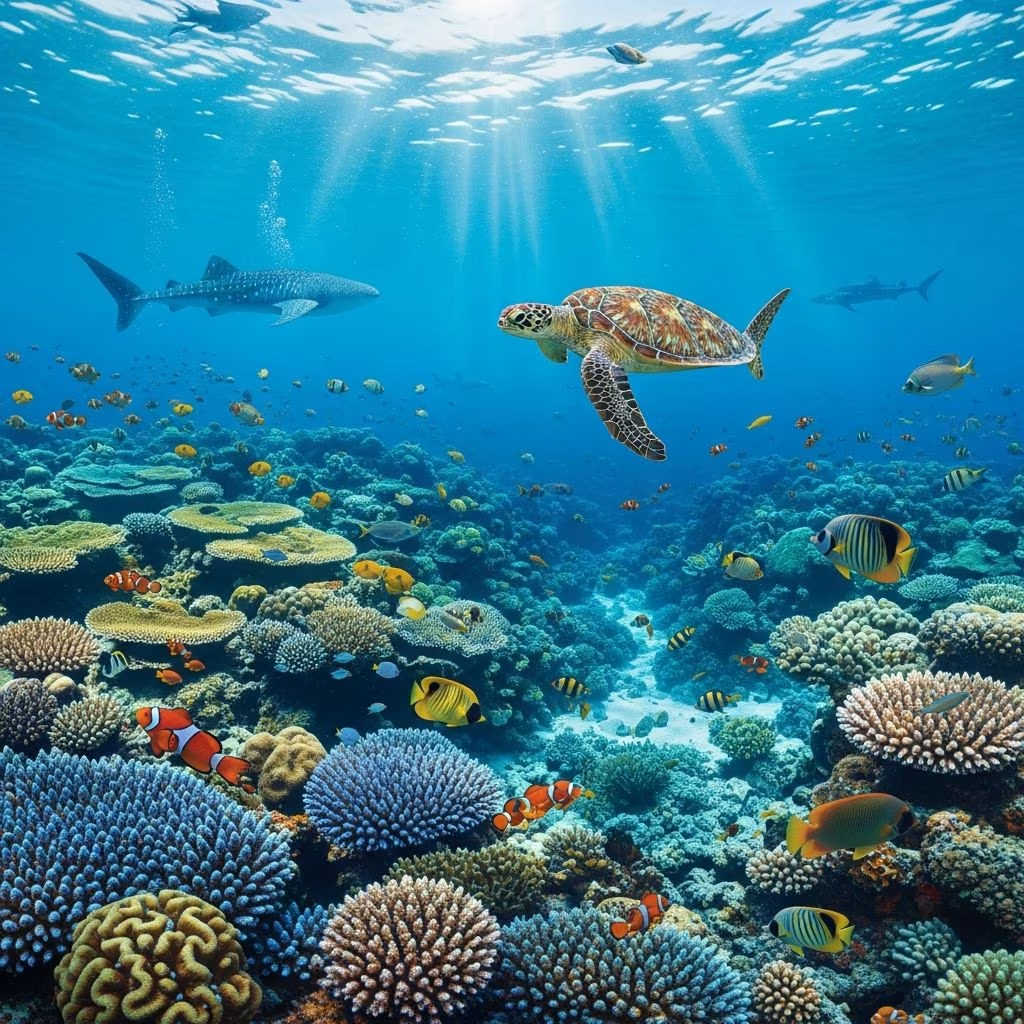
The Great Barrier Reef represents one of Earth’s most remarkable natural achievements, a sprawling underwater kingdom that stretches across thousands of kilometers along Australia’s eastern coastline. This extraordinary ecosystem has captivated scientists, explorers, and nature enthusiasts for generations, yet its full complexity and fragility have only recently become subjects of widespread global attention. Through innovative documentary storytelling and interactive digital platforms, nature’s greatest communicators have brought the reef’s wonders and vulnerabilities into the homes and hearts of millions worldwide.
The sheer scale of the Great Barrier Reef defies easy comprehension. Stretching approximately 2,300 kilometers along the eastern Australian coast, this natural structure covers an area of roughly 344,400 square kilometers—equivalent to the landmass of Italy—making it more than twice the size of any other coral reef system on the planet. This immense geographical footprint encompasses countless individual reef formations, deep channels, and shallow lagoons that together create a mosaic of diverse habitats.
The biodiversity contained within this vast marine territory is equally staggering. The reef supports more than 1,500 species of fish, representing an extraordinary diversity of shapes, sizes, and behaviors adapted to reef life over millions of years. Alongside these fish populations, approximately 600 distinct coral species form the structural foundation of the ecosystem, creating the intricate three-dimensional architecture that defines reef habitats. Marine megafauna is equally impressive, with roughly 30 different whale and dolphin species visiting or inhabiting reef waters at various times throughout the year.
One of the most fascinating aspects of Great Barrier Reef ecology that has captured scientific attention in recent years involves the acoustic environment created by its inhabitants. The reef generates a continuous symphony of biological sounds—clicks, snaps, grunts, and pops—produced by fish and invertebrates as they navigate their daily lives. This soundscape serves crucial functions far beyond mere acoustic ambiance; it represents a fundamental communication network essential to reef survival and reproduction.
Young clownfish, among the reef’s most iconic residents, rely entirely on this acoustic landscape during one of the most critical phases of their lifecycle. After spending their first weeks in open ocean waters, juvenile clownfish must locate and navigate back to reef habitats to establish permanent residence. Rather than visual cues or chemical signals alone, these fish actively search for specific sound frequencies emanating from healthy reef ecosystems. The presence of rich, varied acoustic signatures indicates thriving biological communities, whereas degraded reefs produce noticeably diminished soundscapes that signal danger or insufficient resources.
This acoustic navigation system demonstrates an elegant evolutionary adaptation but simultaneously reveals a vulnerability. When reef health deteriorates due to environmental stressors, the reduction in biodiversity directly translates to a quieter reef. Fewer species mean fewer organisms producing sounds, creating what researchers describe as an acoustic dead zone that young fish cannot effectively locate or navigate toward. This mechanism illustrates how environmental degradation cascades through ecosystem functions at scales rarely visible to casual observation.
Scientific research institutions positioned throughout the reef region work continuously to unravel the reef’s operational complexity. The Australian Institute of Marine Science (AIMS) in Townsville, Queensland, has become a crucial hub for understanding and addressing contemporary threats to reef health. These research centers focus on monitoring ocean temperature fluctuations, measuring changes in water chemistry and acidity levels, and developing strategies to help coral species cope with rapidly escalating thermal stress.
Research stations like those on Lizard Island position scientists at the frontline of both discovery and conservation, offering opportunities to observe reef processes in real time while implementing protective measures against invasive species and environmental degradation. The collaborative nature of modern reef research means that expertise flows internationally, with academic institutions from around the world contributing specialized knowledge to collective conservation efforts.
Despite the reef’s remarkable resilience demonstrated across geological timescales, contemporary environmental pressures present unprecedented challenges. Rising ocean temperatures and increasing water acidity directly threaten the survival of coral polyps and the countless organisms dependent on reef structures. The primary driver of these changes stems from atmospheric carbon dioxide concentrations, which have increased dramatically since industrialization. As carbon dioxide levels rise, greater quantities dissolve into ocean water, chemically transforming it into carbonic acid and fundamentally altering marine chemistry.
This acidification process undermines the reef’s ability to build and maintain calcium carbonate structures, essentially preventing corals from constructing and repairing their skeletal foundations. Simultaneously, warmer ocean temperatures trigger stress responses in corals, leading to bleaching events where symbiotic algae—responsible for producing much of the coral’s nutritional energy—are expelled from coral tissues. Without these algal partners, corals starve and die, leaving behind ghostly white skeletons that mark ecological collapse.
Scientific projections presented in contemporary documentary work have raised alarms about the reef’s long-term viability. Some researchers estimate that without dramatic reductions in carbon emissions and swift global climate action, coral reef ecosystems could face functional extinction within the present century. The Great Barrier Reef, as the world’s most extensively studied and economically valuable coral system, has been designated as a “canary in the coal mine” for global reef health—its fate serving as an indicator of broader marine ecosystem collapse risks.
Not all scientific assessments conclude with absolute pessimism. Experts emphasize that reef degradation remains a partially reversible process, provided humanity undertakes sufficient climate action within the next critical decades. The fundamental solution involves transitioning away from fossil fuel consumption toward renewable energy sources, thereby reducing atmospheric carbon dioxide accumulation. This transition represents a civilizational-scale challenge requiring coordinated policy action, technological innovation, and shifts in energy infrastructure globally.
Beyond emissions reduction, direct intervention strategies are being explored and implemented. Some researchers advocate for active coral restoration programs involving fragmentation, breeding, and assisted reproduction of resilient coral strains. These interventions remain experimental but represent attempts to maintain genetic diversity and biological function even as environmental conditions deteriorate. Additionally, marine protected area management, fishing regulation, and pollution control contribute to reducing secondary stressors that compound temperature and acidity impacts.
Recognizing that conservation success depends partly on public understanding and engagement, innovative digital platforms have emerged to bring reef ecosystems into direct, interactive contact with global audiences. Interactive websites combining cutting-edge technology with narrative expertise allow users to explore reef geography, biodiversity, and research in real time. These platforms represent a democratization of marine science, enabling anyone with internet access to witness ongoing research and discover reef wonders previously accessible only through television documentation or expensive travel.
This digital accessibility serves crucial educational functions, particularly for younger generations whose environmental consciousness will shape future policy and conservation commitment. By visualizing reef complexity through interactive media, audiences develop intuitive understanding of ecosystem interconnections and appreciate the ecological stakes involved in climate policy decisions.
The Great Barrier Reef’s importance extends far beyond its borders. As the world’s most extensive coral ecosystem, it represents an unparalleled natural laboratory for understanding tropical marine biology, coral physiology, and reef ecology. Scientific discoveries made on the reef have generated insights applicable to reef conservation efforts globally. Additionally, the reef supports tourism economies, provides fisheries resources, and contributes to global biodiversity preservation efforts.
The convergence of recreational, economic, scientific, and conservation interests around the reef creates both opportunities and tensions. Balancing tourism development with ecosystem protection, managing fishing sustainability, and prioritizing conservation while supporting regional economies requires sophisticated governance frameworks and sustained international cooperation.
The Great Barrier Reef stands at an ecological crossroads. The decisions humanity makes regarding energy production, emissions reduction, and climate policy over the next decade will substantially determine the reef’s fate beyond 2050. Simultaneously, the reef’s remarkable adaptive capacity, demonstrated through its survival of past environmental disruptions, suggests that complete ecological collapse is not inevitable provided sufficient human action materializes.
The reef’s story, as told through modern scientific documentation and interactive media, has become an urgent call to global environmental responsibility. Every coral species preserved, every young fish successfully navigating home via acoustic signals, and every degree of warming prevented through renewable energy adoption contributes to the reef’s continued existence. The question facing current and future generations is not whether the reef can be saved—scientific evidence suggests it can—but whether humanity will summon the collective will to implement necessary changes.
