

 Travel Essentials
 Travel Essentials

The Great Barrier Reef’s outlook has been downgraded to very poor as climate change drives bleaching, ecosystem loss, and growing economic risk.
 Travel Essentials
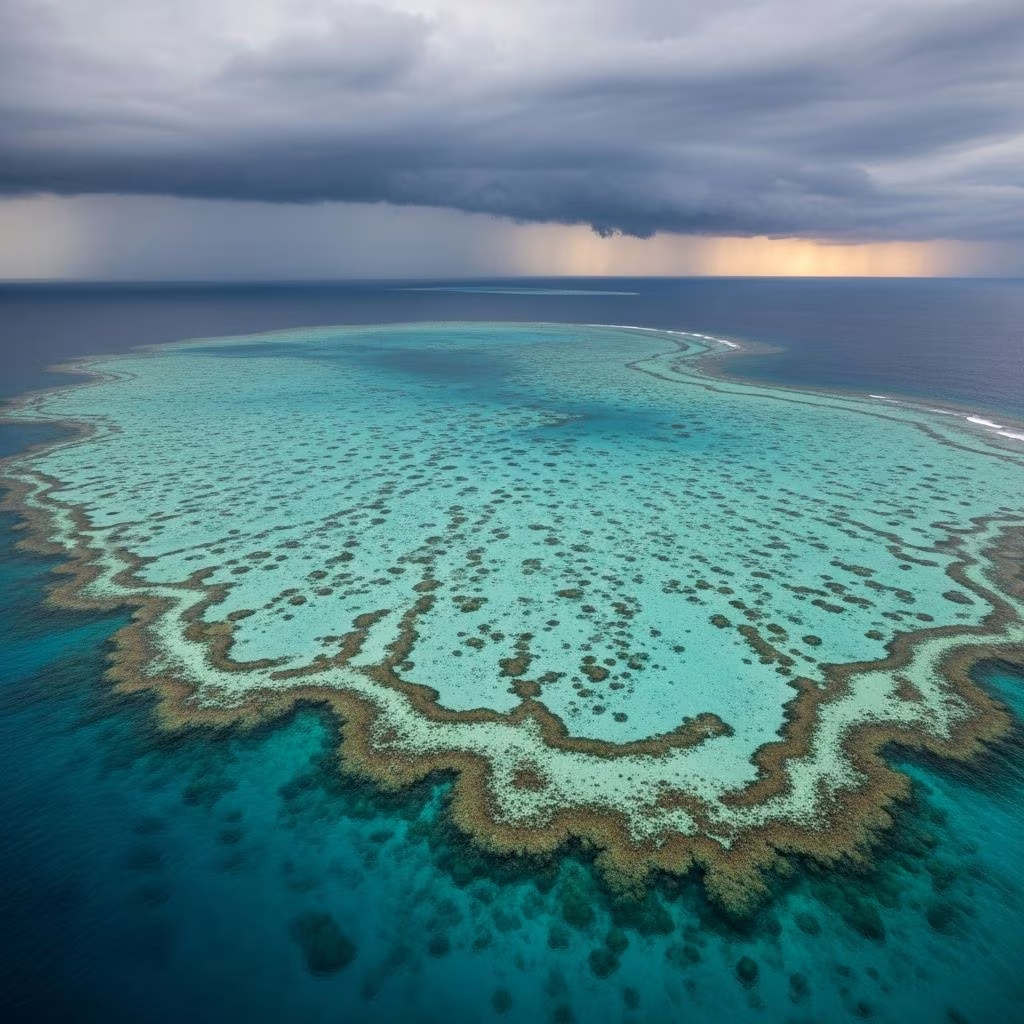
The iconic Great Barrier Reef, the world’s largest coral system, has received a stark warning in its latest five-yearly assessment. Authorities have shifted the overall outlook from poor to very poor, signaling accelerated decline primarily from climate-driven stressors like ocean warming and mass bleaching events.
Stretching over 133,360 square miles off Australia’s northeast coast, the Great Barrier Reef supports 25% of all marine species, provides livelihoods for half a billion people globally, and serves as a natural pharmacy for medical breakthroughs. Its health mirrors planetary well-being; its loss would foreshadow broader ecosystem collapses.
Declared a UNESCO World Heritage site, the reef’s outstanding universal value persists, but its integrity is under severe strain from cumulative threats.
Climate change tops the list of dangers, with rising sea temperatures triggering unprecedented bleaching. Corals expel symbiotic algae under heat stress, leading to starvation and death. Recent events have expanded damaged areas, hindering recovery.
These factors are multiple, cumulative, and intensifying, overwhelming the reef’s natural resilience.
| Report Year | Outlook Rating | Main Concerns |
|---|---|---|
| 2009 (First) | Poor | Initial signs of deterioration from bleaching and starfish. |
| 2014 (Second) | Poor | Increasing pressures noted. |
| 2019 (Third) | Very Poor | Expanded bleaching, climate dominance. |
| 2024 (Fourth) | Very Poor | Ongoing climate threats despite some recoveries. |
The 2024 report, the fourth in the series, highlights that while some areas rebounded due to low-disturbance periods, the trajectory points to future worsening without global intervention.
Not all news is dire. Fast-growing corals on mid- and offshore reefs have shown significant recovery, thanks to decades of protection. Seagrass meadows have also improved, demonstrating inherent resilience.
Management triumphs include:
Research confirms these actions enhance recovery capacity from disturbances, buying precious time.
The reef generates billions in tourism and fishing revenue annually. Degradation threatens jobs, indigenous communities, and global biodiversity. Irreversible losses could erase ecological, heritage, and economic values.
Projections warn that without emission cuts, the reef as we know it could vanish by 2050, with 2°C warming sealing its fate.
Local efforts alone fall short; significant international climate action is essential to curb warming and bolster recovery. Experts stress dramatic greenhouse gas reductions within the next decade.
UNESCO’s World Heritage Committee may reclassify the site as “in danger,” prompting heightened scrutiny.
Australia’s dual-government investments prioritize:
These complement global Paris Agreement goals, emphasizing urgency.
At current trajectories, frequent bleaching stymies regrowth. Beyond 2°C, protection becomes untenable. Models predict near-total loss by mid-century absent intervention.

Escalating climate impacts like ocean warming and bleaching, atop ongoing threats from starfish and pollution.
Partial recoveries occur in low-stress areas, but full resilience requires global emission cuts.
Heat stress expels algae, causing whitening and death; frequency outpaces recovery.
Starfish culling, water quality programs, and Reef 2050 Plan drive local wins.
Many areas remain vibrant, but sustainable practices are key to avoid further harm.
Innovations like solar-powered cooling for corals and genetic selection for heat-tolerant strains offer promise. Community involvement, from divers removing starfish to farmers reducing runoff, amplifies official efforts.
International collaboration must accelerate: curbing coal exports, advancing renewables, and funding adaptation. The reef’s plight underscores that no ecosystem is too vast to fail.
With windows of recovery still open, unified action can preserve this natural marvel for generations.
