

 Travel Essentials
 Travel Essentials

Explore Green Bank, the quietest town in America, nestled in a vast radio quiet zone protecting groundbreaking astronomy from modern noise. Uncover its unique lifestyle and scientific wonders.
 Travel Essentials
In an era dominated by constant connectivity, Green Bank, West Virginia, emerges as a remarkable outlier—a town where silence is not just golden, but scientifically essential. Home to the Green Bank Observatory and at the epicenter of the United States National Radio Quiet Zone (NRQZ), this unassuming community of fewer than 150 residents has carved out a unique existence free from the buzz of cell phones, Wi-Fi, and other electromagnetic disturbances. Spanning approximately 13,000 square miles across West Virginia, Virginia, and a sliver of Maryland, the NRQZ enforces strict regulations to protect sensitive radio astronomy equipment from interference, creating an environment where the faintest whispers from the universe can be heard.
The story of Green Bank begins in 1958 when the Federal Communications Commission (FCC) established the NRQZ to safeguard operations at the newly constructed radio telescopes in Green Bank and the nearby Sugar Grove Station. This vast rectangle—roughly 107 miles on its north edge, 109.6 miles south, and up to 120.9 miles east-west—straddles the Blue Ridge and Allegheny Mountains, with its geographic center near Monterey, Virginia. The zone’s coordinates precisely define its boundaries: latitudes from 37°30’0.4″ N to 39°15’0.4″ N and longitudes from 78°29’59.0″ W to 80°29’59.2″ W.
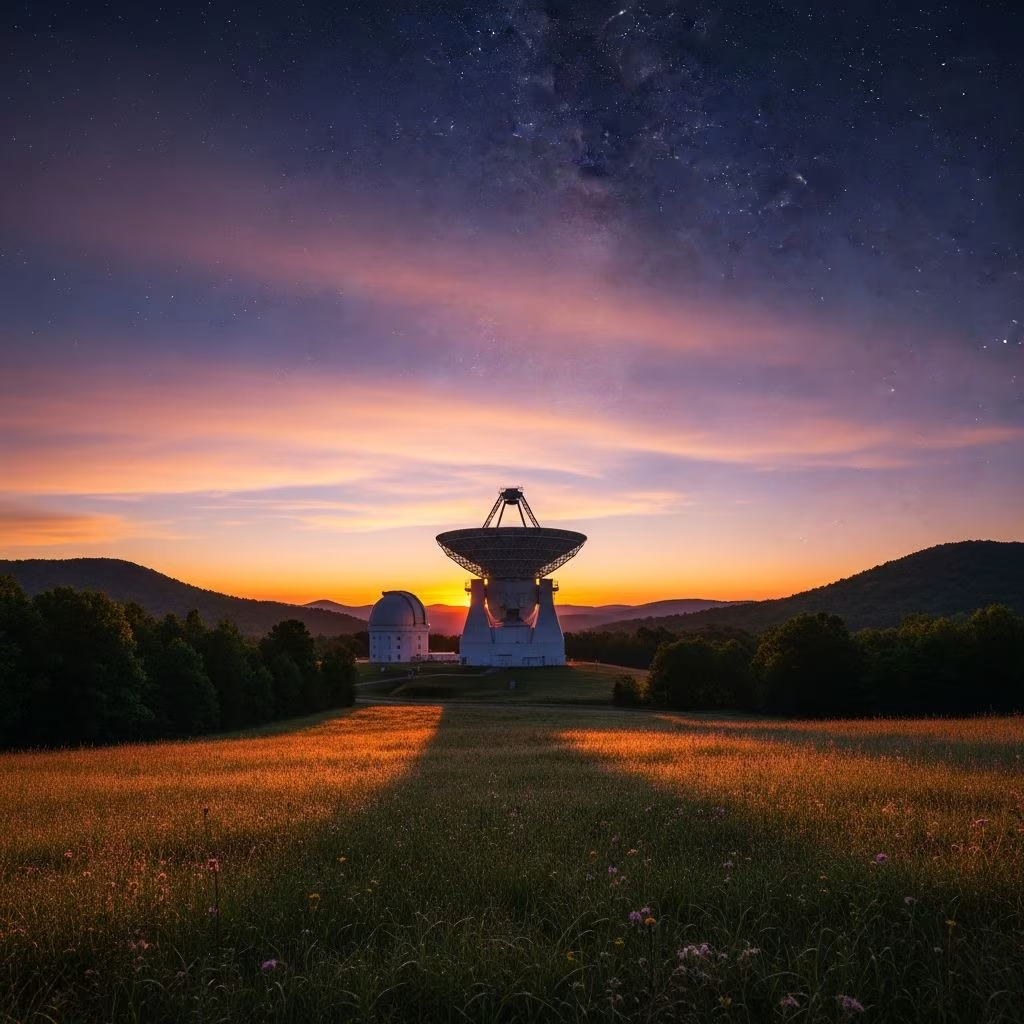
At the heart of it all lies the Green Bank Observatory, once featuring the world’s largest fully steerable radio telescope until its collapse in 2020. Today, it houses other massive instruments, including the 300-foot telescope reimagined for new research, dedicated to probing pulsars, fast radio bursts, and the search for extraterrestrial intelligence (SETI). Sugar Grove, an intelligence outpost, complements these efforts, underscoring the dual civilian and military importance of this quiet domain.
Daily existence in Green Bank revolves around adaptation to an analog world. Residents and visitors alike surrender modern conveniences: no cell service, no standard Wi-Fi routers, no microwaves that could emit stray signals. Landline phones persist, and internet arrives via slow, shielded cables or satellite links approved by regulators. The local observatory employs ‘radio frequency police’—monitors who sweep the area for violations using specialized detectors.
Yet, this isolation fosters a tight-knit community. With a population hovering around 143, locals rely on word-of-mouth, bulletin boards, and occasional trips outside the zone for connectivity. Schools teach with limited tech, emphasizing hands-on learning, while businesses like the local inn and observatory gift shop cater to those seeking respite from urban clamor. One resident likened it to ‘stepping back in time,’ where evenings fill with stargazing rather than screen scrolling.
| Prohibited Technologies | Permitted Alternatives |
|---|---|
| Cell phones (standard) | Landlines, approved low-power devices |
| Wi-Fi routers (> certain power) | Wired ethernet, shielded networks |
| Microwave ovens | Conventional ovens, approved models |
| Wireless baby monitors | Wired monitors |
Exceptions prioritize public safety: emergency repeaters, NOAA Weather Radio, and remote alarms receive case-by-case approvals. Fines for violations can reach thousands, ensuring compliance and preserving the zone’s integrity.
The NRQZ’s silence has yielded profound scientific dividends. Green Bank’s telescopes have detected over 2,000 pulsars—rapidly spinning neutron stars—since Jocelyn Bell Burnell’s 1967 discovery of the first. Recent breakthroughs include mapping the Milky Way’s magnetic fields and hunting fast radio bursts (FRBs), mysterious millisecond signals possibly from distant galaxies.
In SETI pursuits, the Big Ear and Allen Telescope Array predecessors scanned for alien signals, while ongoing projects like Breakthrough Listen utilize Green Bank’s assets. Military applications at Sugar Grove enhance signals intelligence, free from domestic noise. This synergy positions the zone as a global hub for passive radio listening, where natural emissions from space outshine artificial ones.
Beyond science, Green Bank beckons travelers craving disconnection. The observatory offers public tours, daytime programs, and star parties under some of the darkest skies in the eastern U.S. Hike Pocahontas County’s trails, fish in the Williams River, or explore Snowshoe Mountain Resort just outside the zone.
Stay at the quiet inn or camp amid whispering pines. Local eateries serve hearty diner fare—no apps needed for ordering. Events like the annual Quiet Zone festival celebrate this peculiar paradise, drawing astronomers, off-gridders, and silence seekers.
Maintaining silence grows tougher amid 5G expansion and satellite constellations like Starlink. The FCC monitors incursions, but advocacy from the observatory pushes for protections. Recent studies affirm the zone’s irreplaceable role, with no comparable U.S. site matching its scale and low interference baseline.
Climate change indirectly threatens via increased solar activity disrupting observations, prompting resilient tech upgrades. Community resilience shines, with residents viewing restrictions as a badge of honor safeguarding humanity’s cosmic window.
Travelers must prepare: disable phones upon entry (store in Faraday bags), use wired devices, and check observatory schedules. The 4-hour drive from major airports underscores remoteness. Spring and fall offer mild weather; summers bring fireflies illuminating unpolluted nights.
The NRQZ is a 13,000-square-mile region where radio transmissions are severely restricted to prevent interference with radio astronomy and intelligence operations.
Standard cell phones don’t work; use landlines or drive outside the zone. Low-power, approved devices may be permitted.
Its telescopes detect faint cosmic signals impossible elsewhere due to the enforced radio silence.
Yes, with standard precautions; the community welcomes respectful guests interested in science and nature.
It covers about 13,000 square miles, larger than several U.S. states like Connecticut.
Green Bank exemplifies how intentional silence amplifies discovery—both stellar and personal. In a hyper-connected world, this haven reminds us that sometimes, tuning out the noise reveals the universe’s grandest secrets. Whether for research, reflection, or recharge, America’s quietest town offers an unparalleled retreat.
