

 Travel Essentials
 Travel Essentials

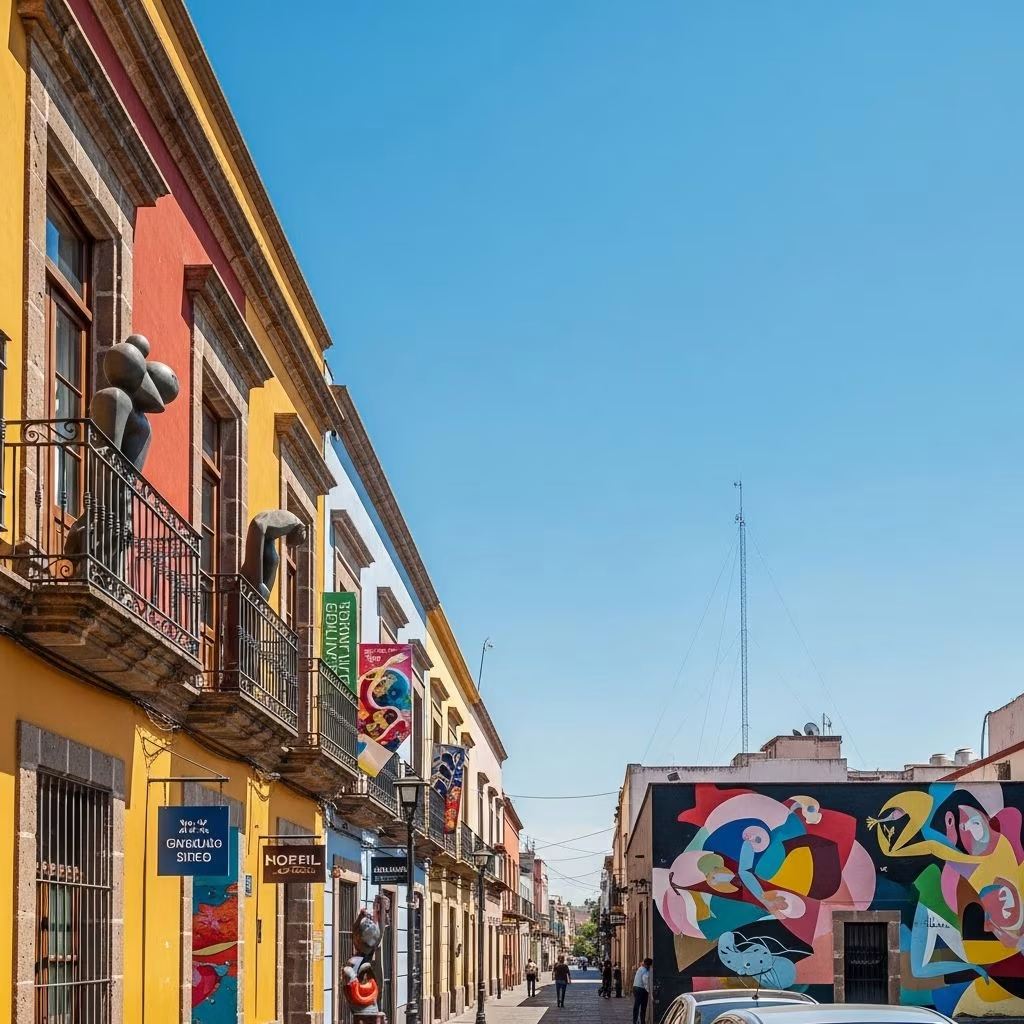
Guadalajara has transformed into a major contemporary art destination, attracting artists, collectors, and cultural enthusiasts with innovative galleries, creative spaces, and a vibrant artistic community.
 Travel Essentials
For decades, Mexico City stood as the undisputed epicenter of artistic ambition in Mexico. Aspiring painters, sculptors, and conceptual artists viewed the capital as the only viable destination for serious creative careers. However, over the past two decades, a remarkable transformation has unfolded in Guadalajara, Mexico’s second-largest city. What was once considered a cultural backwater has evolved into a genuine alternative for artists seeking affordable studio space, collaborative opportunities, and the freedom to experiment without the intense competition of the capital.
This migration reflects broader patterns in global creative culture, where secondary cities increasingly offer advantages that larger metropolitan centers cannot match: lower real estate costs, emerging communities of like-minded practitioners, and governments that view cultural development as economic opportunity. In Guadalajara’s case, the convergence of these factors has created an unusually fertile environment for artistic innovation.
Guadalajara’s emergence as a cultural destination did not occur by accident. The city benefits from several structural advantages that have made it attractive to both established and emerging artists. The cost of living and commercial real estate remains substantially lower than Mexico City, allowing artists to maintain studios and galleries with significantly smaller overhead burdens. This economic advantage has been particularly crucial for enabling experimental and nonprofit artistic ventures that might struggle financially in more expensive urban centers.
The city’s infrastructure, while less developed than Mexico City’s in certain respects, has improved dramatically in recent years. Transportation networks, international flight connections, and telecommunications have all undergone modernization, reducing the practical isolation that might have deterred artists a generation ago. Additionally, Guadalajara’s role as the capital of Jalisco state has attracted institutional investment in cultural programming and support for creative industries.
The physical manifestations of Guadalajara’s art renaissance appear throughout the city’s vibrant neighborhoods. Several galleries have become internationally recognized for their curatorial vision and commitment to showcasing Latin American contemporary practice.
CURRO represents one of the most distinctive institutional voices in the city’s landscape. Founded by a Guadalajara native, the gallery specializes in conceptually challenging work by predominantly Latin American artists. What distinguishes CURRO extends beyond its programming to its architectural setting: the gallery occupies space within the Cube Tower, a futuristic structure designed by renowned architect Carme Pinós. This relationship between contemporary artwork and innovative architectural framing creates an intentional dialogue, where the physical properties of the gallery space become inseparable from artistic experience.
Páramo operates as the largest dedicated contemporary art gallery in Guadalajara, having been established in 2012. The gallery functions simultaneously as commercial space and institutional venue, hosting both for-sale exhibitions and nonprofit curatorial projects. This hybrid model represents an important innovation in how contemporary art institutions operate within emerging market contexts, particularly in Latin America where such dual mandates help ensure financial sustainability while maintaining cultural credibility.
Travesía Cuatro functions as a crucial bridge between European and Latin American artistic conversations. Operating from Casa Franco, a 1929 Mediterranean-style residence designed by Luis Barragán—the legendary pioneer of Mexican modernist architecture—the gallery literally inhabits history while engaging contemporary practice. The deliberate integration of cutting-edge contemporary work within a historically significant architectural frame creates a powerful statement about continuity within innovation.
Beyond commercial galleries, nonprofit and artist-run spaces have fundamentally shaped Guadalajara’s creative ecosystem. These institutions operate according to different logics than market-driven galleries, prioritizing artist development, community education, and experimental practice over commercial viability.
PAOS exemplifies this alternative institutional model. Founded by Los Angeles-based artist Eduardo Sarabio, PAOS occupies a historic building that once served as the studio of José Clemente Orozco, one of Mexico’s most significant muralist figures. By situating a contemporary art incubator within a space saturated with artistic history, PAOS creates a direct lineage between Mexico’s revolutionary muralist tradition and contemporary practice. The program emphasizes artist residencies, public education, and critical thinking about creative processes, actively contributing to the intellectual infrastructure that sustains artistic communities.
Cerámica Suro has emerged as another crucial institutional force.[10] Beginning as a ceramics-focused studio, the project has expanded to welcome close to 600 artists and now operates across multiple locations including spaces in Guadalajara proper and the Centro Histórico. This growth reflects the vibrancy of collaborative creative networks within the city.
The contemporary art scene in Guadalajara encompasses considerable institutional diversity. The following represents key operational approaches visible across the city:
The geographic distribution of galleries and creative spaces has catalyzed neighborhood-level transformations. Colonia Lafayette and Colonia Americana have emerged as particular focal points for artistic activity, attracting not only galleries but complementary cultural infrastructure including restaurants, bookstores, and design studios. This clustering creates self-reinforcing networks where creative practitioners encounter each other, collaborate, and collectively transform neighborhood character and economic conditions.
The Santa Teresita neighborhood represents another important creative zone, hosting newer gallery initiatives and artist studios while retaining distinctive local character. This balance between cultural dynamism and preservation of neighborhood identity distinguishes Guadalajara’s development from the more aggressive gentrification patterns visible in some other contemporary art cities.
Guadalajara’s creative maturation has coincided with increased international recognition. Institutional initiatives including Guadalajara Art Week have positioned the city as a venue for serious contemporary art discourse, attracting international collectors, curators, and critics. The exhibition La casa que nos inventamos: Contemporary Art From Guadalajara presented nearly 50 conceptual artworks by approximately 20 visual artists, demonstrating the depth of local talent and the city’s ability to mount sophisticated international exhibitions.
This international visibility creates feedback loops that strengthen the local scene: greater international attention attracts more ambitious international artists and institutions, which in turn generates enhanced visibility and resources for local practitioners. However, this process requires careful management to ensure that global integration does not come at the expense of local artistic autonomy or cultural specificity.
The transformation of Guadalajara’s art scene has been substantially enabled by individual entrepreneurs who have invested time, capital, and vision into building institutional infrastructure. José Noé Suro, a lawyer-turned-arts entrepreneur, has played a particularly significant role in this process. Such individuals function as catalysts, often taking substantial financial risks to establish galleries, residency programs, and other institutional platforms that would not exist through market forces alone.
The work visible in Guadalajara galleries demonstrates contemporary practice at sophisticated levels. Conceptual frameworks dominate across galleries, with installations, performances, paintings, and sculptures exploring philosophical questions about identity, space, materiality, and social structures. The preponderance of Latin American artists within many galleries reflects both regional artistic networks and deliberate curatorial choices to prioritize continental dialogue over exclusively local or international programming.
Those seeking to experience Guadalajara’s art scene should consider several planning factors:
| Gallery/Space | Key Characteristic | Access Note |
|---|---|---|
| CURRO | Experimental Latin American work | Located in architecturally significant Cube Tower |
| Páramo | Largest commercial gallery space | Regular exhibitions and institutional projects |
| Travesía Cuatro | European-Latin American bridge | Historic Casa Franco building |
| PAOS | Artist residencies and education | Historic Orozco studio location |
| Alma Colectiva | Private collection viewing | Appointment-based access |
Guadalajara’s contemporary art community continues evolving. New galleries including Castillo Interior, founded by all-women curatorial teams, introduce fresh perspectives and institutional voices. The city’s capacity to support artist residencies, exhibition platforms, and commercial galleries simultaneously suggests a mature creative ecosystem rather than a temporary trend.
However, continued growth raises important questions about sustainability, authenticity, and the balance between international visibility and local cultural priorities. The most significant challenge will be maintaining the conditions—economic accessibility, collaborative spirit, and curatorial autonomy—that have enabled Guadalajara’s artistic emergence while accommodating the greater international attention and investment that success inevitably attracts.
Guadalajara offers more affordable real estate, a collaborative atmosphere, and reduced competition for attention and resources. Many artists value the ability to experiment without the market pressures of Mexico City while still accessing international networks and institutional opportunities.
Most commercial galleries maintain regular visiting hours. Some spaces, particularly private collections like Alma Colectiva, require advance appointments. Planning ahead through gallery websites or local tourism offices ensures productive visits.
While Spanish remains the primary language, major galleries increasingly provide English-language materials, and many international artists and curators circulate through the scene. Tourist-focused galleries generally accommodate English-speaking visitors.
Guadalajara Art Week provides concentrated gallery programming and expanded accessibility. However, the scene remains active throughout the year with regular exhibitions, artist residencies, and cultural programming.
Guadalajara’s rich artistic heritage, particularly its muralist tradition, provides conceptual and historical reference points for contemporary artists. Many institutions deliberately maintain connections to this legacy while engaging contemporary innovation.
