

 Travel Essentials
 Travel Essentials

Explore Hadrian's Wall, the 73-mile Roman fortification built in AD 122. Learn its history, engineering marvels, key sites, and modern trails for visitors seeking adventure and ancient legacy.
 Travel Essentials
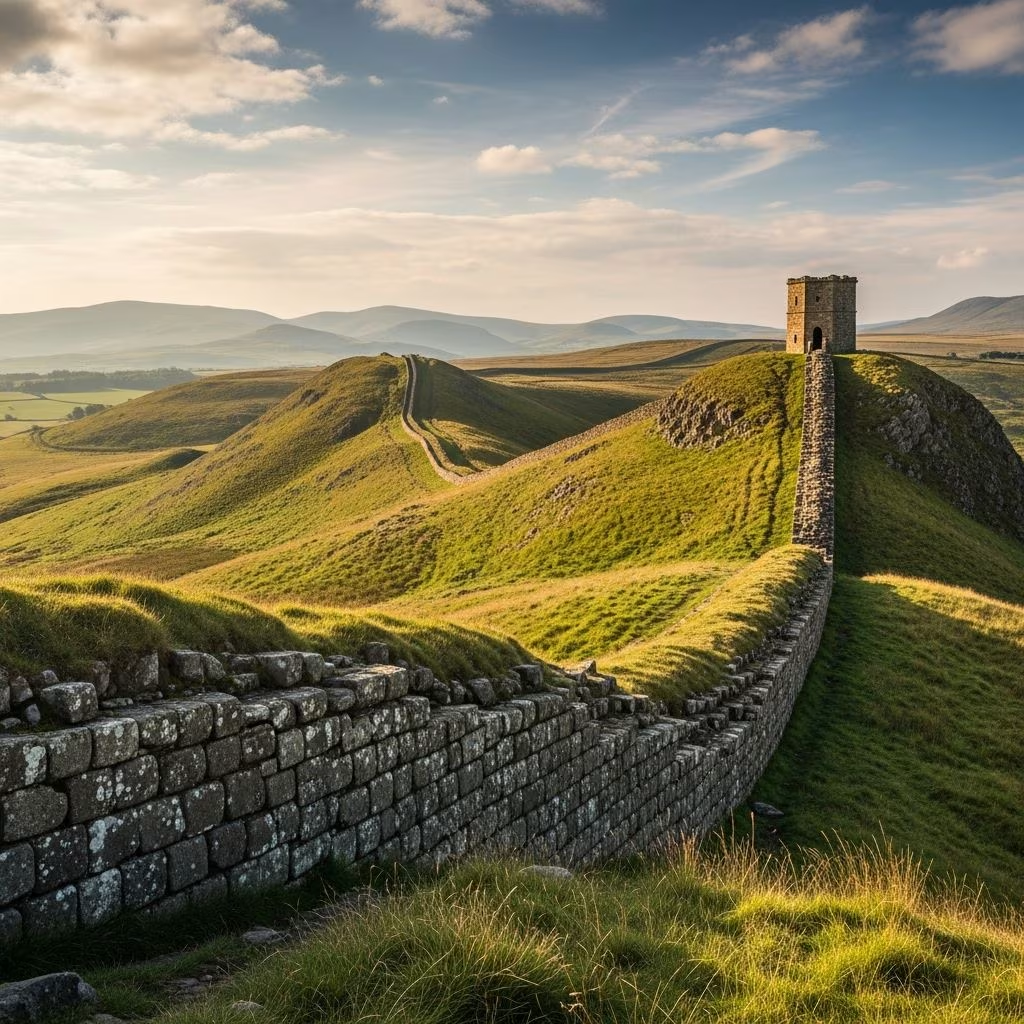
Stretching 73 miles across northern England, Hadrian’s Wall stands as one of the most impressive remnants of the Roman Empire. Constructed on the orders of Emperor Hadrian in AD 122, this fortification served as the northwestern boundary of Roman Britannia for nearly three centuries, separating Roman territories from northern tribes. Today, it captivates visitors with its rugged beauty, engineering prowess, and rich historical narrative, earning UNESCO World Heritage status in 1987.
Emperor Hadrian ascended to power in AD 117 amid challenges to Roman expansion. Rather than pushing further north into unconquered lands, he adopted a defensive policy, consolidating control over existing provinces. During his visit to Britannia in AD 122, he initiated the wall’s construction to demarcate the frontier from the River Tyne in the east to the Solway Firth in the west. A biographer noted Hadrian as ‘the first to build a wall 80 Roman miles long from sea to sea to separate the barbarians from the Romans,’ highlighting its symbolic role.
The wall addressed raids from Caledonian tribes in what is now Scotland, acting not just as a barrier but as a controlled checkpoint system. It slowed invaders, monitored movement through gates, and projected Roman authority—possibly whitewashed to gleam under the sun, visible for miles. Beneath it lay the Stanegate road, linking forts and facilitating military logistics.
Building Hadrian’s Wall was a monumental task involving around 15,000 soldiers over six years. The structure varied: stone in the east, turf in the wetter west, averaging 10-15 feet high and up to 10 feet wide with a flat top for patrols. Every Roman mile featured a milecastle—a small gatehouse fortress—while turrets between them served as watchpoints.
Major forts like Housesteads and Birdoswald housed garrisons of up to 1,000 troops each. A accompanying ditch and vallum (earth bank) enhanced defenses. This network channeled traffic, imposed taxes, and gathered intelligence, turning the frontier into a bustling administrative zone.
| Feature | Description | Spacing |
|---|---|---|
| Milecastles | Gatehouses for controlled passage | Every 1 Roman mile |
| Turrets | Observation posts | Between milecastles (1/3 mile apart) |
| Forts | Major garrisons | Every 5-12 miles |
| Wall Height | Avg. 3-4.5 meters | Continuous |
The wall underwent modifications. Emperor Antoninus Pius briefly shifted the frontier north to the Antonine Wall around AD 142, but it was soon reoccupied. In the late 4th century, as Rome faced internal strife, the wall fell into disuse, abandoned by AD 410 with Roman withdrawal from Britain.
Medieval locals repurposed stones for churches and farms, yet substantial sections endure, revealing inscriptions, altars, and soldier graffiti that offer glimpses into daily life—from baths to temples dedicated to Roman gods.
These sites, managed by English Heritage and others, provide interactive museums and guided tours.
The 84-mile Hadrian’s Wall Path National Trail traces the frontier, traversable in 6-8 days for experienced hikers. Highlights include the dramatic Crags section with sycamore-framed vistas popularized in media.
Shorter options abound: the 7-mile Housesteads to Steel Rigg route offers rugged terrain and viewpoints; family-friendly stretches near Hexham blend history with countryside. Cyclists can follow Sustrans Route 72, while accessibility paths cater to all.
Best visited May-September for weather and daylight. Base in Hexham, Carlisle, or Bardon Mill for transport links. Book accommodations early—B&Bs, campsites, and glamping suit budgets. Pack layers, sturdy boots, and rain gear; apps like OS Maps aid navigation.
Combine with nearby attractions: Roman Army Museum in Carvoran or Corbridge fort. Public buses and the Hadrian’s Wall Country Bus link sites.
Conservation efforts by UNESCO, English Heritage, and Hadrian’s Wall Partnership protect against erosion, tourism, and climate change. Volunteer programs allow participation in digs, ensuring this frontier’s story endures.
Approximately 73 miles (118 km) from Wallsend to Bowness-on-Solway.
To define Rome’s northwestern frontier, control movement, and deter northern raiders.
Yes, via the Hadrian’s Wall Path, a National Trail suitable for multi-day hikes.
Trail access is free; forts charge entry (e.g., £12-15 adult for Housesteads).
Summer for hiking, though shoulder seasons offer fewer crowds.
