

 Travel Essentials
 Travel Essentials

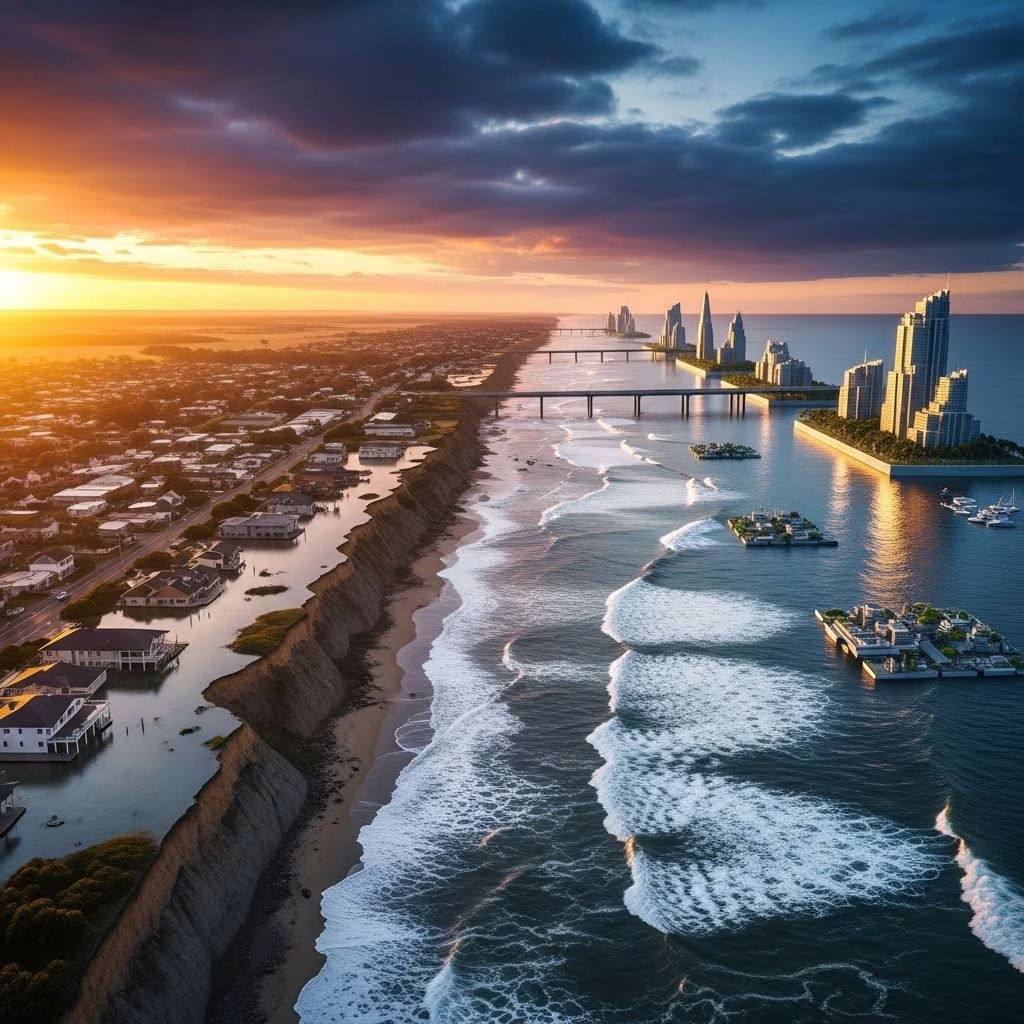
Research shows 50% of sandy beaches globally face near-extinction by 2100, with severe implications for tourism, ecosystems, and coastal communities worldwide.
 Travel Essentials
Sandy beaches represent one of Earth’s most valuable natural resources, covering over 30 percent of the world’s coastlines and providing critical ecological, economic, and cultural functions for billions of people. Yet emerging scientific evidence paints a sobering picture: without significant climate action and coastal management interventions, nearly half of these beaches could vanish entirely by the year 2100. This unprecedented transformation would reshape global tourism industries, eliminate vital storm protection systems, and threaten the livelihoods of millions living in coastal communities.
The findings stem from comprehensive research combining 35 years of satellite observations with 82 years of climate projections and over 100 million storm simulations, providing the most detailed global assessment of future shoreline dynamics to date. The implications extend far beyond environmental concerns, touching economic, social, and geopolitical dimensions that will require coordinated international response.
The magnitude of potential beach loss varies dramatically across different regions, with certain nations facing particularly acute challenges. Research published in Nature Climate Change reveals that multiple countries could lose more than 80 percent of their sandy coastlines by 2100 under current trajectory scenarios. Countries including Congo, Suriname, Comoros, Benin, Pakistan, Guinea, and El Salvador face the prospect of near-complete elimination of their sandy shores.
When measuring total linear distance of threatened coastline, Australia emerges as potentially the most affected nation, with between 12,324 and 15,439 kilometers of sandy coastline under threat from erosion. This staggering figure represents approximately 50 percent of Australia’s sandy beaches. Canada follows as the second-most vulnerable country by total length, with up to 8,963 miles of coastline at risk, followed by Chile, Mexico, and China. The United States ranks fifth globally, with approximately 3,436 miles of vulnerable sandy beaches.
Within the United States, regional variation proves significant. California faces particularly severe projections, with estimates suggesting up to 70 percent of the state’s sandy beaches could disappear by 2100. This concentration of losses in economically important coastal regions raises urgent questions about adaptation and mitigation priorities.
Multiple interconnected factors drive the projected shoreline retreat, with sea level rise playing the dominant role in most global locations. Rising ocean levels, driven by thermal expansion of warming seawater and accelerating ice sheet melting, fundamentally alter the equilibrium between land and sea. Moderate greenhouse gas emission reductions could prevent up to 40 percent of the globally projected shoreline retreat by century’s end, demonstrating that sea level rise represents a partially addressable driver of beach loss.
Beyond climate-driven sea level rise, human interventions and coastal development practices significantly amplify erosion pressures. Unauthorized sand mining for construction purposes disrupts the natural sediment balance that maintains beach stability, rendering coastlines increasingly vulnerable to wave action and storm surge. Infrastructure development, including highway construction through coastal zones, further destabilizes beach systems.
Population growth and urbanization intensify these pressures, particularly in densely populated coastal regions. As more people migrate toward shorelines seeking economic opportunity, increased tourism, construction, and resource extraction accelerate erosion processes. These human-driven factors often prove amenable to management interventions, offering opportunities for strategic coastal planning to mitigate losses.
West African countries face particularly acute vulnerability due to the combination of sea level rise and coastal development pressures. Landmark Beach in Lagos, Nigeria represents the most severely threatened beach globally, projected to shrink by more than 918 meters by 2100. Multiple factors converge to create this crisis: rising seas, planned superhighway construction running through nine coastal states with five lanes on each side, and widespread unauthorized sand mining that disrupts sediment dynamics. Governance challenges and resource limitations further constrain coastal protection implementation.
Cyprus exemplifies the Mediterranean’s vulnerability to dramatic shoreline retreat. The island’s coastlines already experience significant erosion, with certain areas losing up to 50 centimeters of coast annually. Mackenzie Beach ranks as the second-most threatened beach globally, projected to shrink by 660.9 meters by 2100. Scientists warn that up to 72 percent of Cyprus’s beaches could entirely disappear by 2100, despite completed coastal protection projects in areas including Paphos, Larnaca, Germasogeia, and Polis Chrysochous.
The Netherlands demonstrates a contrasting example through proactive management. Sustained nourishment policies—artificially replenishing beach sand—have proven effective in maintaining sufficient beach width to accommodate projected sea level rise of up to 1 meter and extreme storm impacts through 2100.
Small island developing states represent particularly vulnerable populations, as sandy beaches constitute their primary natural assets for tourism and often their main defense against storm surge and tropical cyclones. Many of these nations lack the financial and technical resources necessary for sophisticated coastal adaptation strategies, creating asymmetric vulnerability despite having contributed minimally to global greenhouse gas emissions.
The disappearance of sandy beaches would trigger cascading ecological and economic impacts far exceeding simple loss of recreational space. Beaches function as critical habitats for specialized species and as nurseries for commercially important fish populations. Their elimination would represent irreversible biodiversity loss for many coastal ecosystems.
The socioeconomic implications prove particularly severe for tourism-dependent communities where sandy beaches constitute the primary economic engine. Millions of jobs in hospitality, recreation, and related service sectors depend upon functional, accessible beaches. The loss of these natural attractions would devastate local economies and create humanitarian challenges across multiple continents.
For developing nations already facing economic pressures, beach loss represents an additional constraint on development opportunities. Countries that depend upon beach tourism to generate foreign exchange and employment face the prospect of economic collapse in coastal regions.
Critically, the projected beach losses are not inevitable. Research demonstrates that even moderate climate change mitigation could prevent substantial portions of this shoreline retreat. Specifically, moderate greenhouse gas emission reductions could prevent 17 percent of shoreline retreat by 2050 and 40 percent by 2100 globally. This finding provides essential perspective: while significant losses appear unavoidable given existing atmospheric carbon concentrations, the magnitude of future losses remains partially within human control.
Beyond global climate action, site-specific coastal management practices offer localized protection opportunities. Sustainable coastal zone management can mitigate erosion through mechanisms including strategic sand nourishment, restoration of natural coastal vegetation, construction of living shorelines that combine ecological function with wave attenuation, and protection of sediment supply systems. The Dutch experience demonstrates that sustained commitment to beach nourishment policies can maintain functional beaches despite substantial sea level rise.
Emerging approaches emphasize nature-based coastal defense strategies that provide multiple co-benefits beyond simple erosion control. Marsh restoration, mangrove protection, oyster reef establishment, and seagrass meadow conservation offer wave energy dissipation while supporting biodiversity and fisheries productivity. These approaches often prove more sustainable and cost-effective than traditional hard engineering solutions such as seawalls.
Coastal communities are increasingly adopting these nature-based strategies despite constrained federal climate support. Regional policy campaigns and coordinated coastal adaptation initiatives demonstrate that determined action at community and regional scales can achieve measurable resilience gains even within a context of substantial climate change.
Which beaches face the greatest immediate threat? Landmark Beach in Nigeria (918.3 meters projected loss) and Mackenzie Beach in Cyprus (660.9 meters projected loss) represent the most severely threatened beaches globally. Densely populated coastal areas and regions with high sand mining activity face particularly acute near-term erosion.
Can beach loss be prevented entirely? Complete prevention appears unrealistic given existing atmospheric carbon concentrations and committed sea level rise. However, moderate climate mitigation could prevent 40 percent of projected losses by 2100, and local adaptation strategies can protect specific beaches.
Why do some countries face greater beach loss than others? Vulnerability depends upon multiple factors including latitude (equatorial regions often experience greater relative sea level rise), coastal geology, population density, economic resources for adaptation, and existing coastal development patterns.
What makes sand nourishment effective? Strategic sand replenishment restores the sediment balance necessary for beach stability, allowing beaches to migrate landward rather than simply disappearing. The Netherlands has demonstrated this approach’s effectiveness when sustained over decades.
How will beach loss affect global tourism? Tourism-dependent economies, particularly in small island developing states, face potential collapse as their primary natural attractions disappear. Global tourism patterns will necessarily shift, with significant economic consequences for affected regions.
The projected transformation of global coastlines by 2100 demands urgent, coordinated action across multiple scales. Individual nations must develop country-specific coastal adaptation strategies accounting for their particular geographic, economic, and social contexts. International cooperation should facilitate technology transfer, financial support for vulnerable nations, and coordinated emissions reduction.
Investments in nature-based coastal solutions offer multiple co-benefits and prove increasingly cost-effective compared to conventional approaches. Protecting sediment supply systems, restricting unauthorized sand mining, and restoring coastal vegetation should constitute core elements of coastal management frameworks.
Perhaps most fundamentally, sustained commitment to greenhouse gas emissions reduction remains essential. While local and regional adaptation strategies provide necessary resilience, only global climate action can address the sea level rise component driving much of the projected beach loss.
