

 Travel Essentials
 Travel Essentials

Discover the authentic filming locations of Hamnet, from Tudor villages to historic London sites, that recreated Elizabethan England for cinema.
 Travel Essentials
Chloé Zhao’s 2024 film adaptation of Maggie O’Farrell’s novel Hamnet presents a compelling reimagining of William Shakespeare’s family life, particularly focusing on his relationship with Anne Hathaway and the tragedy that shaped his most famous work. Rather than filming in the obvious location of Stratford-upon-Avon itself, the production team made the strategic decision to seek out alternative settings that would authentically represent the period while avoiding the modern infrastructure that crowds the historic market town. This decision led to a fascinating array of filming locations scattered across England and Wales, each carefully selected to transport audiences back to sixteenth-century England.
One of the primary obstacles facing any period film production involves balancing historical accuracy with practical filming logistics. Stratford-upon-Avon, despite being Shakespeare’s birthplace and the narrative heart of the story, presented significant complications for the production team. The town, now a bustling tourist destination with contemporary buildings, traffic, and modern amenities, would have required extensive set dressing and logistical coordination to convincingly portray the Elizabethan era.
Rather than attempting to transform such a prominent location, production designer Fiona Crombie and director Chloé Zhao opted to identify alternative venues that retained genuine period architecture and rural character. This approach proved remarkably effective, allowing the filmmakers to maintain authenticity while streamlining production schedules and minimizing disruption to local communities. The resulting locations offer viewers an immersive experience that feels genuinely rooted in the sixteenth century.
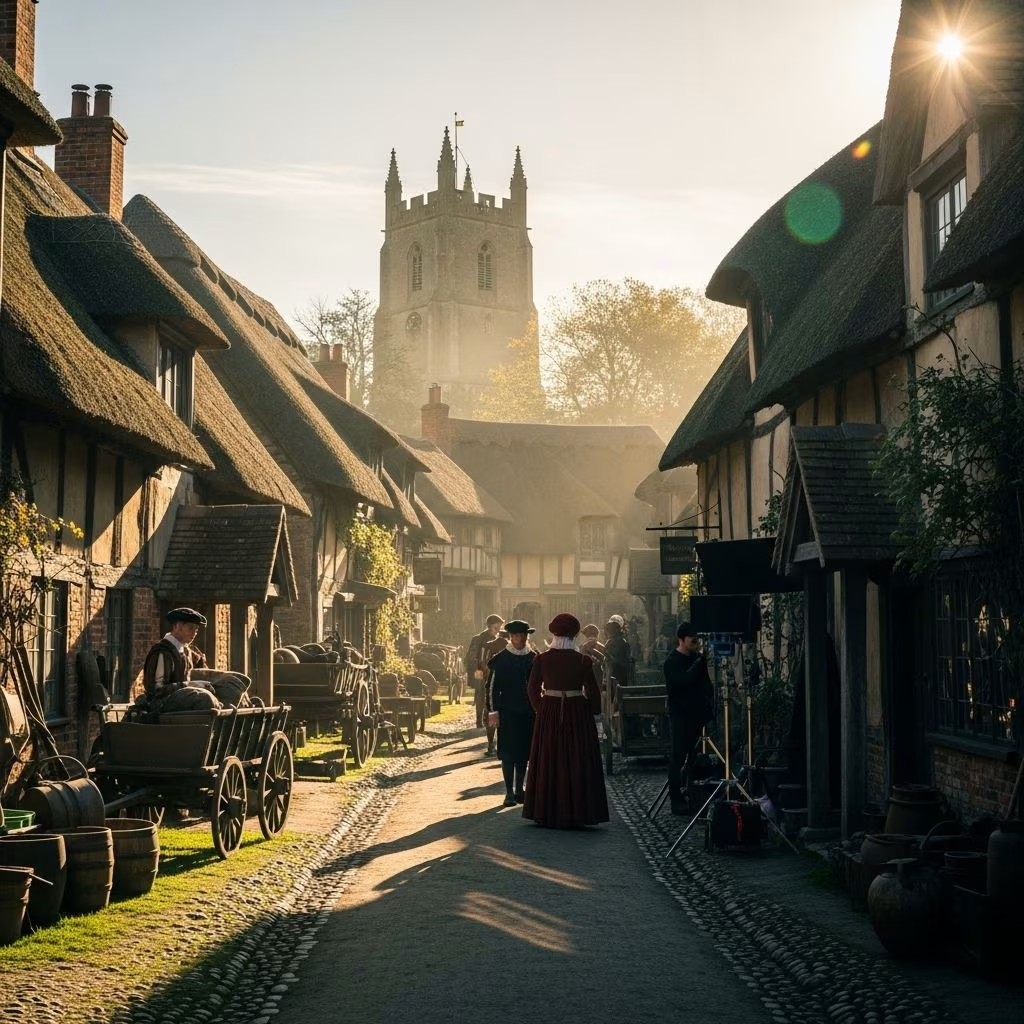
The picturesque village of Weobley in Herefordshire emerged as the primary filming location, serving as the cinematic stand-in for Stratford-upon-Avon. Located approximately twenty-five miles north of Hereford and about sixty miles west of the actual Stratford-upon-Avon, Weobley represents one of the finest preserved Tudor villages in England. The village’s architectural integrity stems largely from its isolation during the Industrial Revolution, which allowed its distinctive character to remain largely intact.
The streets of Weobley showcase authentic timber-framed houses characteristic of the period, with their distinctive black-and-white facades and charming asymmetrical construction creating a convincing sixteenth-century atmosphere. During August 2024, the production team closed the village’s streets to public access and implemented a comprehensive sixteenth-century transformation. Carts, hay bales, and period-appropriate props were strategically positioned throughout the village to enhance the historical ambiance.
Beyond its architectural merits, Weobley held particular significance due to its historical parallels with Shakespeare’s own life. The village functioned historically as a flourishing market town with a thriving wool and glove-making trade—the precise industry in which Shakespeare’s family achieved prominence. This coincidental connection added an extra layer of authenticity to the production, allowing audiences to visualize the economic and social context of Shakespeare’s youth.
Walking through Weobley today reveals why filmmakers found it so compelling for their vision:
A second crucial location emerged at Cwmmau Farmhouse, situated near the village of Whitney-on-Wye in Herefordshire. This Grade II-listed medieval structure, maintained by the National Trust, provided the perfect setting for Agnes Hathaway’s childhood home, known in the film as Hewlands Farm. The actual Anne Hathaway’s Cottage remains accessible to visitors near Stratford-upon-Avon, but the production team recognized that Cwmmau’s preserved fifteenth-century timber-framed architecture and natural surroundings offered superior visual authenticity for cinematography.
The farmhouse itself exemplifies meticulous preservation, with its timber frames and medieval construction techniques still evident centuries after its original construction. Surrounding woodlands and meadows create a pastoral setting that reinforces Agnes’s connection to nature—a thematic element central to both O’Farrell’s novel and Zhao’s film adaptation. The National Trust property had never been utilized for film production before, making its selection a significant coup for the production team seeking genuinely unspoiled locations.
The choice of Cwmmau demonstrates the production’s commitment to visual storytelling through environment. Rather than merely constructing sets that appeared period-appropriate, the team selected locations where authentic historical construction and genuine period atmosphere could speak directly to viewers, creating an immediacy and credibility that artificially constructed environments might not achieve.
A particularly poignant sequence in the narrative involves Agnes giving birth to the couple’s first daughter beneath an ancient tree—a moment that emphasizes her deep connection to the natural world. To capture this powerful scene, the production team traveled to Lydney Park Estate, situated within the Forest of Dean in Gloucestershire, approximately ninety minutes south of Weobley.
The ancient forest provided an appropriately dramatic natural setting for this significant moment in the story. Rather than creating artificial woodland scenes on a soundstage, the choice to film within the genuine forest landscape added visceral authenticity to the sequence. The estate’s ancient trees, some potentially centuries old, created a sense of timelessness that reinforced the emotional weight of the moment being depicted.
The narrative’s shift to London, where William pursues his theatrical ambitions, necessitated filming locations that could convincingly represent the capital during Shakespeare’s era. The production team selected the Charterhouse complex in the City of London, near Smithfield, as the primary London filming location. This ancient walled compound, with its fourteenth-century origins and preserved medieval architecture, provided authentic urban environment that felt genuinely rooted in the period.
The Charterhouse complex offered multiple advantages as a filming location. Its enclosed nature allowed for controlled cinematography while the genuine medieval stonework and spatial layout created convincing London streetscapes without requiring significant modification. Specific scenes, such as Agnes and her brother Bartholomew’s arrival in London to view William’s theatrical work, utilized various courtyards and passages within the complex, with blue screen technology strategically employed to add river views where needed.
Beyond the Charterhouse, filming incorporated other London sites:
While location filming captured much of the film’s visual authenticity, significant portions of the production involved studio work at Elstree Studios outside London. The interior of the Shakespeare household, despite appearing convincingly period-appropriate on screen, was constructed as a studio set. This hybrid approach allowed the production to maintain authentic exteriors while controlling internal environments for optimal cinematography, lighting, and actor performance.
Most significantly, the Globe Theatre was fully reconstructed as a studio set at Elstree. Rather than filming at the modern Globe Theatre reconstruction that now operates in London, the production team built a custom set that corresponded to their vision of how the venue functioned during Shakespeare’s lifetime. This decision ensured visual consistency with other production elements while allowing complete directorial control over the theatrical scenes.
Principal photography commenced on July 29, 2024, in Wales, with production originally scheduled to begin in London on June 3, 2024. The actual filming schedule extended through September 30, 2024, encompassing the various locations across Wales, Herefordshire, Gloucestershire, and London. This timeline allowed the production to utilize seasonal light and landscape conditions while coordinating complex logistics across multiple sites.
The selection of filming locations transcends mere aesthetic considerations. Each venue was chosen to reinforce specific thematic elements within the narrative. Weobley’s rural character and market town heritage connected visually to Shakespeare’s provincial origins. Cwmmau Farmhouse’s woodland setting reinforced Agnes’s characterization as someone deeply attuned to nature. The Charterhouse complex conveyed both the grandeur and confinement of urban theatrical life. These environmental choices functioned as silent storytelling elements, providing context and meaning beyond dialogue and action.
No. Despite the story being centered on Stratford-upon-Avon and the lives of Shakespeare and Anne Hathaway, the production deliberately avoided filming in the town itself. The team selected alternative locations that offered superior period authenticity and fewer logistical complications.
Many locations are accessible to the public. Weobley remains a functioning village open to visitors. Cwmmau Farmhouse is managed by the National Trust and available for tours. Lydney Park Estate and the Charterhouse complex welcome visitors, though specific access may vary seasonally.
The primary transformation involved careful set dressing with period-appropriate props, temporary closure of streets to modern traffic, and strategic camera angles that avoided anachronistic elements. The villages’ authentic architecture required minimal modification.
No. The Globe Theatre scenes were filmed on a purpose-built set at Elstree Studios, allowing the production team complete control over the visual presentation and historical accuracy of the theatrical sequences.
The meticulous selection of filming locations directly contributed to the film’s atmospheric quality and visual credibility. By prioritizing authentic historical environments over convenience, director Chloé Zhao and her team created a production that feels genuinely grounded in its period setting. Audiences experience not merely a story about Shakespeare, but a carefully crafted visual journey through sixteenth-century England.
This approach to location selection represents a commitment to cinematic authenticity that honors both O’Farrell’s source material and the historical figures depicted. The result is a film that transcends typical biographical drama through its immersive attention to environmental storytelling and period detail.
