

 Travel Essentials
 Travel Essentials

Hannah Reynolds' delayed funeral honors an overlooked Civil War victim and sparks national dialogue about slavery's human cost and historical memory.
 Travel Essentials
The final chapter of the American Civil War encompasses far more than the surrender negotiations between military leaders. Within the shadows of grand historical narratives lies the story of Hannah Reynolds, a woman whose life and death encapsulate the profound human toll of slavery and armed conflict. In a remarkable effort to correct historical oversights, commemorative ceremonies have brought renewed attention to her legacy, transforming her from a mere statistical footnote into a central figure in discussions about how nations remember their past.
Hannah Reynolds resided in the household of Dr. Samuel Coleman and his wife, Amanda Abbitt Coleman, in Appomattox County, Virginia. When Confederate and Union forces converged on the region in April 1865, the Colemans abandoned their home to seek safety elsewhere. Reynolds remained behind, left to navigate the chaos of battle without protection or assistance from those who claimed ownership over her labor and freedom.
During the combat operations at Appomattox Court House, artillery fire raked through the Coleman property. A Union cannonball penetrated the structure, striking Reynolds with devastating force. The impact created a substantial concave wound corresponding to the projectile’s dimensions and trajectory. Medical documentation from the time, preserved by J.E.M. Wright, a chaplain serving with the 8th Maine Infantry, described the severity of her injuries in clinical but sobering detail. Wright and a Union physician provided what comfort they could during her final days, offering medical assistance to both Reynolds and her husband, Abram Reynolds, who remained beside her throughout the ordeal.
Reynolds succumbed to her injuries on April 12, 1865, just three days after the initial attack and mere hours before General Robert E. Lee’s formal surrender to General Ulysses S. Grant on April 9, 1865. For generations, historical records suggested she had perished during the battle itself. However, meticulous archival research eventually revealed that Reynolds actually survived the immediate combat, dying instead from her injuries in the days following, technically as a free person, though she may never have understood her changed legal status.
For approximately 150 years, Hannah Reynolds remained largely anonymous in the broader historical consciousness. She was, at best, noted as “the lone civilian casualty” of the Battle of Appomattox Court House, her identity and individuality dissolved into statistical categorization. Researchers and historians working on comprehensive Civil War documentation undertook painstaking efforts to illuminate previously obscured narratives. Through careful examination of primary source materials, they discovered that Dr. Coleman had actually documented Reynolds’ death, listing himself as her “former owner”—a rare acknowledgment from a slaveholder of their former captive’s passing.
This documentary evidence transformed Reynolds from anonymous casualty into named individual. The discovery proved particularly significant because it corrected long-standing misconceptions about when and under what circumstances she died. Rather than perishing in the immediate crossfire, Reynolds had survived several days, experiencing a transition from enslaved status to freedom, even if briefly and even if she may not have fully comprehended the legal transformation occurring around her.
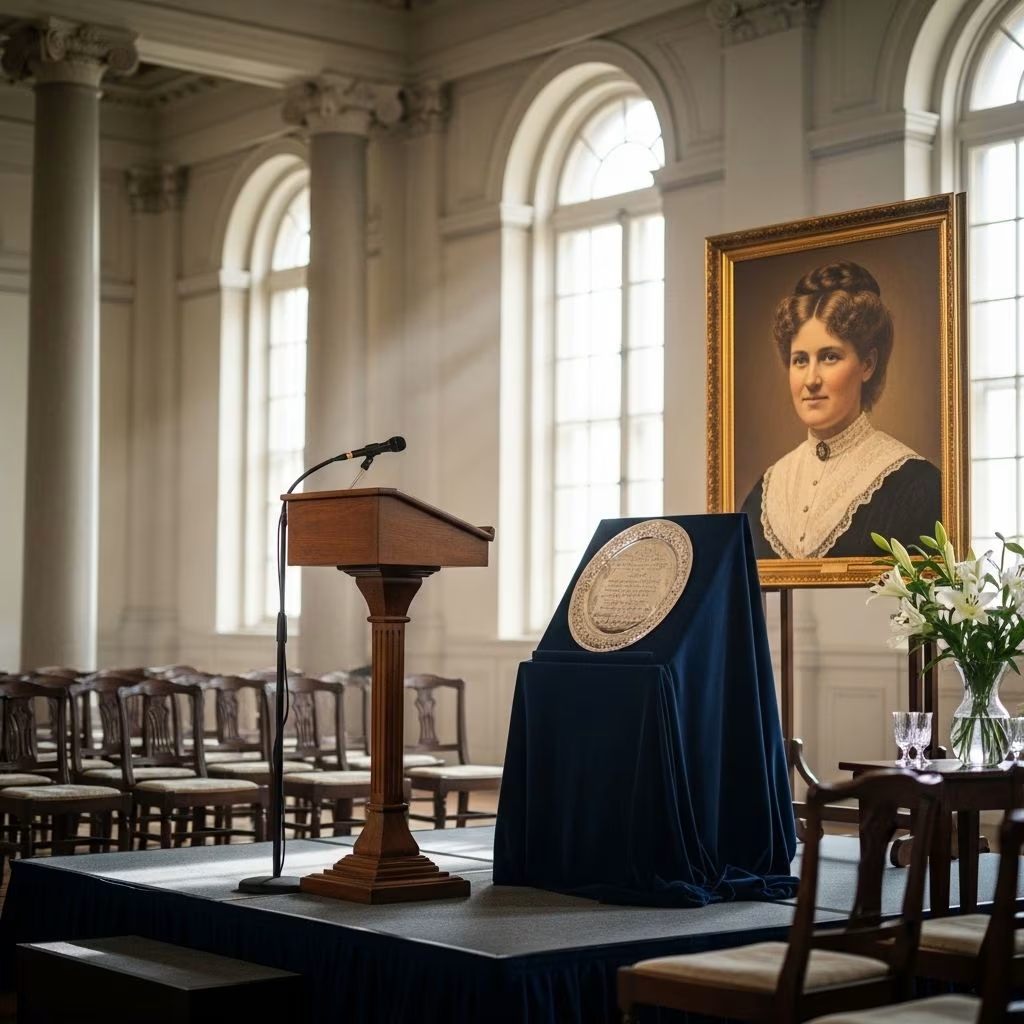
Recognizing the symbolic and historical weight of Reynolds’ story, organizers at Appomattox National Historical Park developed comprehensive commemorative programming centered on her life and death. Rather than allowing Reynolds to remain a peripheral figure, planners elevated her narrative to prominence alongside the military leaders typically dominating Civil War remembrance. This represented a deliberate effort to rebalance historical attention toward previously marginalized perspectives and experiences.
The commemorative events incorporated multiple layers of symbolic and spiritual significance. A solemn service featured eulogies delivered in period-appropriate language, honoring the linguistic and cultural traditions of the era. A gospel choir comprising one hundred singers performed spirituals—music born directly from the African American experience of enslavement and resistance. The selection of spirituals held particular resonance, as these songs emerged from communities enduring systems of bondage and represented expressions of faith, resilience, and hope amid profound suffering.
Perhaps most poignantly, organizers lit 4,600 candles throughout the commemoration space—each flame representing one enslaved individual in Appomattox County who achieved freedom through Lee’s surrender and Grant’s acceptance of Confederate capitulation. This visual representation transformed an abstract number into tangible recognition, allowing participants to comprehend the scale of human liberation intertwined with Reynolds’ death.
The decision to hold a formal funeral ceremony 150 years after Reynolds’ death raises profound questions about historical accountability and public memory. While some might view such delayed recognition as inadequate compensation for generations of erasure, others recognize the ceremony as an important step toward fuller historical understanding and public acknowledgment of previously marginalized experiences. The service created space for collective reflection on the human dimensions of slavery and warfare—dimensions often eclipsed by military strategy, political negotiations, and the actions of prominent leaders.
Reynolds’ funeral became occasion for interrogating how societies choose to remember pivotal historical moments. Appomattox Court House holds immense significance in American historical imagination as the location where the Confederacy formally conceded defeat. Yet for generations, this location’s meaning remained defined almost exclusively through the lens of military command and political resolution. Reynolds’ story insists upon a different framework—one that centers the experiences of enslaved and formerly enslaved people whose lives intersected with these supposedly epochal events.
Hannah Reynolds’ funeral ceremony participates in larger historiographical shifts occurring across American institutions. Increasingly, museums, historical sites, and commemorative events acknowledge that comprehensive understanding of the Civil War requires centering formerly enslaved people’s perspectives and experiences. The war itself emerged fundamentally from disputes about slavery, yet traditional commemoration often marginalizes slavery from the narrative, focusing instead on military campaigns, strategic maneuvers, and political leadership.
Reynolds’ story exemplifies how individual biographical details can illuminate broader historical truths. Her death resulted directly from the military conflict precipitated by slavery. Her survival as a slave until mere hours before formal emancipation captures the temporal proximity between bondage and freedom that countless individuals experienced. The fact that two Union soldiers—a doctor and chaplain from Maine—tended to her wounds suggests the possibility of interracial compassion even amid warfare and ideological conflict. Her husband’s presence provides crucial evidence of enslaved family bonds that slavery as an institution attempted to deny or trivialize.
The recovery of Hannah Reynolds’ history demonstrates the importance of rigorous archival research and willingness to challenge established historical narratives. Primary source materials, particularly chaplain Wright’s detailed medical observations and Dr. Coleman’s records, provide documentary anchoring for Reynolds’ story. These materials, preserved across generations, enabled modern researchers to reconstruct crucial biographical details that had been lost or distorted through decades of historical carelessness.
The commitment to source documentation reflects scholarly recognition that historical truth requires engagement with evidence—letters, military records, burial documentation, and eyewitness accounts. In Reynolds’ case, the existence of Wright’s written observations and Coleman’s death record proved essential to recovering her narrative from historical obscurity. Without these documentary traces, Reynolds might have remained permanently anonymous, her individuality erased entirely from the historical record.
Beyond institutional and scholarly dimensions, Reynolds’ funeral carried profound spiritual significance for participants and observers. The gospel choir’s performance connected contemporary audiences to musical traditions born from enslaved communities’ experiences. Spirituals—often dismissed or appropriated in mainstream culture—represented sophisticated theological and artistic responses to bondage. Songs simultaneously expressed grief, resistance, faith, and aspirations for liberation. Their performance during Reynolds’ service honored these traditions while creating sonic space for collective emotional processing of historical traumas.
The use of a plain wooden coffin respected symbolic austerity while honoring Reynolds’ humble circumstances. This choice contrasted sharply with elaborate funeral practices extended to prominent military figures and political leaders. Yet in its simplicity, the coffin conveyed dignity and respect—recognition that Reynolds’ life and death possessed inherent worth regardless of social status or institutional prominence. The 4,600 candles similarly created sacred atmosphere, transforming numerical representation into emotional and spiritual experience.
Hannah Reynolds’ ceremonial funeral 150 years after her death represents a significant moment in American historical consciousness. By elevating her from obscurity, commemorative organizers acknowledged that complete Civil War history must incorporate perspectives and experiences of enslaved and formerly enslaved people. Reynolds’ final hours—marked by injury, suffering, and perhaps the dawning realization of freedom—encapsulate the profound transformations occurring across American society during the war’s climactic days. Her story insists that historical comprehensiveness requires attention to individuals whose lives were shaped by slavery and liberation, whose experiences deserve recognition and respect, and whose narratives must be recovered and honored as essential components of national memory.
