

 Travel Essentials
 Travel Essentials

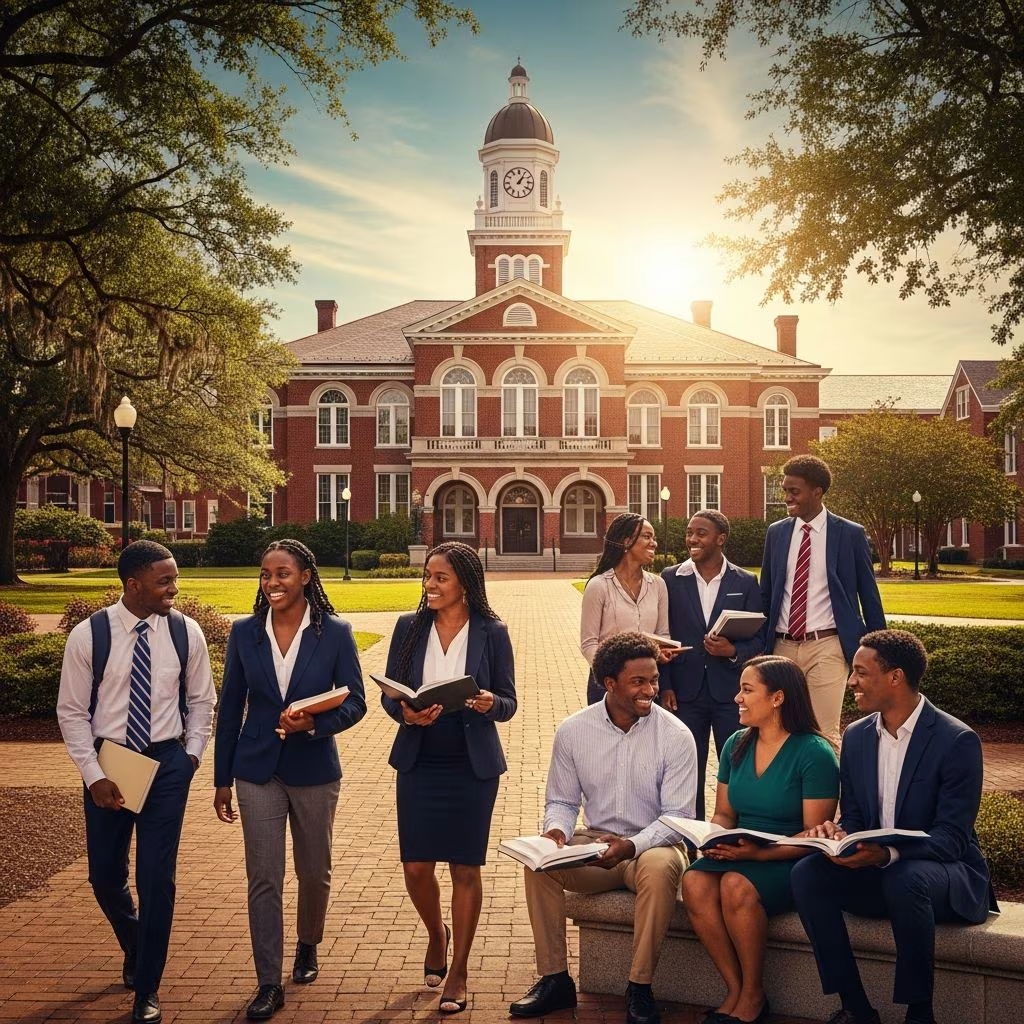
Explore the history, impact, and top HBCUs shaping Black education and leadership in the US, from Reconstruction-era origins to modern success stories.
 Travel Essentials
Historically Black Colleges and Universities (HBCUs) stand as enduring symbols of resilience, innovation, and academic achievement in the United States. Established primarily before 1964 to educate African Americans during eras of systemic exclusion, these institutions have produced a disproportionate number of Black professionals, leaders, and changemakers.
HBCUs emerged in response to widespread educational barriers faced by African Americans. The Higher Education Act of 1965 formally defines them as institutions founded prior to 1964, with a principal mission of educating Black Americans, and accredited by recognized agencies. Many trace their roots to the Reconstruction era (1865–1877), when the need for higher education opportunities surged post-Civil War. Early examples include Cheyney University of Pennsylvania (1837), Lincoln University (1854), and Wilberforce University, predating the war itself.
Atlanta University, now part of Clark Atlanta University, holds the distinction as the first HBCU in the South, established in 1865. These schools filled a critical void, as most white institutions barred Black enrollment. Today, over 100 HBCUs operate across 27 states, the District of Columbia, and the U.S. Virgin Islands, with the majority in the South—Alabama leads with the most, followed by North Carolina and Georgia.
Despite comprising just 3% of U.S. colleges, HBCUs award nearly 20% of bachelor’s degrees to Black students in fields like STEM, education, and business. They have been instrumental in building the African American middle class, nurturing talents like Kamala Harris (Howard University), Toni Morrison (Howard), and countless scientists, judges, and entrepreneurs.
HBCUs foster environments of cultural affirmation, where Black students thrive academically and socially. Research shows HBCU graduates often outperform peers from predominantly white institutions in graduation rates and career placement, particularly in underrepresented fields. Their emphasis on community, mentorship, and holistic development creates lifelong networks that propel alumni to leadership roles nationwide.
HBCUs are concentrated in the Southeast, reflecting historical segregation patterns. Alabama hosts 14, including powerhouses like Tuskegee University (1881) and Alabama State University. North Carolina follows with institutions such as North Carolina A&T State University, a leader in engineering.
| State | Number of HBCUs | Notable Examples |
|---|---|---|
| Alabama | 14 | Tuskegee University, Alabama A&M |
| North Carolina | 10 | NC A&T, Fayetteville State |
| Georgia | 9 | Morehouse College, Spelman College |
| Mississippi | 8 | Jackson State, Tougaloo College |
| Texas | 8 | Prairie View A&M, Texas Southern |
This distribution underscores their role in regional development, from agricultural advancements at Prairie View A&M to medical training at Meharry Medical College in Tennessee.
Howard University in Washington, D.C., often called the “Black Harvard,” boasts alumni including Thurgood Marshall and Vice President Kamala Harris. Its law school led the charge in desegregating U.S. education through landmark cases.
Spelman College in Atlanta, a women’s HBCU, ranks among the nation’s top liberal arts colleges, emphasizing empowerment and global leadership. Morehouse College, its brother institution, produced Dr. Martin Luther King Jr. and focuses on ethical manhood.
In STEM, Xavier University of Louisiana excels as the only Black Catholic HBCU, leading in producing Black pharmacists and doctors. Its “Emerald City” campus in New Orleans features iconic green-roofed buildings honoring saint Katharine Drexel.
HBCUs offer diverse curricula, from liberal arts to cutting-edge STEM. They produce 25% of Black STEM bachelor’s degrees despite limited funding. Tuskegee pioneered aviation training via the Tuskegee Airmen; today, it advances sustainable engineering.
Public HBCUs like Florida A&M University emphasize pharmacy and agriculture, while private ones like Dillard University prioritize journalism and performing arts. Recent investments, including federal initiatives, bolster research in cybersecurity, renewable energy, and public health.
HBCU culture pulses with energy—think Homecoming celebrations rivaling major festivals, featuring step shows, yard fests, and marching bands like Southern University’s Human Jukebox. Greek life thrives, with Divine Nine organizations fostering brotherhood and sisterhood.
Traditions like Florida A&M’s “Marching 100” band parades draw thousands, blending academics with unparalleled community spirit. These experiences build resilience and pride, essential for navigating systemic challenges.
Chronic underfunding plagues many HBCUs; the federal government owes billions in promised land-grant funds. Enrollment dipped post-desegregation but rebounds with targeted recruitment. Natural disasters, like hurricanes hitting Gulf Coast schools, test resilience, yet alumni loyalty endures.
Pandemic-era adaptations showcased innovation, with virtual programming and emergency aid sustaining operations.
With rising interest in diverse education, HBCUs attract global students and expand online offerings. Initiatives like the White House HBCU Initiative channel resources into endowments and infrastructure. Partnerships with tech giants promise growth in AI and biotech.
Projections indicate HBCUs will lead in equitable AI training and climate solutions, amplifying Black voices in policy.
Institutions established before 1964 primarily to serve Black students, per the Higher Education Act.
107, per U.S. Department of Education.
Yes, they are open to all, with diverse enrollments.
Howard University, with figures like Kamala Harris and Thurgood Marshall.
Many public HBCUs offer lower tuition; scholarships abound for qualified students.
