

 Travel Essentials
 Travel Essentials

Heathrow has modernized its liquid restrictions. Learn what containers are now permitted, how to pack efficiently, and special rules for medicines and baby products.
 Travel Essentials
Travelers flying through one of Europe’s busiest aviation hubs now benefit from streamlined security procedures that reflect advances in detection technology. Heathrow Airport has adopted a more permissive approach to liquid containers in cabin baggage, moving away from the restrictive protocols that have defined air travel for nearly two decades. This evolution represents a significant shift in how passengers prepare for their journeys, offering greater flexibility while maintaining rigorous safety standards.
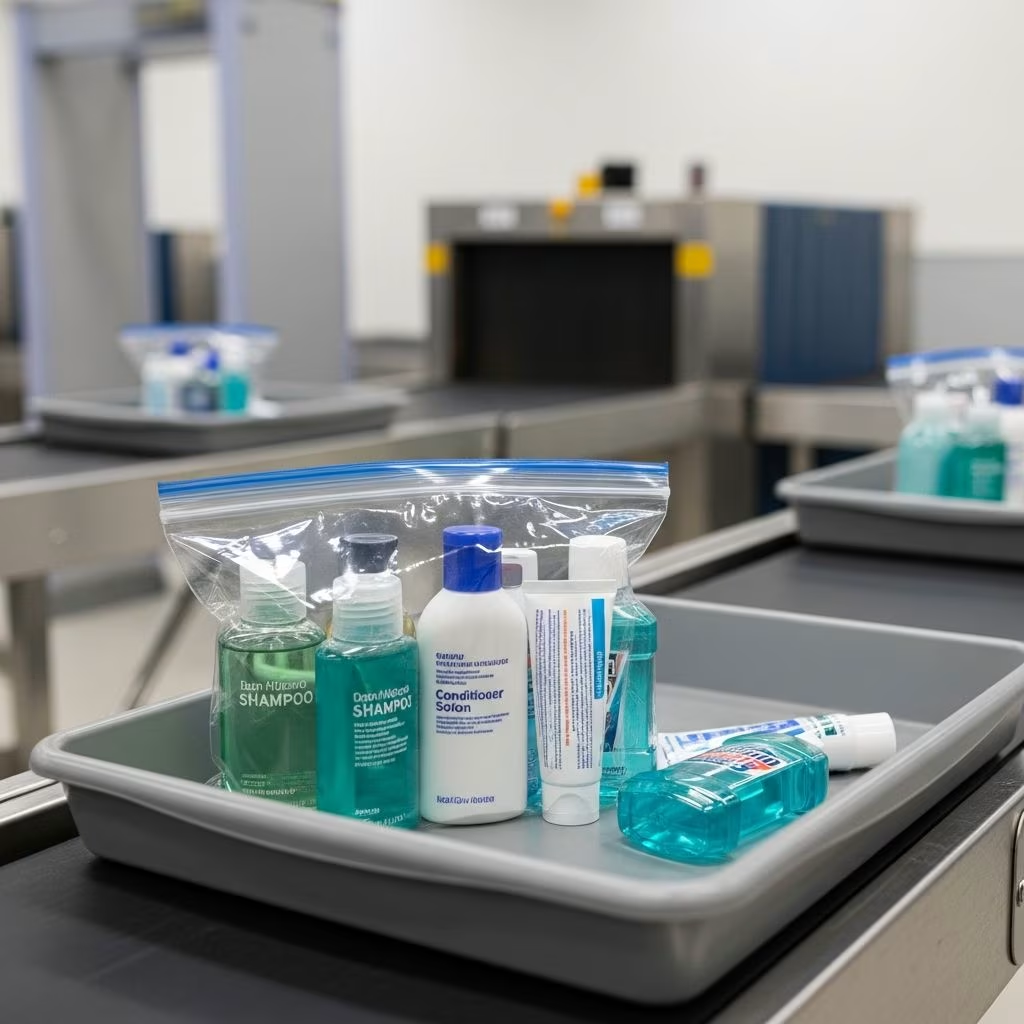
Rather than adhering to the long-standing 100-milliliter restriction that many international airports still enforce, Heathrow now permits passengers to carry liquid, aerosol, and gel containers holding up to 2 liters in their cabin baggage. This expanded capacity fundamentally changes how travelers pack toiletries, beverages, and other essential liquids. The containers themselves do not require removal from your bag during security screening—a convenience that accelerates the checkpoint process across all five terminals at the airport.
This policy applies uniformly across Heathrow’s terminal network, ensuring consistency whether you depart from Terminal 2, Terminal 3, Terminal 4, or Terminal 5. The standardized approach eliminates confusion and allows passengers to move through security with confidence.
Understanding which products fall under liquid classification prevents delays and frustration at security checkpoints. Heathrow’s official definitions help passengers correctly categorize their belongings before arriving at the airport.
Items not classified as liquids—such as solid deodorants, powder-based products (except in quantities exceeding 350 milliliters for US-bound flights), and creamy solids with minimal moisture content—can bypass these restrictions entirely. However, passengers should remain prepared for additional scrutiny of ambiguous items at security.
While Heathrow permits containers up to 2 liters, individual items must fit logically within standard cabin baggage dimensions. The airport enforces a two-bag policy for hand luggage, with each item not exceeding 56 centimeters in length, 45 centimeters in width, and 25 centimeters in depth. This means passengers cannot pack a single 2-liter container if doing so makes their bag exceed approved dimensions.
Refillable metal containers and double-walled bottles present special considerations. These must be emptied before passing through security, though passengers may refill them at designated water stations or retail outlets once they’ve cleared the checkpoint. This accommodation supports environmental consciousness while maintaining security protocols.
Passengers requiring liquid medications benefit from exceptions to standard volumetric limitations. Prescription medications exceeding the 2-liter standard can be carried in cabin baggage when documentation accompanies them—specifically, a valid prescription or letter from a medical practitioner confirming medical necessity for the flight. Such documentation should remain easily accessible during security screening.
Liquid medications not required during flight should be packed into checked baggage to streamline the security process. This approach reduces delays caused by verification procedures and allows passengers to move through checkpoints more efficiently.
Infant nutrition receives particular attention within Heathrow’s framework. Breast milk in liquid format (not frozen) may be carried in quantities up to 2 liters when stored in clear, transparent containers or commercially designed storage systems. Metal or double-walled containers cannot be used for breast milk storage in cabin baggage. When traveling without an infant, breast milk quantities remain limited to 2 liters per container.
Standard infant formula, by contrast, follows different rules. The airport’s Reserve and Collect service allows passengers to reserve formula before their journey and retrieve it after security clearance, eliminating the need to carry substantial quantities through the checkpoint.
Purchases made after passing through security checkpoints enjoy different regulations than pre-security cabin baggage. Bottled beverages, fragrances, and cosmetic products in containers exceeding 100 milliliters can be brought aboard aircraft when purchased at Heathrow’s duty-free retailers.
However, this flexibility contains important exceptions. Passengers on connecting flights must account for subsequent security screenings at their next airport. Similarly, travelers returning on the same day face restrictions on duty-free liquid purchases due to mandatory security processing at their destination airport before the return journey.
Australia-bound passengers face stricter regulations: containers exceeding 100 milliliters cannot be carried aboard flights to that destination, even when purchased duty-free at Heathrow. Passengers should verify specific restrictions with retail staff when making purchases.
All duty-free liquids must be sealed in security tamper-evident bags with receipts enclosed at the point of purchase—a requirement that protects both passenger and airport interests.
Certain liquids remain categorically prohibited regardless of container size or passenger justification. Flammable liquids, explosive substances, and toxic materials cannot be transported in either cabin or checked baggage. This restriction encompasses fuels, certain cleaning products, and industrial chemicals that pose significant safety risks.
Heathrow’s consistent policy across all terminals means passengers transitioning between terminals face uniform requirements. The two-bag cabin baggage limit applies equally to all departure areas. However, terminal-specific retail options and passenger amenities may vary, potentially affecting purchasing decisions at duty-free locations.
Modern travelers can enhance their airport experience by applying Heathrow’s expanded regulations strategically:
All cabin baggage undergoes X-ray screening regardless of liquid container contents. Modern detection technology now permits passengers to leave liquid containers in their bags during screening, eliminating the time-consuming unpacking procedures that previously characterized international air travel.
Passengers should remove coins, keys, mobile phones, and other small metallic items during screening to prevent false alarms. Coats should be placed on top of trays containing these items and cabin baggage to maintain organization and facilitate efficient processing.
Passengers concerned about body scanning technology can request alternative screening procedures. The Department for Transport has determined that no known health effects result from scanners currently in use at Heathrow. Individuals with medical devices, pregnancy-related concerns, or other health considerations should inform security personnel, who will arrange more extensive hand-search procedures conducted with privacy accommodations and an option to bring a witness.
Can I carry scissors or cutting implements in addition to liquids? Yes, scissors and nail files with blades not exceeding 6 centimeters in length are permitted in cabin baggage. Knitting needles can also be transported in the aircraft cabin.
How do I know if my particular airline allows the same liquid quantities? While Heathrow permits containers up to 2 liters, individual airlines may impose stricter restrictions on cabin baggage allowances. Passengers should verify airline-specific policies before packing.
What happens if I accidentally exceed container size limits? Items larger than the specified dimensions must be checked as hold luggage. Size-checking gauges are available at check-in areas to help passengers verify their bags before security screening.
Can I carry yogurt or soup in my cabin baggage? Yes, these items are classified as liquids and can be transported in containers up to 2 liters. However, space constraints within your cabin baggage dimensions may prove limiting for practical purposes.
Heathrow’s modernized liquid policy reflects broader evolution in aviation security approaches based on technological advancement and risk assessment. As detection capabilities improve, regulatory bodies adjust restrictions to balance passenger convenience with safety imperatives. This progression demonstrates how established institutions adapt policies to contemporary conditions while maintaining unwavering commitment to security standards.
Travelers can navigate Heathrow’s updated framework with confidence by understanding these updated provisions, maintaining awareness of exceptions for medical and infant products, and planning purchases strategically for connecting or same-day return journeys. The expanded liquid allowances represent a practical recognition of modern travel patterns while preserving the rigorous safety protocols essential to international aviation operations.
