

 Travel Essentials
 Travel Essentials

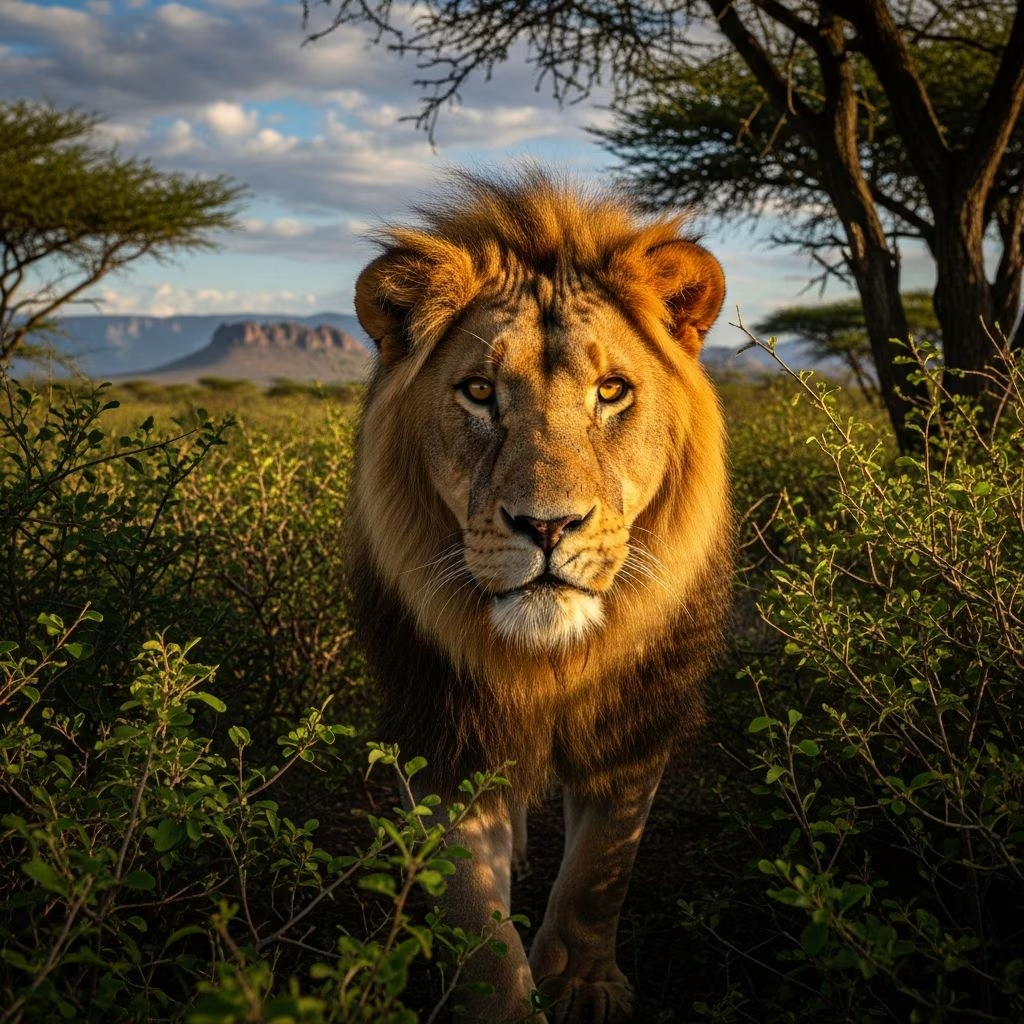
Conservationists discovered at least 100 lions in Ethiopia's Alatash National Park, expanding knowledge of lion distribution and providing critical insights for species preservation efforts.
 Travel Essentials
The discovery of a previously unknown lion population in a remote corner of northwestern Ethiopia represents one of the most significant wildlife conservation findings in recent years. Researchers from Oxford University’s Wildlife Conservation Research Unit, working with the Born Free Foundation, confirmed the existence of at least 100 lions living in the Alatash National Park, an area situated along Ethiopia’s border with Sudan. This groundbreaking discovery not only expands our understanding of where lions persist in Africa but also offers renewed hope for a species facing unprecedented decline across the continent.
The confirmation of lions in Alatash National Park emerged from a carefully planned research expedition led by Dr. Hans Bauer, a recognized authority on lion conservation from Oxford University. The research team, funded by Born Free Foundation, ventured into this remote and largely unexplored region with the knowledge that lions could theoretically survive there, though no definitive evidence had ever been documented. What began as an exploratory mission yielded results that would reshape conservation priorities for the entire region.
Using advanced camera trap technology, the research team systematically monitored the park’s landscapes, capturing photographic evidence of lions moving through their natural habitat. Simultaneously, field researchers identified and documented lion tracks throughout the area, corroborating long-standing reports from local communities who had observed these magnificent predators in their midst. The combination of photographic evidence and physical tracking data provided irrefutable proof that a viable lion population thrived in this previously undocumented location.
The population estimate of at least 100 lions represents a conservative assessment based on the evidence gathered during the expedition. Dr. Bauer and his team suggested that the actual population could range between 100 and 200 individuals, indicating that Alatash National Park might harbor a more substantial lion community than initially suspected. This significant population, whether it reaches the lower or upper bounds of the estimate, holds major implications for understanding lion distribution across Ethiopia and the broader Horn of Africa region.
The lions inhabiting this region belong to the Central African subspecies, a lineage that has experienced catastrophic population declines in recent decades. Conservation scientists estimate that only approximately 900 individuals of this subspecies remain in the wild across their entire range, making the Alatash population particularly precious from a genetic and ecological perspective. The discovery of 100 or more Central African lions in a single location immediately elevates this population to significance within global lion conservation efforts.
The location of the lion population provides crucial context for understanding African conservation challenges and opportunities. Alatash National Park’s position along the Ethiopia-Sudan border creates a transnational conservation situation that requires coordination between neighboring nations. The park’s proximity to Dinka National Park in Sudan suggests the possibility of lions moving across international boundaries, creating a potentially interconnected population system that extends beyond the borders of a single nation.
This geographic reality underscores the complexity of modern wildlife conservation, where political boundaries often intersect with ecological boundaries in ways that complicate protection efforts. Lions do not recognize international borders, and their survival depends on maintaining habitat corridors and movement routes that span multiple countries. The discovery in Alatash highlights the necessity for transnational conservation strategies that view populations as ecological units rather than political divisions.
To fully appreciate the significance of this Ethiopian discovery, one must understand the dramatic decline of lion populations across the African continent. Over the past three decades, the total lion population in Africa has decreased by approximately fifty percent, a loss that reflects habitat destruction, human-wildlife conflict, prey depletion, and other anthropogenic pressures. Contemporary estimates suggest that fewer than 20,000 wild lions remain across Africa, existing on less than ten percent of their historically occupied range.
This historical context transforms the Alatash discovery from a mere zoological curiosity into a conservation milestone. Each confirmed lion population, particularly one that escaped scientific documentation until recent times, represents a potential sanctuary for a species under existential threat. The existence of a population numbering in the hundreds suggests that remote, protected areas can still harbor viable wildlife communities even in regions where human presence and development might suggest otherwise.
An often overlooked but essential aspect of this discovery involves the validation of local community knowledge. For years, residents living in and around the Alatash region reported lion sightings and encounters, observations that were sometimes dismissed or underestimated by external researchers unfamiliar with the area. The scientific confirmation of the population vindicated these community reports and demonstrated the value of incorporating local ecological knowledge into conservation efforts.
This dimension of the discovery carries important lessons for future conservation work. Local populations living adjacent to wildlife habitats often possess detailed understanding of animal movements, seasonal patterns, and population dynamics developed through generations of observation and interaction. Effective conservation strategies that ignore or marginalize this knowledge base miss valuable information while potentially alienating the communities whose cooperation proves essential for long-term protection efforts.
The successful confirmation of the lion population relied on contemporary wildlife research technologies and field methodologies. Camera traps, which capture images when triggered by animal movement, have revolutionized wildlife monitoring by providing non-invasive documentation of animal presence. The deployment of multiple camera traps throughout Alatash National Park created a systematic surveillance network that captured photographic evidence of lions across different areas and time periods.
Complementing the technological approach, traditional field research methods including track identification and physical evidence collection provided additional confirmation. The combination of modern technology with established ecological research practices represents a holistic approach to wildlife documentation that increases confidence in findings and provides multiple lines of evidence supporting the conclusions.
The discovery of the Alatash lion population immediately raises important questions about conservation management and protection strategies. Born Free Foundation and other conservation organizations must work with Ethiopian wildlife authorities to develop management plans that protect the population while addressing human needs and development pressures in the region. The challenge involves balancing the imperative to preserve a rare and significant wildlife population with the legitimate aspirations of local communities for economic development and improved living standards.
Conservation success in Alatash will likely require investment in anti-poaching patrols, habitat management, support for local communities affected by wildlife conservation restrictions, and potentially translocation programs if necessary to increase genetic diversity or establish satellite populations. The long-term viability of the population depends on securing adequate funding, political commitment from Ethiopian authorities, and sustained international support for conservation initiatives.
Prior to this discovery, scientists believed that lion populations in Ethiopia were largely confined to specific known reserves and protected areas. The confirmation of a substantial population in Alatash fundamentally expands the documented range of lions in the country and suggests that other previously unknown populations might exist in remote, insufficiently surveyed regions. This realization has prompted conservationists to reconsider their assumptions about where lions can survive in Ethiopia and across the broader Horn of Africa.
The discovery may prompt future research expeditions into other remote and protected areas throughout Ethiopia and neighboring countries where lions might persist undetected. Such reconnaissance efforts could reveal additional populations that, like the Alatash lions, have eluded scientific documentation until recently. Each newly confirmed population provides additional insurance against extinction and expands the genetic and demographic foundation for species survival.
Born Free Foundation’s involvement in funding and supporting the Alatash research reflects the essential role played by international conservation organizations in wildlife protection efforts. These organizations bring financial resources, technical expertise, and international attention to conservation priorities that might otherwise receive insufficient attention. By documenting the lion population and publicizing the discovery, Born Free helped ensure that Alatash receives appropriate conservation consideration and resources.
The partnership between international organizations and local conservation authorities represents a model for effective wildlife protection. International expertise and resources complement the local knowledge and authority of national governments, creating collaborative approaches that leverage the strengths of all parties. Successful long-term conservation in Alatash will depend on sustained cooperation between Born Free, Oxford University researchers, Ethiopian wildlife authorities, and local communities.
While the discovery of the Alatash population offers reasons for optimism, significant challenges threaten both this population and lions across Africa. Human population growth, agricultural expansion, and infrastructure development continue to fragment lion habitat and increase human-wildlife conflict. Poaching, though less prevalent than in some regions, remains a concern in remote areas where enforcement capabilities are limited. Prey depletion due to overhunting reduces food availability for lions, forcing them into competition with human interests or into areas with inadequate resources.
Climate variability and environmental degradation pose additional threats to long-term population viability. Droughts can devastate both lion populations and their prey base, while changing precipitation patterns may alter the suitability of habitats for sustaining viable populations. Conservation strategies must account for these environmental challenges and develop resilience-building approaches that help populations withstand environmental fluctuations.
The confirmation of lions in Alatash represents not an endpoint but rather the beginning of a new conservation chapter. The challenge now involves transforming scientific discovery into sustained protection and population growth. This requires establishing effective management structures, securing adequate funding for anti-poaching and habitat management, and building social support among local communities for lion conservation efforts.
The Alatash discovery demonstrates that Africa’s wild places still hold surprises and that effective conservation remains possible even in regions where pessimism about wildlife survival might seem justified. By documenting this population and committing resources to its protection, the international conservation community can help ensure that these magnificent predators continue to inhabit Ethiopian wilderness for generations to come. The lions of Alatash, hidden for so long from scientific knowledge, now offer visible hope for a species facing an uncertain future across much of Africa.
