

 Travel Essentials
 Travel Essentials

Discover London’s hidden gardens, secret art, false houses, ancient ruins, and overlooked memorials that reveal the city beyond its landmarks.
 Travel Essentials
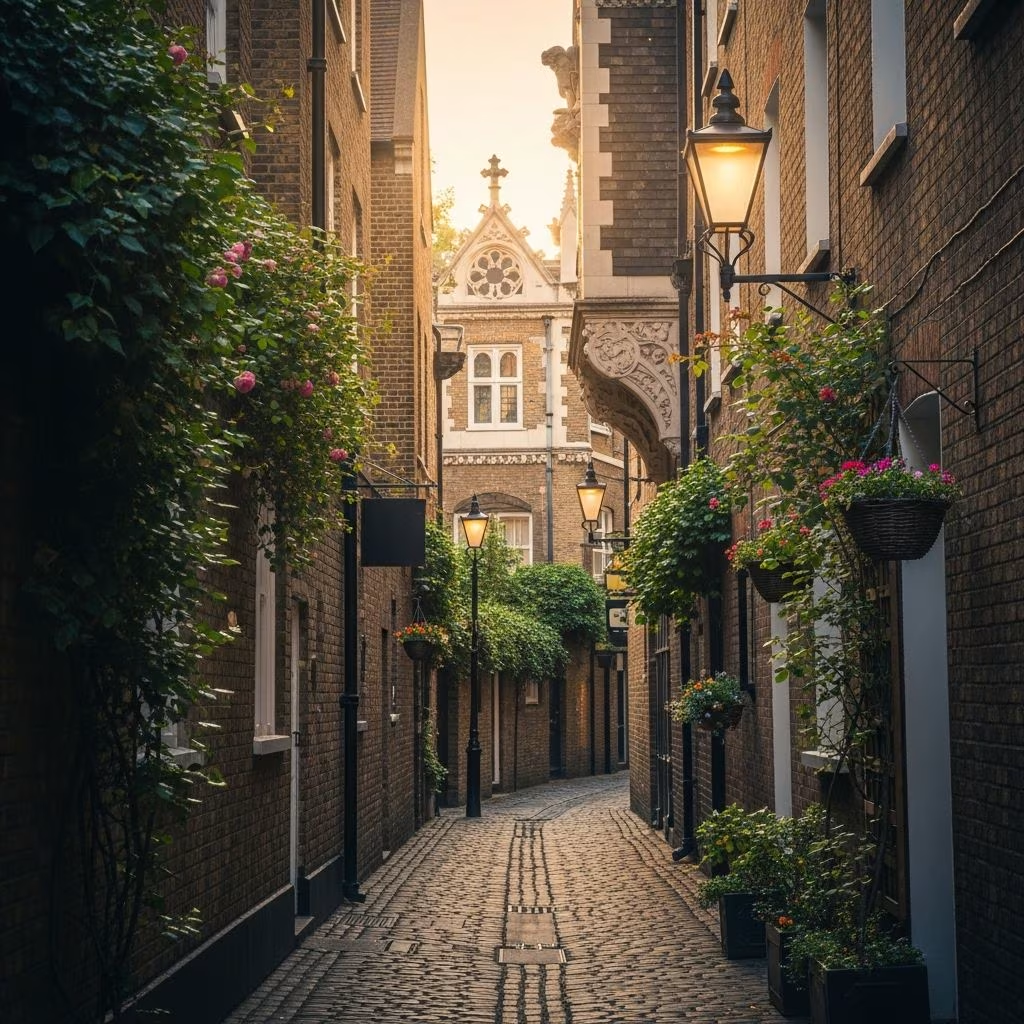
London stands as one of the world’s most visited cities, yet beneath its iconic landmarks and bustling tourist corridors lies a network of lesser-known locations that tell stories often overlooked by conventional guidebooks. These spaces—ranging from consecrated ground transformed into memorial gardens to architectural illusions and immersive artistic installations—offer visitors and residents alike an alternative perspective on the British capital. Exploring these enigmatic sites provides a deeper understanding of London’s layered history, from its Roman foundations to its role as a refuge for society’s marginalized populations.
Among London’s most poignant yet understated destinations is a burial ground in Southwark that serves as a testament to the city’s historical complexities. This unconsecrated cemetery once received the remains of individuals deemed unsuitable for traditional church burials, including medieval sex workers and impoverished residents. The space now operates as a volunteer-maintained garden and memorial site, hosting workshops and commemorative events that honor those historically excluded from mainstream society. The transformation of this ground from a place of social rejection into a space of remembrance demonstrates how communities can reclaim historical narratives and celebrate those frequently rendered invisible by conventional history.
Another significant yet rarely discussed ecclesiastical site showcases architectural resilience. Originally constructed nearly a millennium ago, this former church building survived the wartime bombing campaign of 1941 but was left in ruins rather than reconstructed. Today, visitors can wander through overgrown gardens nestled among deteriorating stonework, creating an atmosphere that blends natural regeneration with historical preservation. This garden sanctuary illustrates how architectural fragments can be repurposed as contemplative spaces rather than completely demolished or restored to original specifications.
The cityscape contains several examples of buildings designed to deceive the eye and challenge perceptions of urban space. In one Bayswater neighborhood, a seemingly continuous row of Victorian terraced houses conceals an architectural secret. Behind their orderly facades lie two constructed frontages that exist purely for aesthetic purposes—false houses designed during the 1860s to maintain visual continuity when original structures required demolition to accommodate railway infrastructure. Walking behind this residential line reveals the exposed train tracks these facades were created to conceal, offering a fascinating glimpse into nineteenth-century urban problem-solving that prioritized visual coherence over architectural honesty.
The genius of these false houses lies in their ability to demonstrate how cities manage competing interests between transportation development and residential aesthetics. They represent a compromise solution that satisfied multiple stakeholders: railway authorities could expand infrastructure while residents maintained street-level visual harmony. This architectural pragmatism reveals historical attitudes toward development that differ significantly from contemporary approaches to urban planning.
Among London’s most intriguing contemporary artistic legacies are approximately thirty-five plaster noses scattered throughout the Soho district. Between 1996 and 2005, artist Rick Buckley clandestinely distributed these nose casts—modeled from his own facial features—across rooftops, building facades, and other elevated locations. The project generated considerable speculation regarding its underlying motivation, with urban mythology suggesting the noses represented commentary on the proliferation of surveillance technology throughout the city. Whether intended as social critique or artistic experiment, the noses have become embedded in local folklore, with only about ten confirmed to remain visible today. Discovering these mysterious sculptures has become an informal treasure hunt that guides explorers through some of Soho’s most historically significant locations.
The persistence of these artworks in public consciousness demonstrates how ephemeral or intentionally hidden artistic installations can achieve lasting cultural significance. Their ambiguous nature—existing partially hidden yet deliberately placed—invites ongoing interpretation and encourages pedestrians to observe their urban environment with heightened awareness.
Among London’s most unusual residential experiences is a Georgian townhouse in Spitalfields that functions as an elaborate historical tableau. The owner arranged ten rooms of this property as a “still-life drama” depicting domestic life across the eighteenth and nineteenth centuries. Visitors encounter an uncanny atmosphere created through carefully positioned period clothing, lingering smoke, and strategic lighting that creates the impression that aristocratic residents have just departed the premises. This immersive approach to historical interpretation contrasts sharply with traditional museum displays, instead inviting visitors to become participants in a constructed temporal experience rather than detached observers of curated objects.
The effectiveness of this approach lies in its engagement of multiple sensory experiences beyond visual observation. The combination of period-appropriate furnishings, atmospheric effects, and spatial arrangement creates cognitive dissonance that encourages deeper contemplation of historical domestic life than conventional museum settings typically achieve.
Beneath contemporary London’s financial district lie remnants of a temple dedicated to Mithras, an ancient Persian deity whose worship spread throughout the Roman Empire. Discovered in 1954, these archaeological remains were initially relocated to accommodate urban development, demonstrating how mid-twentieth-century planners prioritized commercial expansion over historical preservation. Subsequently moved back to an adjacent location, a reconstructed version opened to the public in 2017, incorporating artifacts from Roman London and providing context for understanding the multicultural religious landscape of ancient Britannia.
The journey of these ruins—from worship site to rubble to museum reconstruction—encapsulates broader tensions between historical preservation and urban development. The restoration of this temple provides contemporary Londoners with tangible connection to their city’s pre-Christian past and testament to religious diversity in Roman-era Britain.
London’s commercial landscape includes establishments that transcend conventional retail functions. Specialized shops dedicated to unusual merchandise—from practical items to fantastical curiosities—create shopping experiences that blur boundaries between commerce and theatrical experience. These establishments serve communities with distinctive interests while contributing to neighborhood character and cultural vitality. Such retailers demonstrate how commerce can function simultaneously as economic activity and cultural expression.
Beyond the well-known expanses of Hyde Park and Regent’s Park, London contains numerous quieter gardens that offer respite and aesthetic experience. These include medicinal plant collections, tranquil water gardens with architectural significance, and planted landscapes designed during earlier centuries. Many of these spaces remain relatively unknown despite their horticultural and historical importance, offering visitors opportunities for contemplation in urban settings that feel removed from main tourist corridors.
Certain neighborhoods and establishments maintain connections to London’s artistic and musical traditions. Venues and districts associated with creative movements—from punk rock to electronic music to visual art—provide insight into the city’s role as incubator for cultural innovation. Street art, gallery spaces, and performance venues continue this legacy, particularly in areas known for attracting artists seeking affordable studio and performance opportunities.
Beyond conventional monuments, London contains numerous sites commemorating ordinary individuals and their contributions to community welfare. Small plaques and dedicated gardens honor firefighters, rescue workers, and civilians who made significant personal sacrifices. These understated memorials often go unnoticed by passersby yet provide profound testament to human courage and community interdependence.
Most hidden sites are accessible year-round, though spring and summer offer more favorable weather for outdoor exploration. Some specialized venues maintain limited opening hours, requiring advance research before planning visits. Volunteer-maintained spaces like memorial gardens operate continuously but may host special events during specific seasons.
Accessibility varies significantly. Some sites, particularly outdoor gardens among historical ruins, involve uneven terrain and limited pathway infrastructure. Specialized museums and galleries generally offer better accessibility accommodations. Advance contact with individual venues can provide specific accessibility information for planning purposes.
Many hidden London sites operate freely and remain perpetually accessible to the public. Some specialized museums charge modest admission fees that support maintenance and programming. Volunteer-operated memorial spaces typically operate on donation-based or completely free models.
Guided walking tours, local history organizations, and specialized travel publications provide detailed directions and contextual information. Digital mapping applications increasingly include information about unusual attractions. Local residents frequently serve as valuable sources for discovering neighborhood-specific hidden gems.
Many hidden attractions lack the promotional budgets, tourist infrastructure, and name recognition of flagship sites like Big Ben or Tower Bridge. Their locations in residential neighborhoods or limited operational hours also restrict casual visitor discovery. Additionally, some sites deliberately resist commercialization, maintaining quiet, contemplative atmospheres that discourage mass tourism.
London’s lesser-known attractions collectively comprise an alternative geography of urban experience, revealing complexities and contradictions embedded within the city’s physical and social landscape. From burial grounds transformed into memorial gardens to false houses concealing railway infrastructure, these sites demonstrate how cities continuously negotiate tensions between development, preservation, aesthetics, and commemoration. Exploring these hidden treasures encourages visitors and residents to engage with London not as a collection of famous monuments but as a living archive of human experience, artistic innovation, and historical complexity. Such exploration enriches understanding of contemporary urban life while honoring the contributions of individuals and communities whose stories might otherwise remain obscured by mainstream historical narratives and tourist-focused representations of the city.
