

 Travel Essentials
 Travel Essentials

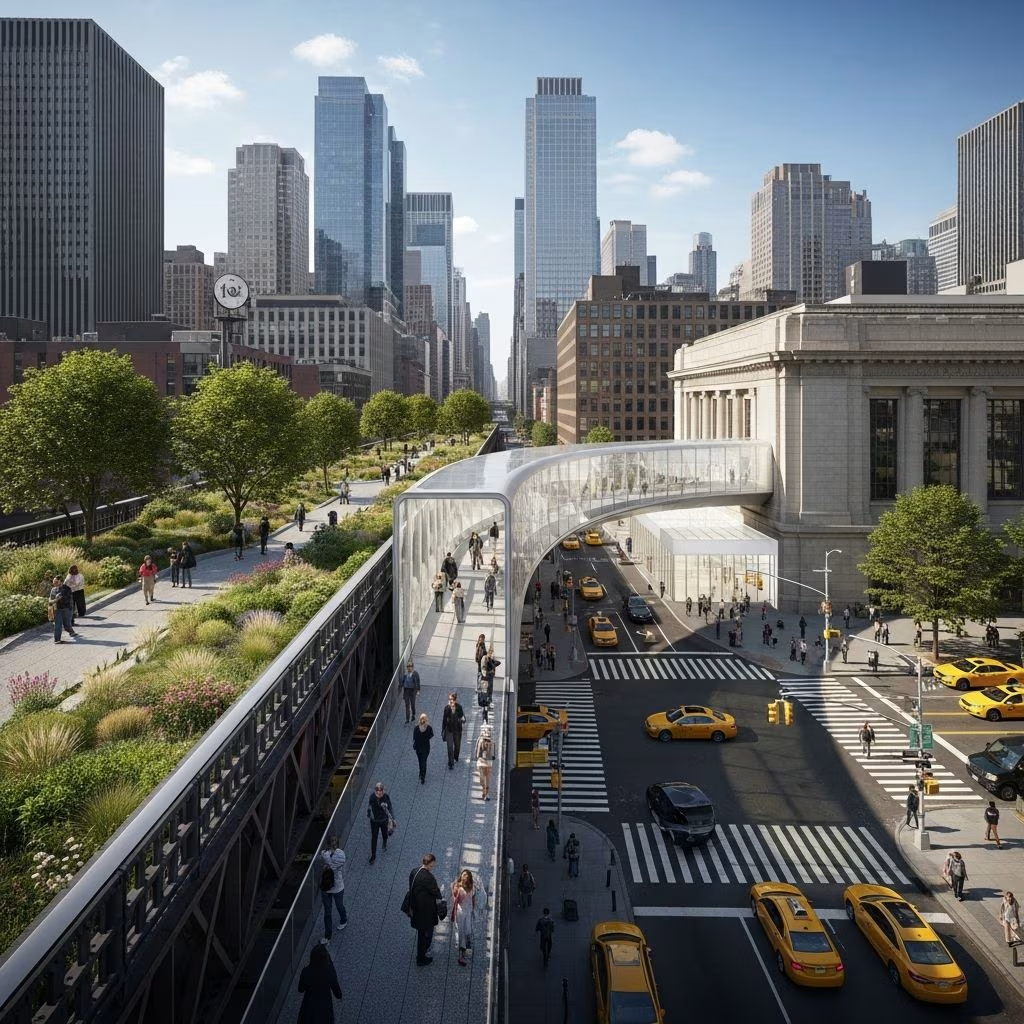
A new elevated connector links the High Line to Moynihan Train Hall, creating a safer, scenic route between Hudson Yards and Penn Station.
 Travel Essentials
This innovative pedestrian connection transforms how visitors and locals navigate Manhattan’s West Side, blending green spaces with major transit hubs for an unparalleled city experience.
The High Line-Moynihan Connector represents a pinnacle of urban planning, directly linking the renowned High Line park to the expansive Moynihan Train Hall. Opened in June 2023, this 600-foot extension features two elegantly designed bridges that eliminate the need to navigate treacherous street-level traffic. Previously, reaching Penn Station from the High Line meant dodging busy avenues like 10th and Dyer, fraught with vehicles heading to the Lincoln Tunnel. Now, pedestrians enjoy a continuous, elevated route fostering safety and immersion in the city’s skyline.
Announced in early 2021 by New York State, the project stemmed from a vision to integrate the High Line—originally a repurposed freight rail line—with the $1.6 billion Moynihan Train Hall redevelopment. This hall, housed in the historic James A. Farley Post Office Building, replaced the cramped Penn Station concourse, drawing over 600,000 daily commuters. The connector ensures these travelers can transition effortlessly from verdant park paths to gleaming transit facilities.
At the heart of the connector are two distinct bridges, each crafted for both functionality and aesthetic appeal. The Woodlands Bridge stretches eastward parallel to West 30th Street, forming a lush ribbon of trees and greenery atop steel decking. This structure evokes the High Line’s wild, overgrown heritage while providing shade and visual respite amid concrete jungles.
Adjacent, the Timber Bridge employs a classic Warren truss design, soaring above Dyer Avenue to reach Manhattan West’s Magnolia Court. Bronze handrails and durable materials ensure longevity against harsh weather, with full ADA accessibility throughout. Together, these spans create an L-shaped journey: east along 30th Street, then north to Brookfield Properties’ elevated public plaza, finally descending toward 9th Avenue opposite the Farley Building.
| Bridge Name | Length & Path | Key Features | Design Firms |
|---|---|---|---|
| Woodlands Bridge | ~300 feet, parallel to 30th St | Tree-lined greenway, steel decking | James Corner Field Operations, SOM |
| Timber Bridge | ~300 feet, over Dyer Ave | Warren truss, bronze railings | James Corner Field Operations, SOM |
The High Line’s story begins in the 1930s as an elevated freight corridor, sparing Manhattan’s streets from train traffic. Decommissioned in 1980, it lay abandoned until grassroots efforts by Friends of the High Line sparked its rebirth. Opened in phases from 2009, the 1.45-mile park now attracts 8 million visitors yearly, showcasing native plantings by Piet Oudolf and architecture from Diller Scofidio + Renfro and James Corner Field Operations.
Penn Station’s evolution mirrors this renewal. Once a beaux-arts masterpiece demolished in 1963, its replacement became notoriously overcrowded. The Moynihan Train Hall, unveiled in January 2021, restores grandeur with soaring glass ceilings and public art, serving Amtrak, LIRR, and subway lines. The connector completes this triad: park, development, station—unifying Midtown West’s renaissance.
James Corner Field Operations, veterans of the original High Line, partnered with Skidmore, Owings & Merrill (SOM) to ensure the connector feels like a natural extension. Expect episodic landscapes: wildflower meadows on the Woodlands Bridge transitioning to structured plantings on the Timber span. Materials emphasize sustainability—recycled steel, permeable surfaces for stormwater management, and drought-resistant flora reduce maintenance needs.
This design philosophy prioritizes ‘urban journey,’ guiding users through vignettes: from High Line’s historic viaduct, across modern bridges, into Manhattan West’s contemporary plazas, and into Moynihan’s neoclassical halls. Lighting integrates seamlessly, with LED fixtures mimicking daylight to extend usability into evenings.
Prior to the connector, pedestrians faced disjointed routes plagued by signalized crossings and narrow sidewalks. The elevated path offers unobstructed views of Hudson Yards’ supertalls and the Hudson River, while serving diverse users: commuters rushing to trains, tourists photographing vistas, families strolling post-event from Javits Center.
A $50 million public-private venture, funded by Empire State Development, Port Authority, Brookfield, and Friends of the High Line, underscores collaborative urbanism.
Manhattan West, Brookfield’s 6-million-square-foot development, anchors the connector’s eastern end. This mixed-use oasis features offices, residences, hotels, and 1.8 acres of gardens, including Magnolia Court where the Timber Bridge lands. From here, escalators and stairs deposit users steps from Moynihan’s entrance, mere minutes from Penn Station platforms.
Future visions include further extensions: one curving past Javits to Pier 76, potentially creating a waterfront loop. This would amplify the High Line’s role in a ‘chain of pedestrian pathways’ from Penn Station to Hudson Yards and beyond.
Access the High Line at its northern terminus near 34th Street and 12th Avenue, then drift south through its 500+ plant species. At 10th Avenue, the connector beckons—follow signage for the Woodlands Bridge. Journey time end-to-end: 10-15 minutes, free admission, open dawn to dusk with extensions for events.
The connector catalyzes Midtown West’s boom, supporting 20,000+ jobs in nearby developments. Environmentally, it promotes walking—reducing car dependency—and its green infrastructure sequesters carbon while cooling urban heat islands. Studies project a 20% uptick in pedestrian traffic to cultural sites, bolstering local businesses.
Yes, it opened in June 2023 and operates daily, free of charge.
Approximately 600 feet total, comprising two bridges.
James Corner Field Operations and SOM.
It leads to Moynihan Train Hall entrances, adjacent to platforms.
Seating benches yes; restrooms at High Line ends and Manhattan West.
In a city of 8.8 million, such connections humanize megastructures, prioritizing people over cars. The High Line-Moynihan Connector exemplifies resilient design—post-pandemic, it encourages outdoor activity while knitting transit, leisure, and commerce. As Manhattan evolves, this pathway invites everyone to experience its layered beauty from above.
