

 Travel Essentials
 Travel Essentials

Discover Lucca’s Volto Santo, a rare 8th-century crucifix blending legend, restoration, and pilgrimage history in Tuscany.
 Travel Essentials
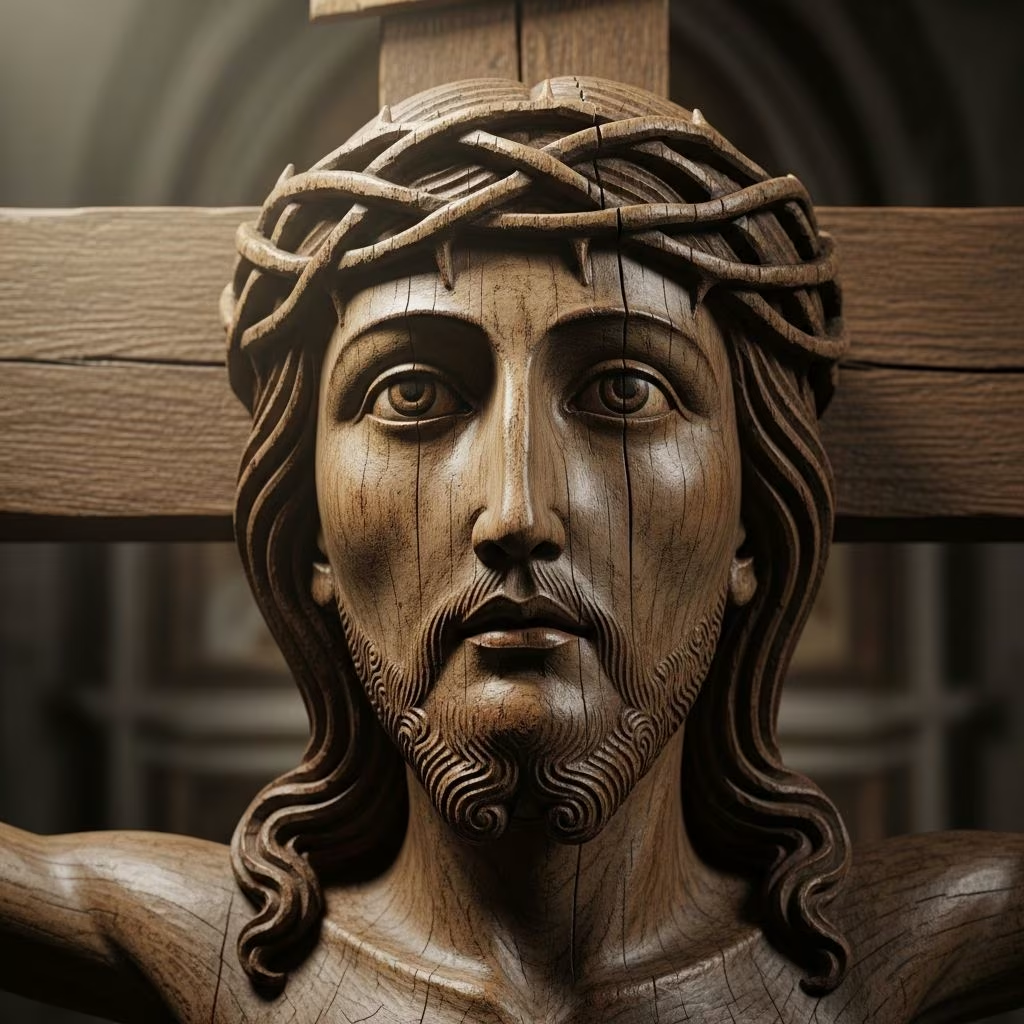
The **Holy Face of Lucca**, known locally as the Volto Santo, stands as one of Christianity’s most enigmatic treasures. This life-sized wooden crucifix, housed in the Cathedral of San Martino, has captivated pilgrims, artists, and historians for over a millennium. Crafted in the 8th century, it embodies a blend of legend, artistry, and faith that continues to draw visitors to the walled city of Lucca in Tuscany.
Medieval tales trace the crucifix’s creation to Nicodemus, the biblical figure who aided in Christ’s burial. According to tradition, Nicodemus began carving the figure but struggled with the face, falling asleep in exhaustion. Upon waking, he discovered the face miraculously completed by divine intervention, infusing the wood with a lifelike presence.
The relic’s journey to Lucca forms another layer of wonder. Hidden for centuries after its crafting, it was rediscovered and placed on an unmanned ship that drifted across the Mediterranean. Guided by providence, the vessel reached Italy’s shores near Luni. From there, a cart pulled by oxen, without human direction, transported it inland to Lucca around 782 AD—or 742 according to some accounts—settling it as the city’s eternal guardian.
Modern analysis supports these ancient timelines. Radiocarbon dating of the wood and canvas dates the artifact to between 770 and 880 AD, aligning closely with the legendary arrival. Diagnostic studies affirm it as one of the three oldest surviving wooden crucifixes in Western Christianity, uniquely preserved despite its age.
A major restoration project, completed after years of meticulous work, peeled back layers of dark overpainting to reveal the original polychrome brilliance. This effort exposed 9th- to 17th-century hues, showcasing intricate construction techniques and materials that highlight the sculptor’s mastery.
Upon reaching Lucca, the Holy Face was first enshrined in the Basilica di San Frediano before a miraculous event prompted its move to the Cathedral of San Martino. This transfer, detailed in the *Leggenda di Leobino* or *Relatio leobiniana*, occurred amid rivalry with nearby Luni. Bishop John of Lucca resolved the dispute by gifting a vial of Christ’s blood to Luni’s bishop, securing the crucifix for his city.
The cathedral’s consecration in 1070 by Anselmo da Baggio marked a pivotal moment, with the relic prominently featured. Today, it resides in an octagonal tempietto in the left aisle, a dedicated marble structure that elevates its sanctity.
The Volto Santo depicts Christ standing triumphantly on the cross, clad in a colobium—a long tunic symbolizing resurrection rather than suffering. This Romanesque style, with its rigid posture and serene expression, influenced crucifixes across Europe, from England to Scandinavia.
Post-restoration, the figure gleams with rediscovered colors: gold accents, vivid reds, and blues that once animated its form. Legends whisper of hidden relics within, including thorns from the crown and blood vials, enhancing its aura of authenticity.
| Feature | Description | Significance |
|---|---|---|
| Material | Painted wood, canvas elements | Dated 770-880 AD via radiocarbon |
| Style | Standing Christ in colobium | Proto-Romanesque influence |
| Colors | Polychrome, restored originals | Reveals 9th-17th century vibrancy |
| Location | Octagonal tempietto, San Martino | Protected pilgrimage focal point |
The Holy Face transcended religion to become Lucca’s emblem. It adorned medieval coins, merchant guild seals, and even inspired Dante Alighieri’s Inferno, where he invokes it in a poetic oath. Pilgrims on the Via Francigena route from Canterbury to Rome routinely detoured to venerate it, cementing Lucca’s status as a spiritual hub.
Saints like Gemma Galgani found solace before it, pouring out prayers in the cathedral. Her encounters there, including visions, underscore its role in personal devotion.
April 24 marks the Festa del Volto Santo, Lucca’s grandest celebration. A candlelit procession carries a replica through torch-lined streets, culminating in floral tributes at the cathedral. Thousands converge, blending faith with Tuscan festivity—think processional bands, fireworks, and communal feasts.
Year-round, the cathedral welcomes explorers. Climb the adjacent Torre Guinigi for panoramic views of the city’s red-tiled roofs encircled by Renaissance walls. Stroll the anello delle Mura, a tree-shaded rampart path ideal for biking or picnicking.
Lucca shines as a day trip from Florence or Pisa, both 1-1.5 hours by train. The compact centro storico rewards walking: from the crucifix, head to San Michele in Foro, whose facade teems with carved angels, or the Baptistery with its zodiac frescoes.
Stay overnight for authenticity—boutique hotels in palazzi or agriturismi amid olive groves. Savor regional fare: buccellato (sweet anise bread), garmugia soup, and farro salads washed down with Colline Lucchesi wines.
Ongoing conservation ensures the Volto Santo’s endurance. The restoration not only revived its visual impact but also advanced scholarly understanding of medieval woodwork. As Lucca evolves, this relic remains a timeless anchor, inviting reflection on faith’s enduring power.
A life-sized 8th-century wooden crucifix in Lucca Cathedral, revered for its miraculous origins and as one of Europe’s oldest.
Legends cite 782 AD; radiocarbon supports 770-880 AD.
Yes, a major project revealed its original polychrome colors.
April 24 for Festa del Volto Santo, or anytime for serene viewing.
Walk from train station (Piazza Ricasoli) in 10 minutes; free entry.
