

 Travel Essentials
 Travel Essentials

Learn how aerodynamic forces, wing design, and engine power combine to lift and propel aircraft through the atmosphere.
 Travel Essentials
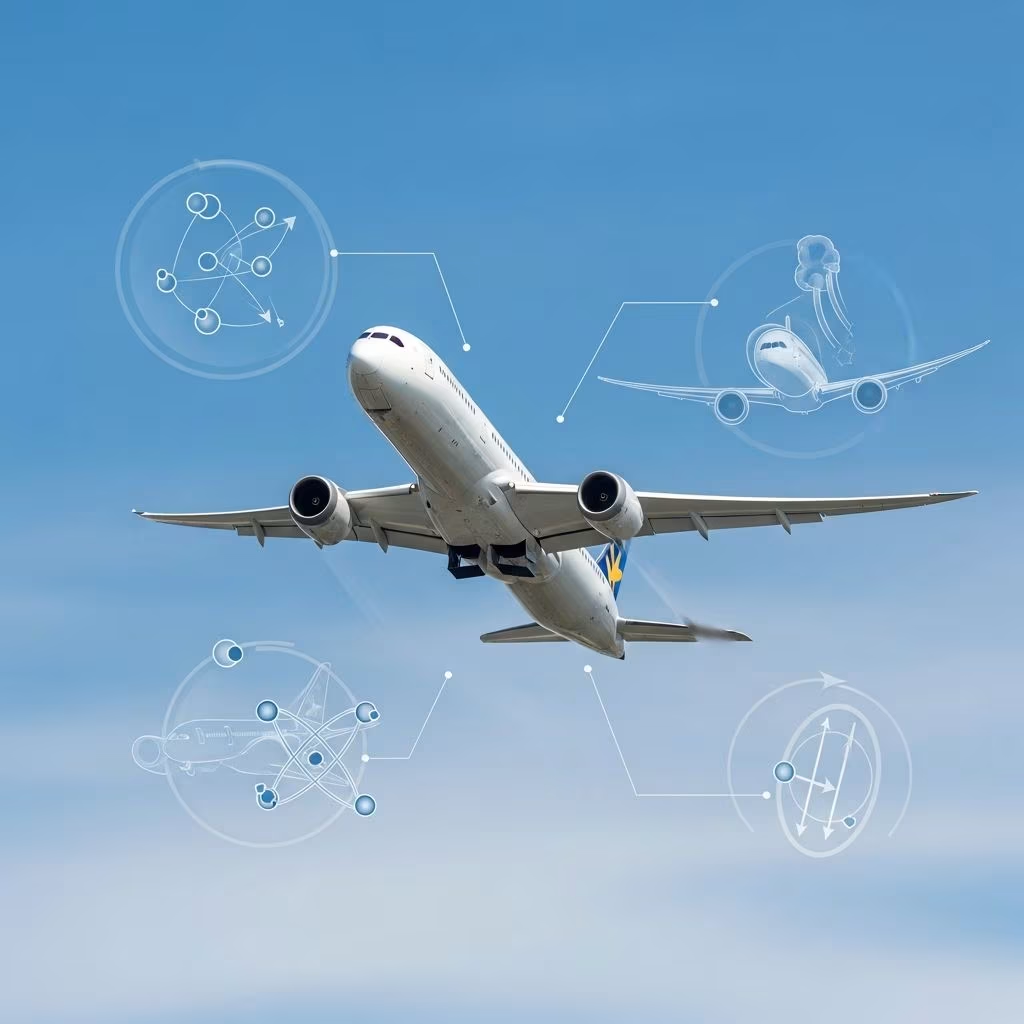
Every day, thousands of aircraft transport millions of passengers through the skies, defying gravity and covering vast distances. Yet few travelers pause to consider the elegant physics that makes this possible. The ability of a massive metal structure to rise above the ground and sustain flight in the air depends not on magic, but on precise interactions between engineering, design, and fundamental forces. Understanding how aircraft fly reveals one of humanity’s most remarkable achievements in applied physics.
At the foundation of aviation science lies a simple yet profound concept: four forces work together to control whether an aircraft rises, descends, or maintains a steady altitude. These forces—lift, weight, thrust, and drag—create the dynamic equilibrium that defines flight. When these forces balance perfectly, an aircraft can cruise effortlessly through the atmosphere. When they become unbalanced, the aircraft accelerates, slows down, or changes altitude.
Lift is the upward force that counteracts gravity and enables flight itself. Weight is the gravitational force pulling the aircraft downward. Thrust is the forward force generated by the engines that propels the aircraft through the air. Drag is the resistance the aircraft encounters as it moves through the atmosphere. For an aircraft to climb, thrust must overcome drag, and lift must exceed weight. During level flight, lift equals weight and thrust balances drag.
Lift is the most critical force enabling flight. It acts perpendicular to the aircraft’s direction of motion, pushing the aircraft upward against the pull of gravity. Without sufficient lift, even the most powerful engines cannot keep an aircraft airborne. The challenge for aeronautical engineers lies in designing structures that generate enormous amounts of lift while remaining light enough for practical operation.
The generation of lift depends primarily on the aircraft’s wings, which possess a distinctive cross-sectional shape called an airfoil. This carefully engineered profile transforms the simple act of air movement into a powerful upward force. The efficiency of this transformation determines how much weight an aircraft can carry and how fast it can travel.
The key to understanding how aircraft generate lift lies in studying the airfoil shape. A typical aircraft wing features a curved upper surface combined with a flatter lower surface, creating an asymmetrical profile. This seemingly simple geometry produces profound aerodynamic effects when air flows across it at high speed.
The relationship between wing shape and lift generation involves multiple physical mechanisms working in concert:
When an aircraft moves forward at sufficient speed, the wings split the oncoming air stream. The air above the wing must travel faster than the air below it, creating a pressure differential. According to aerodynamic principles, fast-moving air generates lower pressure than slow-moving air. This pressure difference produces an upward force that lifts the aircraft’s wings and thus the entire aircraft.
The angle of attack—the angle at which the wing meets the oncoming air—plays an equally important role in lift generation. Wings are not perfectly horizontal; they are tilted slightly backward. This orientation allows them to push air downward more effectively, generating additional lift through direct deflection. The curved upper surface amplifies this effect by deflecting more air than the flatter lower surface, creating significantly greater lift from the same airflow.
While wings provide lift, engines provide the forward motion necessary to generate that lift. Jet engines operate by drawing air into their intake, compressing it, igniting fuel to heat the air, and expelling the superheated gases at high velocity out the rear of the engine. This process directly applies Newton’s third law of motion: for every action, there is an equal and opposite reaction.
The tremendous force of hot exhaust gas shooting backward from the jet engine creates a reaction that propels the aircraft forward. This forward motion is thrust—the force that pushes the aircraft through the air at increasingly high speeds. As the aircraft accelerates, more air flows across the wings, generating more lift. This interdependence between engines and wings represents the elegant coordination that makes flight possible.
Throttle controls allow pilots to manage engine power. Pushing the throttle increases fuel flow to the engines, raising engine power and thus increasing thrust. Pulling the throttle decreases power output. The pilot manipulates these controls throughout flight to adjust the aircraft’s speed and altitude in response to changing flight conditions.
Drag represents the total air resistance encountered by an aircraft as it moves through the atmosphere. This force opposes thrust and increases dramatically with speed. Aircraft designers must carefully minimize drag through aerodynamic shaping and material selection to ensure that engines can overcome this resistance efficiently.
Two primary sources contribute to total drag: parasitic drag and induced drag. Parasitic drag results from air friction against the aircraft’s skin, interference patterns where different components meet, and pressure differences created by the aircraft’s shape. Induced drag is generated as a byproduct of lift production—the vortices created by air flowing around the wing tips generate additional resistance.
Aircraft manufacturers reduce drag through streamlined fuselage design, smooth surface materials, and optimal wing geometry. Every component of the aircraft, from the nose cone to the landing gear, influences the overall drag profile. Modern aircraft incorporate aerodynamic principles developed through decades of research to achieve efficient flight at various speeds and altitudes.
The balance between the four forces changes depending on what the aircraft is doing at any given moment. During takeoff, thrust must exceed drag, and lift must exceed weight to accelerate the aircraft into the air. Pilots push the throttle to maximum, and as the aircraft speeds up, increasing airflow over the wings generates more lift until it overcomes the aircraft’s weight.
Once airborne and climbing, pilots adjust engine power to maintain the necessary thrust-to-drag ratio while the lift exceeds weight, causing continued altitude gain. During cruise, all four forces reach equilibrium—lift exactly balances weight, and thrust precisely matches drag. This balanced state allows the aircraft to maintain constant altitude and speed with minimal engine adjustment.
When descending for landing, pilots reduce thrust and may increase drag by extending flaps or deploying spoilers. As the aircraft slows, the wings generate less lift. When lift drops below weight, the aircraft descends toward the runway. Proper management of these forces ensures safe, controlled flight throughout all stages of operation.
Beyond the four fundamental forces, aircraft require control systems enabling pilots to manipulate their flight paths. Several moveable surfaces modify airflow around the aircraft to achieve pitch (up-and-down movement), roll (side-to-side tilt), and yaw (left-right rotation).
Ailerons, positioned near the wing tips, control roll by raising one wing and lowering the other. Pilots operate these surfaces through a control wheel—turning it clockwise raises the right aileron while lowering the left aileron, rolling the aircraft to the right. The rudder, located on the vertical tail, controls yaw by pushing air to one side. Elevators on the horizontal tail control pitch by deflecting the tail up or down, which tilts the entire aircraft’s nose up or down.
These control surfaces work by modifying the airflow around the aircraft and adjusting the distribution of lift and drag across different regions. When a pilot wants to turn, they coordinate aileron and rudder inputs to bank the aircraft and redirect its thrust vector toward the desired direction.
An aircraft’s balance—how weight is distributed from nose to tail—significantly affects its flight characteristics. If an aircraft becomes nose-heavy, the pilot must continuously hold back on the control stick to maintain level flight, wasting energy and increasing fuel consumption. A tail-heavy aircraft becomes unstable and difficult to control. Proper weight distribution, achieved through careful loading procedures and fuel management, keeps the aircraft in optimal balance throughout flight.
Airlines and crew members follow strict protocols regarding cargo and passenger placement to maintain the aircraft’s center of gravity within acceptable limits. This seemingly administrative task directly affects flight safety, efficiency, and control authority.
If lift drops below the aircraft’s weight, gravity overcomes the upward force, and the aircraft descends. This occurs naturally when pilots reduce engine power or decrease airspeed, causing less air to flow across the wings and therefore less lift to be generated.
Yes. An inverted aircraft can fly if the pilot increases the angle of attack sufficiently to generate enough lift to overcome weight. Stunt pilots and military pilots regularly perform inverted flight. However, most commercial aircraft are not designed for sustained inverted flight due to structural considerations and fuel system limitations.
Aircraft require distance to accelerate to sufficient speed so that airflow over the wings generates enough lift to overcome their weight. The heavier the aircraft or the warmer the air (which reduces air density and therefore lift), the longer the runway required to reach takeoff speed.
At higher altitudes, air density decreases, which reduces the amount of lift generated for any given airspeed. Aircraft must fly faster at high altitudes to generate equivalent lift. Most commercial jets cruise at altitudes where air density provides optimal efficiency between fuel consumption and speed.
The ability of aircraft to fly represents the culmination of physics, engineering, and human innovation. By harnessing four fundamental forces and applying them through carefully designed structures and systems, engineers have created machines that safely transport billions of people annually through the skies. Each flight demonstrates the practical application of aerodynamic principles discovered through centuries of scientific investigation.
Modern aviation continues to advance as engineers develop lighter materials, more efficient engines, and increasingly sophisticated control systems. Yet the fundamental physics remains unchanged—lift, weight, thrust, and drag must work in harmony to achieve flight. Understanding these basic principles reveals why aircraft are marvels of applied science that we can confidently trust to carry us safely to destinations around the world.
