

 Travel Essentials
 Travel Essentials

Explore how federal funding lapses impact national park operations, visitor access, staff safety, and local economies across all 50 states and territories.
 Travel Essentials
When Congress fails to pass appropriations legislation before the fiscal year concludes, a cascade of consequences unfolds across America’s network of protected natural areas. The operational framework that sustains hundreds of parks, monuments, and recreation areas depends entirely on congressional funding, making budget impasses a critical threat to visitor experiences, resource conservation, and the economies of surrounding communities.
The National Park Service operates through a complex funding structure that relies almost exclusively on annual congressional appropriations. Unlike private enterprises that generate revenue through operations, national parks depend on federal dollars approved by legislators each fiscal year. When Congress cannot agree on a spending bill before September 30, the federal government enters a shutdown state, forcing park management to navigate unprecedented operational constraints.
This funding model creates vulnerability. National parks serve as stewards of irreplaceable natural and cultural resources while simultaneously welcoming millions of visitors annually. The system requires continuous maintenance, professional staff, and safety infrastructure—all contingent on steady federal funding flows.
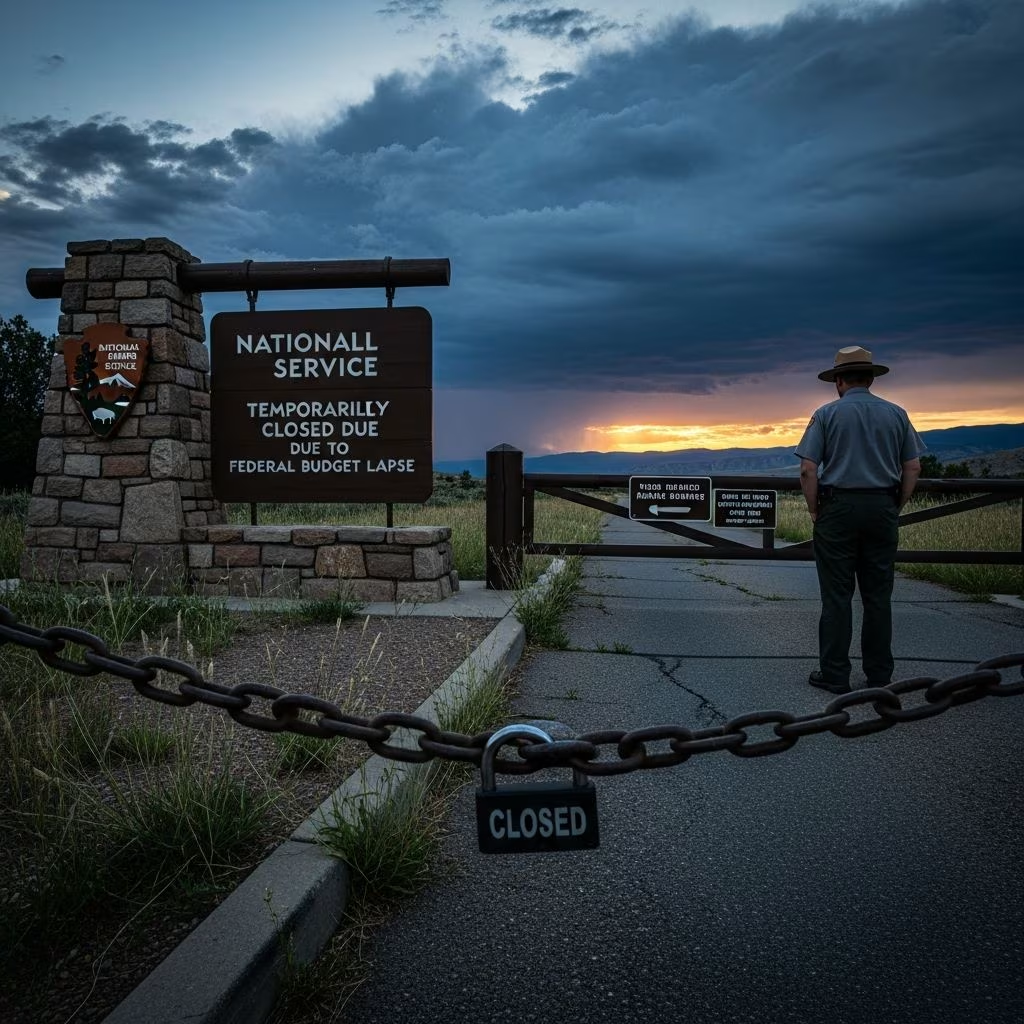
Federal funding lapses create immediate uncertainty regarding public access to national parks. While some parks may remain partially accessible due to their open terrain, the majority face complete or substantial closures. During previous shutdowns, park entrances are locked, visitor centers shuttered, and rangers furloughed, effectively barring the public from these cherished destinations.
The safety implications are particularly concerning. When parks operate with minimal staffing, visitor protection becomes compromised. Law enforcement, emergency response capabilities, and risk management functions deteriorate significantly. Park officials issue warnings encouraging visitors to stay away, recognizing that adequate supervision cannot be maintained. The liability exposure increases substantially when thousands of visitors attempt to access parks with skeletal staff complements.
Beyond immediate safety concerns, parks face secondary risks. When professional management disappears, unauthorized activities proliferate. Illegal camping, trespassing on closed areas, unauthorized hiking in dangerous terrain, and even extreme sports like BASE jumping occur without regulation or rescue capability. These activities not only endanger participants but also increase damage to fragile park ecosystems.
The human toll of appropriations failures manifests immediately through workforce disruptions. Nearly two-thirds of National Park Service employees—approximately 9,300 individuals—are classified as non-essential and face furlough without pay during shutdowns. These are not peripheral administrative workers; they represent the backbone of park operations including maintenance teams, rangers, biologists, and administrative specialists.
The magnitude of parks magnifies staffing problems. Yellowstone National Park alone covers more land than Delaware and Rhode Island combined, yet operates with a finite workforce. Managing such vast territories under normal circumstances strains resources; managing them with two-thirds of staff eliminated creates impossible conditions.
Maintenance operations cease almost entirely. Basic park upkeep—trail repairs, facility inspections, infrastructure assessment—accumulates into deferred maintenance backlogs. National parks already carry decades of postponed maintenance due to chronic underfunding. Shutdowns only worsen this problem, as the limited remaining staff cannot perform preventive work that stops minor issues from becoming major crises.
Professional park staff view natural and cultural resource stewardship as central to their mission. When these employees are furloughed, conservation efforts halt. This creates dangerous gaps in protection during critical seasons when visitor pressure peaks or environmental threats intensify.
The consequences manifest through multiple pathways. Littering increases as visitor behavior monitoring disappears. Graffiti damages cultural and geological features. Off-trail hiking accelerates soil erosion and damages sensitive vegetation. Invasive species management programs cease, allowing non-native organisms to spread unchecked. These impacts accumulate quickly and often prove irreversible, particularly in ecologically fragile environments.
Climate change adaptation strategies also suffer. Parks employ specialists monitoring shifting species ranges, water availability patterns, and extreme weather risks. When these positions are furloughed, monitoring stops, leaving parks blind to evolving environmental challenges.
The economic impact extends far beyond park boundaries. Small communities surrounding national parks depend disproportionately on visitor spending. These gateway towns—often rural areas with limited economic diversification—rely on park-related tourism for business activity.
The numbers are substantial. National parks generate approximately $19 million daily in visitor spending during winter months alone. When parks close, this revenue stream evaporates overnight. During the 2013 shutdown lasting just 16 days, gateway communities lost an estimated $414 million in revenue. Current estimates suggest local economies could lose as much as $80 million in visitor spending every day parks remain closed.
This economic damage cascades through local business ecosystems. Hotels cannot fill rooms. Restaurants lose customers. Retail shops experience reduced traffic. Employee hours get cut. Seasonal workers face unemployment. Communities dependent on visitor spending face genuine hardship.
National parks generate substantial fee revenue from entrance passes, camping permits, and recreational use licenses. This money supports park operations and cannot be replaced through other funding mechanisms during shutdowns. Data indicates parks lose more than $1 million daily in fee revenue when closed.
Historical data provides context. During the 2018-19 shutdown period, the National Park Service lost approximately $400,000 per day from missed entrance fee revenue. But beyond direct entrance fees, parks lose camping reservation income, special event permits, and commercial use fees. The cumulative financial impact creates operational deficits that reverberate long after parks reopen.
Additionally, concessioners—private companies operating lodges, restaurants, and retail within parks—face lost revenue and potential layoffs. These businesses struggle to remain viable when parks close, creating secondary economic damage beyond the park system itself.
The cultural and recreational value of park access should not be underestimated. National parks represent accessible opportunities for Americans to experience natural wonders, engage in outdoor recreation, and connect with heritage sites. When shutdowns occur, millions lose this opportunity.
During the 2013 shutdown, parks experienced 8 million lost recreational visits over just 16 days. Families with vacation plans canceling reservations. School groups postponing educational field trips. Individual travelers adjusting itineraries. Seniors visiting bucket-list destinations finding gates locked. The disruption affects Americans across all demographics and economic circumstances.
Educational programs cease entirely during shutdowns. Interpretive rangers who explain geological formations, historical events, and ecological processes are furloughed. Structured educational offerings—school programs, ranger talks, guided nature walks—disappear.
Government shutdowns do not occur in isolation. They intersect with existing systemic challenges facing the National Park Service. Prior to recent shutdowns, the Park Service had already lost nearly 24 percent of its permanent staff, many occupying senior leadership roles with decades of experience. This pre-existing staffing crisis means shutdowns strike an already-weakened system.
Chronic underfunding creates perpetual resource constraints. Parks operate with insufficient funds for adequate staffing, facility maintenance, and conservation programs. Budget battles and threat of shutdowns add uncertainty that complicates strategic planning and employee retention. Talented park professionals leave for more stable employment, further eroding institutional knowledge.
The maintenance backlog represents an enormous financial burden. Parks carry deferred maintenance obligations exceeding the annual federal allocation by multiples. Shutdowns prevent even routine maintenance work, allowing backlogs to expand.
Park managers face difficult choices when funding lapses occur. The Department of the Interior must decide whether to completely close parks or maintain limited operations. This decision involves balancing multiple priorities: visitor safety, resource protection, liability exposure, and public access to public lands.
Completely closing parks provides maximum resource protection and eliminates liability exposure but denies public access and eliminates fee revenue. Maintaining limited operations sustains some visitor access and revenue but stretches minimal staff and creates safety risks. Some administrations have attempted contingency approaches, partially opening parks with skeleton crews during shutdowns, but these approaches merely redistribute the problems rather than solving them.
Park officials uniformly discourage visitation during shutdowns, warning visitors to enter at their own risk. These warnings acknowledge reality: parks cannot be safely managed without adequate staffing and resources.
Government shutdowns affect national park units across all 50 states, the District of Columbia, and U.S. territories including Puerto Rico, Guam, and American Samoa. This geographic dispersion means disruptions affect diverse populations and economies nationwide. Visitors planning trips to parks in every region face uncertainty. Communities in every state that depend on park tourism face economic stress.
When parks reopen after shutdowns, challenges persist. Parks must conduct resource assessments to evaluate damage accumulated during closure periods. Cleanup operations addressing increased littering and vandalism require significant labor. Maintenance backlogs grow. Deferred conservation work continues accumulating.
Staff morale suffers from the uncertainty, furloughs, and reduced paychecks associated with shutdowns. Experienced employees become frustrated with government dysfunction and seek private sector employment, perpetuating staffing challenges that outlast the shutdown itself.
The Department of the Interior develops contingency plans determining park closure decisions. Complete closure protects resources most effectively but eliminates public access. Limited operations maintain some access but create safety and resource management challenges. Administrative decisions reflect attempts to balance competing priorities under impossible circumstances.
Shutdown duration depends on congressional action. Recent shutdowns have lasted from days to weeks. The longest federal shutdown lasted 35 days in 2018-19. Each day of closure multiplies economic damage, operational challenges, and resource protection gaps.
Some essential personnel may continue working without pay under emergency provisions, typically limited to immediate safety and emergency response functions. The vast majority of park staff face furlough without compensation until appropriations legislation passes.
Damage varies by duration and park characteristics. Some environmental damage proves irreversible. Extended underfunding of maintenance accelerates deterioration of facilities. Loss of institutional knowledge when experienced staff leave creates lasting operational consequences.
Government shutdowns represent systemic failures of fiscal responsibility that disproportionately harm America’s natural heritage and surrounding communities. Parks cannot effectively fulfill their dual mandate—providing public access while protecting resources—when operations suspend due to congressional budget failures. Addressing this vulnerability requires commitment to timely appropriations, adequate funding levels, and recognition that parks represent essential national infrastructure requiring sustained investment and professional stewardship.
