

 Travel Essentials
 Travel Essentials

Learn how to predict aurora activity using magnetic field data, solar cycles, and weather patterns for optimal viewing opportunities.
 Travel Essentials
The Northern Lights have captivated observers for centuries, but the mystery surrounding their appearance has only recently been demystified through modern space weather science. Rather than relying on folklore or blind luck, today’s aurora enthusiasts can leverage sophisticated forecasting tools and scientific measurements to dramatically improve their chances of witnessing this spectacular natural phenomenon. This comprehensive guide explores the mechanisms driving auroral activity and introduces practical strategies for predicting when and where the Northern Lights will be visible.
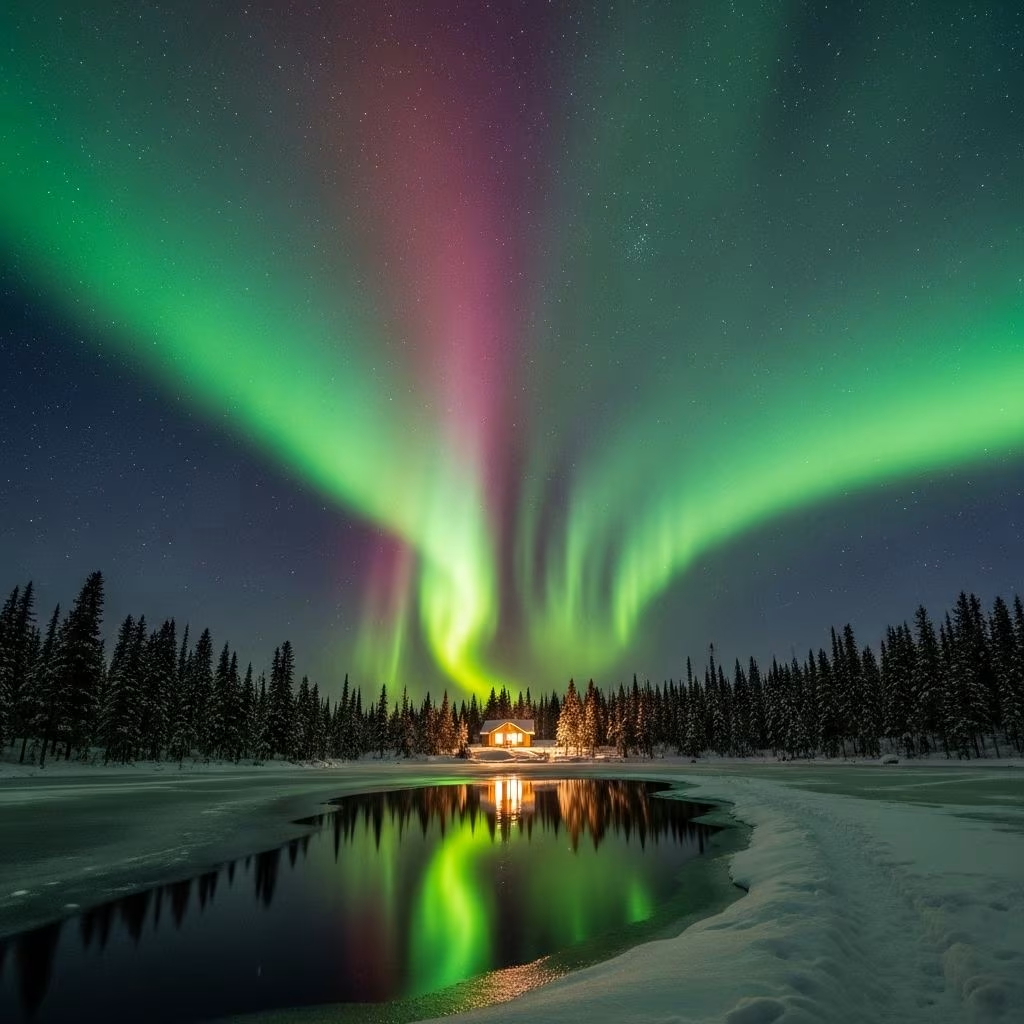
Aurora displays result from a complex interaction between our sun and Earth’s magnetic field. When the sun ejects charged particles into space through solar wind, these particles travel toward Earth at varying speeds and intensities. Upon reaching our planet, they collide with gases in the upper atmosphere, typically at altitudes between 60 and 200 miles above the surface. These collisions excite atmospheric molecules, causing them to emit the characteristic green, red, and purple hues that define auroral displays.
The strength and frequency of these displays depend critically on the sun’s activity level. During periods of heightened solar activity—marked by increased sunspot formation and coronal mass ejections—the intensity and geographic range of aurora activity expand dramatically. Understanding where we are within the solar cycle therefore becomes essential for long-term aurora forecasting.
The sun operates on an approximately 11-year cycle of activity, with periods of relative quiescence alternating with periods of intense magnetic activity called Solar Maximum. During Solar Maximum, the frequency of solar flares, coronal holes, and sunspot activity increases substantially, generating more consistent auroral displays across higher northern and southern latitudes.
For those planning aurora viewing expeditions, understanding the current phase of the solar cycle provides valuable context. The sun completes one full rotation approximately every 27 to 28 days as observed from Earth. This means that sunspots and coronal holes—persistent sources of solar wind—maintain their geoeffective positioning roughly every four weeks. Aurora observers who identify particularly active nights can mark their calendars and expect enhanced activity again 27 to 28 days later, provided the same solar features remain active.
This predictability allows both casual observers and dedicated aurora hunters to plan viewing trips with greater confidence, knowing that conditions that produced spectacular displays in one month may repeat with similar intensity a month later.
While popular culture often references the Kp index as the primary aurora forecasting metric, space scientists emphasize that this measurement has significant limitations for practical viewing predictions. Instead, more sophisticated forecasters rely on measurements of Earth’s magnetosphere and the Interplanetary Magnetic Field (IMF).
The Bz Component
The most critical measurement for aurora forecasting is the Bz value, which represents the north-south orientation of the Interplanetary Magnetic Field. When the Bz turns negative—particularly dropping below -10 nanoTesla (nT)—the conditions become highly favorable for auroral activity. The more negative the Bz value becomes, the stronger the resulting aurora displays typically are. Values plunging to -200 to -500 nT indicate exceptional conditions where brilliant, widespread displays should occur.
This relationship occurs because a negative Bz value indicates that the IMF is pointing southward, enabling it to effectively couple with Earth’s magnetosphere. This coupling allows solar wind energy to transfer into our planetary magnetic field more efficiently, energizing the auroral oval and intensifying displays across polar regions.
The Bt Strength Component
Beyond the Bz orientation, the overall strength (Bt) of the Interplanetary Magnetic Field matters significantly. Higher Bt values—ideally 20 nT or greater—indicate a more intense solar wind environment capable of producing brighter, more expansive auroras. The combination of a negative Bz and high Bt creates optimal conditions for spectacular displays.
Perhaps the most overlooked forecasting principle involves understanding the geographic distribution of auroral activity. Aurora displays concentrate within a ring-shaped region circling Earth’s magnetic poles, called the auroral oval. This oval typically positions itself between approximately 65 and 70 degrees north and south latitude under quiet magnetic conditions.
This geographic reality fundamentally changes how forecasting tools should be interpreted depending on the observer’s location.
High-Latitude Observers
For individuals located within or very near the auroral oval—such as residents of Alaska, northern Canada, Greenland, Iceland, Norway, Sweden, Finland, or Siberia—aurora can become visible at any time during hours of darkness, regardless of the Kp index or other broad forecasting metrics. Since the auroral oval already encompasses or hovers directly above these locations, aurora activity occurs almost continuously, though the intensity varies. Even at Kp levels of 0 or 1, observers in these regions may witness auroral displays overhead because the lights are literally happening in their local airspace.
Mid-Latitude Observers
For observers located at lower latitudes—south of approximately 50 degrees north—the situation changes dramatically. These individuals sit well outside the typical auroral oval, and displays become visible only when the auroral oval expands southward during active magnetic storms. High Kp values (5 or greater) become crucial for mid-latitude observers because they indicate that the auroral oval has expanded sufficiently to bring aurora displays into view from lower latitudes.
Aurora activity varies not only with solar conditions and geographic location but also with seasonal factors. The prime aurora season across northern polar latitudes runs from August through April, when extended darkness provides adequate conditions for observation. During the May-through-July months, continuous daylight in far-northern locations eliminates viewing opportunities, though aurora can still be spotted at lower latitudes during summer months.
Statistical analysis of historical aurora data reveals that autumn equinox conditions (particularly September) and spring equinox periods (March) statistically produce the most reliable aurora activity, though winter months (October through February) offer abundant darkness and consistently good opportunities.
Peak viewing typically occurs between 11 PM and 2 AM local time, though aurora can appear at any hour after sunset. Early morning displays between midnight and dawn occur frequently, and dedicated observers have reported successful viewing as early as 8 PM and as late as 8 AM.
Scientific forecasting prowess means little if cloud cover obscures the sky. Since aurora occurs in the upper atmosphere, any substantial cloud layer between the observer and the auroral oval completely prevents viewing, regardless of how favorable the magnetic conditions may be.
Successful aurora hunting therefore requires integrating space weather forecasts with terrestrial weather data. Many modern aurora forecasting applications incorporate local cloud forecasts alongside magnetic activity predictions, enabling observers to identify not only magnetically favorable nights but also locations nearby with clear skies. A 30-minute drive to an adjacent region with clearer conditions can transform a disappointing night into an exceptional viewing experience.
Moon phase also influences viewing quality. Full moon conditions increase ambient light and reduce contrast between auroral displays and the night sky. New moon or dark moon phases provide superior viewing conditions by eliminating lunar light pollution. Additionally, viewers should minimize exposure to terrestrial light sources—distant cities, towns, and artificial lighting all degrade aurora visibility. Remote locations far from populated areas provide substantially better viewing experiences.
Modern aurora forecasting requires synthesizing information from multiple sources rather than relying on any single metric. A comprehensive forecasting approach incorporates:
Official space weather agencies, including NOAA’s Space Weather Prediction Center, provide detailed forecasts incorporating these variables. Numerous specialized applications deliver real-time alerts and multi-week projections, enabling observers to identify favorable periods well in advance.
Several persistent misconceptions mislead aurora hunters and reduce their success rates.
The Cold Temperature Myth
Many assume that aurora activity requires extreme cold. In reality, aurora displays depend on darkness and clear skies rather than temperature. The association between cold nights and aurora viewing exists because clear skies—which permit aurora observation—typically coincide with cold air masses. Temperature itself plays no direct role in aurora formation or visibility.
The Kp Index Overreliance
While Kp indices feature prominently in popular aurora forecasting discussions, they serve limited practical value for observers already located within high-latitude regions where the auroral oval typically resides. The Kp index primarily indicates whether the auroral oval has expanded sufficiently to bring displays into view from mid-latitude locations. High-latitude observers depending exclusively on Kp values miss countless opportunities to view active displays occurring directly overhead.
Successful aurora observation combines scientific knowledge with practical logistics. Begin by determining your location relative to the auroral oval. For high-latitude observers, focus on magnetic field measurements (Bz and Bt values) rather than Kp indices. Check weather forecasts nightly during favorable periods, and be prepared to travel short distances to clear skies. For mid-latitude observers, emphasize the Kp index while monitoring magnetic field data and weather conditions.
Allow eyes approximately 20 minutes to dark-adapt for optimal viewing. Avoid using flashlights or checking mobile devices (set to lowest brightness) during observation periods. The human eye’s sensitivity to faint auroral displays increases substantially after this adaptation period.
Maintain flexible expectations. Despite favorable forecasts, aurora displays can be unpredictable in intensity and visibility. Some nights produce barely visible green glows, while others deliver brilliant, dancing curtains across the entire sky. Patience and multiple viewing attempts over several nights dramatically increase the probability of witnessing truly spectacular displays.
