

Food & Culture Stays Travel Essentials Travel Guides Trip Ideas
Categories
From the Blog
Remy’s Ratatouille Adventure at EPCOT: Ride Review, Tips & 2D Update
Travel Essentials

How to Forecast the Northern Lights

Discover how to interpret Northern Lights predictions, key metrics like Kp index, solar wind data, and optimal viewing strategies for unforgettable sky shows.
Travel Essentials

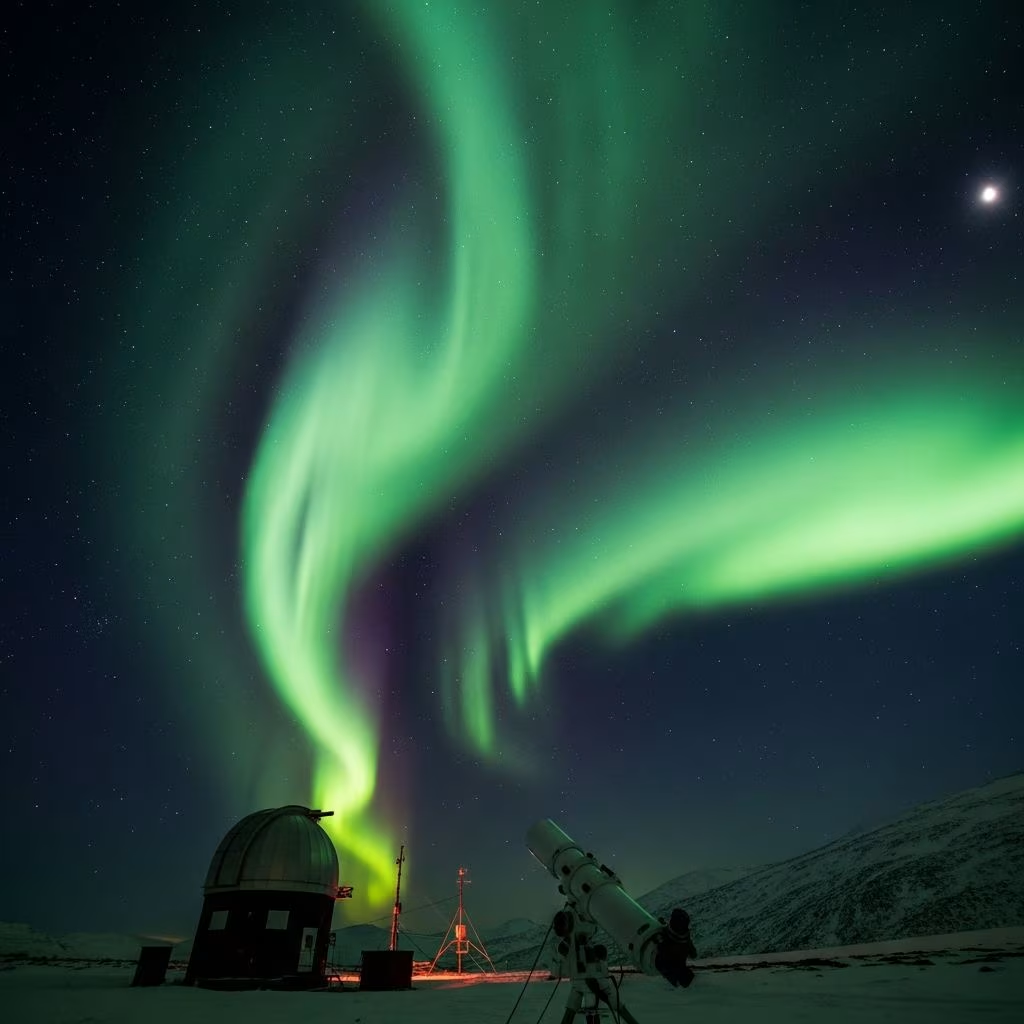
The Northern Lights, or Aurora Borealis, captivate skywatchers with their ethereal dances across polar skies. Charged particles from the sun collide with Earth’s atmosphere, creating vibrant glows visible primarily in high-latitude regions. Accurate predictions hinge on monitoring solar activity and geomagnetic conditions, allowing enthusiasts to time their outings perfectly.

The Science Behind Aurora Displays

Auroras stem from solar wind—streams of charged particles ejected from the sun—interacting with Earth’s magnetic field. These particles excite atmospheric gases, producing light in greens, purples, and reds. Stronger solar events, like coronal mass ejections (CMEs), amplify displays by triggering geomagnetic storms.

Earth’s magnetosphere funnels these particles toward the poles, concentrating auroras within the auroral oval, roughly between 60° and 75° latitude. This zone spans Iceland, Scandinavia, Alaska, and northern Canada. During intense storms, the oval expands southward, reaching mid-latitudes like the northern U.S. or Scotland.

Core Metrics for Aurora Forecasting

Reliable forecasts rely on several key indicators. Understanding them empowers precise planning.

  • Kp Index: This planetary scale (0-9) gauges global geomagnetic activity. Values of 0-2 signal quiet conditions with faint auroras near the poles; 5+ promises vivid shows viewable farther south. For mid-latitude viewers, aim for Kp 6 or higher.
  • Solar Wind Speed: Measured in km/s, speeds over 500 km/s heighten storm potential. Faster winds deliver more particles, intensifying auroras.
  • Bz Component: Part of the interplanetary magnetic field (IMF), negative Bz values (southward orientation) enable particles to penetrate Earth’s field, sparking stronger displays. Values below -10 nT are ideal.
  • 27-Day Solar Outlook: The sun’s 27-day rotation lets forecasters track recurring sunspots or coronal holes, predicting enhanced activity cycles.

Forecasts update frequently—often every few hours—due to rapidly evolving space weather. Short-term (1-3 days) predictions outperform long-range ones, especially in changeable climates.

Prime Seasons and Timing for Sightings

Aurora season aligns with polar darkness, from late August to early April. Equinox periods (September-October, March-April) yield peak activity due to Earth’s magnetic alignment with solar wind.

MonthAurora StrengthDarkness LevelNotes
September-OctoberHighModerateEquinox boost; milder weather
November-FebruaryMedium-HighMaximumLong nights; potential cloud cover
March-AprilHighModerateEquinox peak; improving conditions

Peak viewing hours span 11 PM to 2 AM local time, though displays can appear from dusk to dawn in darkness. Cold isn’t required—clear, dark skies suffice—but winter often pairs them.

Top Tools and Apps for Real-Time Alerts

Leverage these resources for up-to-the-minute data:

  • NOAA Space Weather Prediction Center: Official aurora viewlines and 3-day outlooks for North America.
  • Geophysical Institute (Alaska): Localized forecasts with Kp estimates.
  • My Aurora Forecast App: Hourly predictions, solar data, and cloud cover overlays.
  • AuroraHunter.com: 27-day solar cycle trackers and historical patterns.
  • Perlan.is: Iceland-specific forecasts emphasizing solar wind direction.

Combine geomagnetic forecasts with local weather apps to dodge clouds, the primary viewing spoiler. Apps often integrate moon phase data, as full moons wash out fainter auroras.

Strategic Locations for Optimal Viewing

Escape light pollution to dark sites. In Iceland, head to remote highlands; Norway’s Tromsø offers tours to fjord-edge spots; Alaska’s Fairbanks provides urban access with rural escapes.

Pro Tips:

  • Drive or join tours to open areas away from cities.
  • Allow 20-30 minutes for eyes to dark-adapt.
  • Face north (south in Southern Hemisphere for Aurora Australis).
  • Patience pays—auroras pulse unpredictably.

During solar maximum (peaking around 2024-2025), expect more frequent, intense shows as the sun’s magnetic flip ramps particle ejections.

Advanced Prediction Techniques

Beyond basics, inspect solar imagery for coronal holes—persistent dark patches spewing solar wind. Track solar flares and CMEs via SOHO or SDO satellites; Earth-directed events arrive in 1-3 days.

Cross-reference multiple sites: NOAA for official data, aurora cams for live validation. In Iceland, south-facing solar wind enhances visibility by aligning with the magnetic field.

Common Myths Debunked

  • Myth: Auroras only appear on cold nights. Truth: Darkness and clarity matter more; mild equinox nights excel.
  • Myth: Full moons ruin all shows. Truth: They dim faint glows but strong Kp 7+ storms overpower lunar light.
  • Myth: Midwinter is always best. Truth: Equinoxes statistically outperform solstice lows.

Photography and Safety Essentials

Capture auroras with wide-angle lenses (14-24mm), tripods, and long exposures (10-30 seconds) at ISO 1600-3200. Track focus to infinity for sharp stars.

Safety first: Dress in layers, inform others of plans, and check road conditions in remote areas. Respect nature—stay on paths to protect fragile tundra.

Frequently Asked Questions

What Kp index guarantees Northern Lights?

No guarantee exists, but Kp 5+ offers good odds overhead at high latitudes; 7+ for lower ones. Always verify weather.

Can I see auroras from home?

Possible during G3+ storms (Kp 7) as far south as 40° latitude. Check NOAA viewlines.

How far ahead can I predict auroras?

3-day geomagnetic forecasts are reliable; 27-day solar trends guide longer plans.

What’s the solar cycle’s impact?

Solar maximum (every 11 years) boosts frequency; we’re in an active phase through 2025.

Do clouds always block auroras?

Yes, infrared auroras evade clouds, but visible light doesn’t. Prioritize clear forecasts.

Armed with these insights, transform aurora hunting from luck to strategy. Monitor forecasts diligently, seek darkness, and prepare for nature’s most spectacular light show.

References

  1. How to Read the Northern Lights Forecast — Perlan. Accessed 2026. https://perlan.is/articles/how-to-read-northern-lights-forecast
  2. Northern Lights Forecast — Aurora Hunter by Todd Salat. Accessed 2026. https://www.aurorahunter.com/northern-lights-forecast.html
  3. 6 ways to predict an aurora display in your area — Sky at Night Magazine. Accessed 2026. https://www.skyatnightmagazine.com/advice/how-predict-aurora
  4. Aurora Borealis Forecast — Soft Serve News. Accessed 2026. https://www.softservenews.com
  5. Aurora Viewline for Tonight and Tomorrow Night (Experimental) — NOAA SWPC. Accessed 2026. http://www.swpc.noaa.gov/products/aurora-viewline-tonight-and-tomorrow-night-experimental
  6. My Aurora Forecast & Alerts — Google Play. Accessed 2026. https://play.google.com/store/apps/details?id=com.jrustonapps.myauroraforecast&hl=en_US
  7. Aurora Forecast — Geophysical Institute, University of Alaska. Accessed 2026. https://www.gi.alaska.edu/monitors/aurora-forecast
  8. Aurora Tutorial — NOAA Space Weather Prediction Center. Accessed 2026. https://www.swpc.noaa.gov/content/aurora-tutorial
SN
Sneha Tete
Sneha is a relationships and lifestyle…

Sneha is a relationships and lifestyle writer with a strong foundation in applied linguistics and certified training in relationship coaching. She brings over five years of writing experience to CultureTreker,  crafting thoughtful, research-driven content that empowers readers to build healthier relationships, boost emotional well-being, and embrace holistic living.Her writing and insights reflect the belief that beauty, happiness, and wellness begin from within, through the harmonious balance of the mind, body, and heart. With a background in instructional design and research writing, Sneha transforms complex topics into practical insights that are easy to understand and apply.Sneha has also self-published a novella on adolescent mental health, highlighting her ability to navigate emotionally layered topics with nuance and empathy. When she's not writing, you'll find her exploring storytelling through photography, diving into K-dramas, or enjoying quiet moments with her family and friends.

← Previous
Best Mardi Gras Celebrations in the U.S.
‹›
