

 Travel Essentials
 Travel Essentials

Comprehensive guide to navigating Tokyo's trains, subways, buses, and airport transfers with practical advice for visitors.
 Travel Essentials
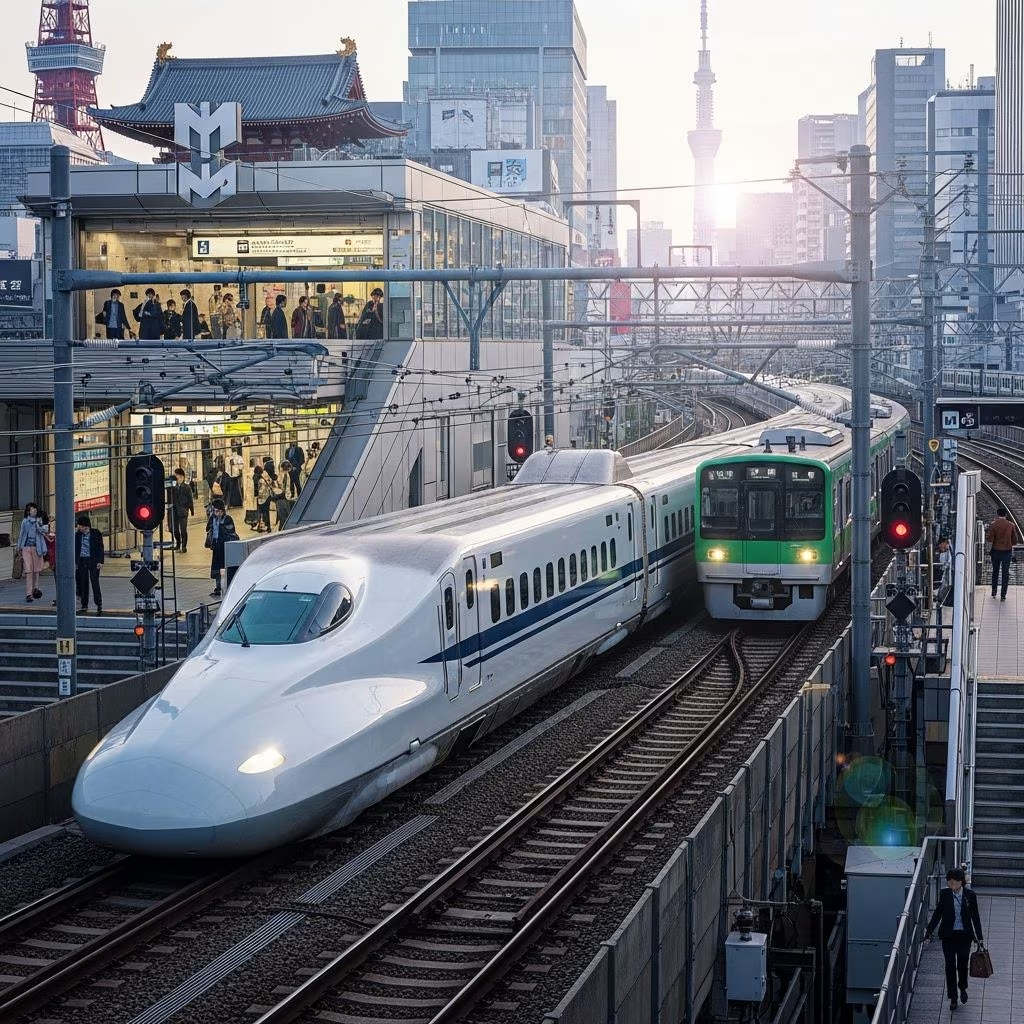
Tokyo’s reputation as one of the world’s most efficiently connected cities is well-deserved. The sprawling metropolitan area operates an intricate web of railways, subway lines, and bus networks that collectively move millions of residents and visitors daily. Understanding how to navigate this complex system transforms your Tokyo experience from potentially overwhelming to genuinely enjoyable. Whether arriving from one of the city’s two major airports or exploring neighborhoods from central hubs, mastering the fundamentals of Tokyo’s transportation infrastructure opens the city to seamless exploration.
Tokyo’s public transit network represents one of the most sophisticated and reliable systems globally, operated by approximately a dozen different companies working in coordinated harmony. Rather than viewing this as a complication, understanding the basic organizational structure actually simplifies navigation considerably. The network separates into distinct but interconnected components: the JR (Japan Railways) network managed by JR East for the Tokyo region, Tokyo Metro’s nine subway lines, the Toei Transportation system with four additional subway lines, and supplementary bus and local railway services.
This multi-operator approach emerged from historical development patterns rather than chaotic urban planning. Each entity maintains its own ticketing and card systems while ensuring physical integration at major interchange stations. For visitors, this means learning one core principle—using an IC card—grants access across most of the network regardless of operator.
Your first transit decision occurs before entering central Tokyo, at one of the city’s two primary gateways. Narita Airport, located 60 kilometers east of the city center, traditionally handled international arrivals but now competes with the more conveniently positioned Haneda Airport for both domestic and international traffic. The specific airport you arrive at significantly influences your most practical route into the city.
Travelers arriving at Narita Airport have several options for reaching the city, with the Skyliner train standing as the most efficient choice for most visitors. This dedicated express service connects the airport directly to central Tokyo with minimal transfers, operating on a predictable schedule that eliminates the uncertainty sometimes associated with bus or shared shuttle services. Purchasing a pre-paid Skyliner ticket before arrival streamlines the boarding process, allowing immediate access without navigating ticket counters during jet lag.
Haneda Airport’s proximity to central Tokyo presents even more favorable transit options compared to Narita. The Tokyo Monorail connects Haneda directly to the city center via an elevated route offering scenic views during your journey. For passengers preferring train alternatives, the Keikyū Railway also services Haneda with connections to major districts. Using a Suica IC card at Haneda—obtainable at airport convenience stores or pre-ordered online—enables tap-and-go convenience across monorail and railway services.
The single most transformative decision for navigating Tokyo involves obtaining a prepaid IC card, with Suica and Pasmo representing the two primary options. These contactless smart cards function across nearly the entire network, eliminating the need to purchase individual tickets for each journey or understand operator-specific ticketing systems. Visitors can purchase cards at airport locations, convenience stores throughout the city, or pre-order them online for pickup upon arrival.
The convenience factor cannot be overstated. Instead of joining queues at ticket machines to purchase individual fares, card holders simply tap at entrance gates and exit gates, with the system automatically calculating appropriate fares regardless of which operator manages each line segment. For most short-term visitors, prepaid cards prove significantly more cost-effective than daily passes or single tickets, particularly for those exploring multiple neighborhoods during their stay.
Understanding Tokyo’s geography becomes substantially easier once you grasp the significance of the Yamanote Line, perhaps the single most important transit route in the entire city. This JR-operated loop line circles central Tokyo in an approximately 35-kilometer route, connecting virtually every major neighborhood and commercial district. Rather than resembling a traditional linear route with a starting and ending point, the Yamanote Line functions as a continuous circle, meaning you can board at any station and travel either direction to reach virtually any central Tokyo destination.
The line serves as both a practical transportation tool and an informal orientation mechanism for visitors. Major stations on the Yamanote circuit include Shinjuku (the city’s largest commercial hub), Shibuya (entertainment and fashion district), Ginza (upscale shopping area), Marunouchi (business district), and numerous other significant neighborhoods. Trains arrive with remarkable frequency—approximately every three minutes during daytime hours—ensuring minimal waiting time between services.
The Klook travel blog offers a particularly useful navigation tip: if you become disoriented while navigating Tokyo’s complex system, boarding the Yamanote Line provides an opportunity to regain your bearings and plan your next movement. Its distinctive yellow-green line color on maps and its designation as Line 6 make it easily identifiable in wayfinding systems.
While the Yamanote Line provides essential circular connectivity, Tokyo’s full exploration requires understanding the radial and cross-city routes extending outward from the central loop. The Chuo Line and Sobu Line offer important east-west connections, with the Chuo Line particularly useful for reaching areas beyond the Yamanote circle. The Keihin-Tohoku Line runs parallel to the Yamanote Line while continuing south to connect Yokohama and other outlying cities.
For visitors with longer stays or specific neighborhoods to explore, recognizing these secondary routes prevents unnecessary retracing through central hubs. The interconnected nature of Tokyo’s rail system means most destinations can be reached through multiple route combinations, allowing flexibility based on current conditions or personal preference.
While above-ground JR trains dominate Tokyo’s image, the subway system proves equally essential for thorough city exploration. Two separate operators manage Tokyo’s 13 subway lines: Tokyo Metro with nine lines and Toei Transportation with four lines. Together, these systems blanket central Tokyo with extensive coverage, particularly throughout the Yamanote circle interior and eastern districts.
Tokyo Metro’s nine lines penetrate major neighborhoods and attractions, including the Ginza Line serving Shibuya, Omotesando, and Ginza districts; the Marunouchi Line connecting Asakusa; and the Namboku Line providing access to Tokyo Station and Roppongi. Toei’s four lines offer complementary coverage, with the Asakusa Line reaching traditional areas and the Oedo Line serving newer developments including Tokyo Skytree and Tsukiji Market area.
Navigating between JR trains and subway lines at major interchange stations has been considerably simplified through standardized signage and physical integration. Transfers between systems rarely require surface-level journeys; instead, underground corridors connect platforms with clear directional signage. For first-time visitors uncertain about connections, consulting Google Maps provides real-time guidance to appropriate platforms and optimal exit routes at destination stations.
Tokyo’s extensive bus network provides valuable transportation alternatives, particularly for destinations outside immediate central areas or routes where transit time by train would involve multiple transfers. However, transportation guides generally recommend that short-term visitors prioritize trains and subways, as buses require greater familiarity with route systems and Japanese language navigation. For longer stays or specific neighborhood exploration, buses offer legitimate advantages and greater flexibility than predetermined rail routes.
Central Tokyo itself maintains a relatively compact footprint relative to its geographic extent, making bicycles practical transportation for neighborhood exploration. Many areas feature manageable walking distances between attractions, with Tokyo’s dense clustering of cultural sites, restaurants, and shops within walkable zones. Combining short train journeys with walking and occasional bicycle use often provides the most authentic and flexible exploration methodology.
Tokyo’s taxi system offers exceptional service quality with clean vehicles, professional drivers, and reasonable English-language signage at major hotels and stations. However, taxi costs substantially exceed train fares for equivalent distances, making taxis impractical for frequent daily movement. Reserves should be saved for late-night transportation when trains cease operation or situations where precise door-to-door delivery justifies premium pricing.
Visitors planning intensive exploration over consecutive days might evaluate specialized pass options beyond basic IC card usage. The JR Tokyo Wide Pass enables unlimited rides across JR lines for three consecutive days, benefiting those planning to visit multiple outlying areas or making frequent Yamanote line circuits. For subway-focused exploration, day passes covering Tokyo Metro and Toei lines provide value for those making numerous transfers within single days.
Calculating individual fares for anticipated journeys against pass pricing prevents overpaying for passes that may not align with actual usage patterns. The flexibility of IC cards often proves sufficient for most visitors, eliminating the need for passes unless planning specific high-frequency travel days.
Modern technology dramatically simplifies Tokyo navigation for visitors accustomed to smartphone mapping applications. Google Maps integrates Tokyo’s complete transit network, providing real-time routing recommendations, estimated travel times, and platform-specific guidance. Rather than consulting printed maps or advance planning, smartphone navigation enables spontaneous exploration with confidence that optimal routes remain discoverable even when initial plans change.
Learning to identify stations by line color and number systematizes navigation beyond relying solely on station names. Multilingual signage throughout central Tokyo stations provides English information, reducing translation barriers. Station attendants at manned booths generally possess English capability at major hubs, offering personalized guidance when necessary.
Successfully navigating Tokyo’s transportation system represents one of travel’s most rewarding skills, transforming potential frustration into confident independence. The combination of reliable scheduling, comprehensive coverage, and modern technology creates an environment where spontaneous exploration becomes genuinely feasible. Rather than viewing the multi-operator system as complicated, understanding its organizational logic reveals logical patterns that accommodate visitors while efficiently serving millions of daily commuters.
Begin with fundamentals: obtain an IC card immediately upon arrival, learn the Yamanote Line’s significance as your geographic anchor, and utilize smartphone mapping for real-time guidance. This foundation positions you to explore Tokyo with increasing confidence, expanding from central neighborhoods to outlying areas as comfort with the system grows. Tokyo’s exceptional transit infrastructure represents decades of refinement and investment; approaching it with curiosity rather than apprehension unlocks possibilities for genuine urban exploration that relatively few international cities can match.
