

 Travel Essentials
 Travel Essentials

Explore the rise of commercial space tourism to the ISS, from pioneering missions to future prospects, costs, and impacts on space exploration.
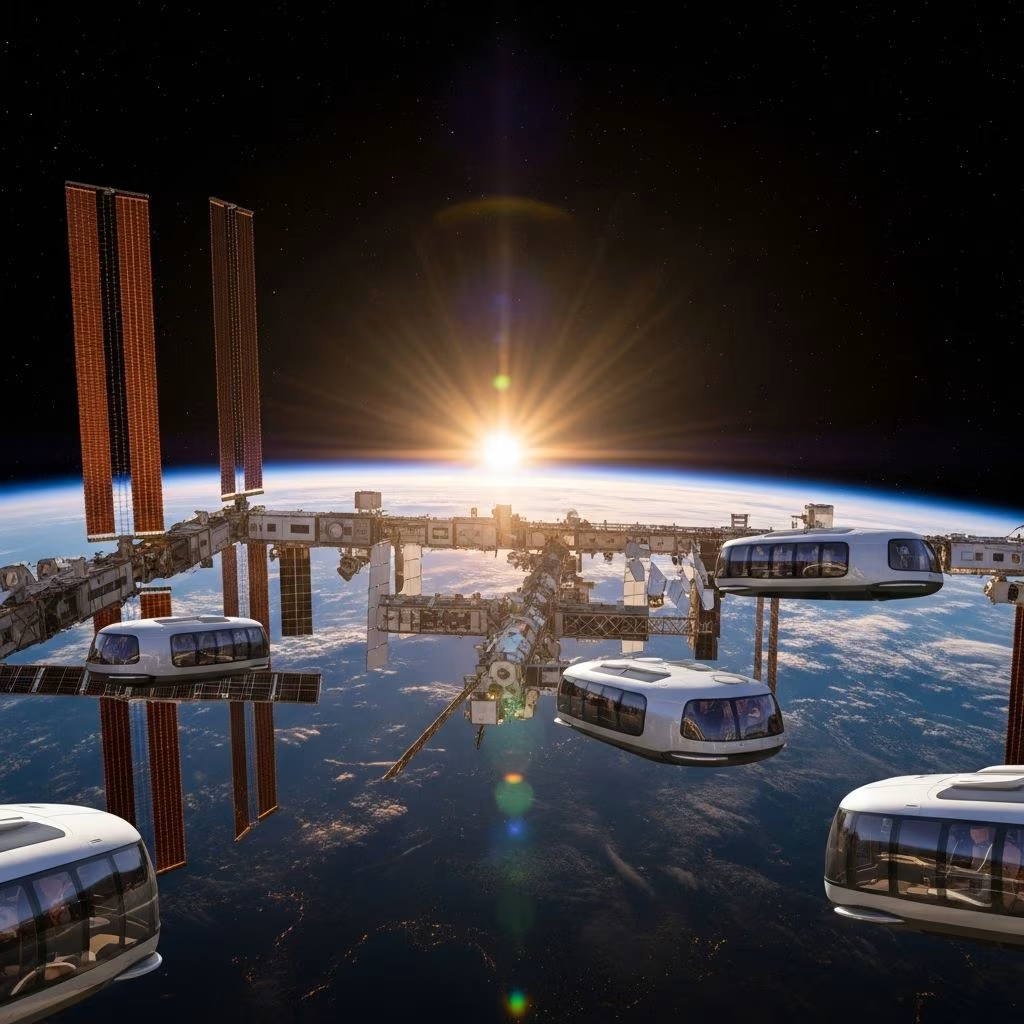 Travel Essentials
Commercial spaceflight has reached a pivotal moment, with private individuals now able to book trips to the **International Space Station (ISS)**, humanity’s orbital laboratory. These missions, facilitated by companies like Axiom Space and SpaceX, mark the shift from exclusive government programs to accessible adventures for the wealthy. Over 290 people from 26 countries have visited the ISS, including 13 private spaceflight participants from seven nations. This article delves into the evolution, logistics, experiences, and implications of this burgeoning industry.
The ISS, operational since 1998, was initially reserved for professional astronauts from partner nations like the US, Russia, Europe, Japan, and Canada. Early visitors arrived via Space Shuttle or Soyuz spacecraft, but the landscape changed dramatically in 2022 with Axiom Mission 1 (Ax-1), the first all-private crewed flight to the station. Launched on a SpaceX Dragon capsule named Endeavour, Ax-1 carried commander Michael López-Alegría—a veteran astronaut—and three private individuals: Larry Connor (USA), Mark Pathy (Canada), and Eytan Stibbe (Israel). They spent about a week conducting experiments and outreach, not mere sightseeing.
Subsequent missions like Ax-2 and Ax-3 have continued this trend, with crews including former NASA astronauts alongside novices. As of recent counts, 292 individuals have visited, blending professional crew with private visitors. This democratization, as described by participants, broadens space access beyond elite agencies.
Tickets to the ISS come at a premium. Early Soyuz seats sold for around $20-40 million per person through agencies like Space Adventures. Axiom’s packages start at approximately $55 million, covering launch, stay, and return, though exact figures vary by mission. These costs fund vehicle operations, training, and station resources. Prospective tourists undergo rigorous medical checks, physical training, and simulations to prepare for microgravity and emergencies.
| Mission | Launch Vehicle | Crew Composition | Duration (days) | Notable Features |
|---|---|---|---|---|
| Ax-1 (2022) | SpaceX Dragon | 1 pro + 3 private | ~8 | First all-private ISS crew |
| Ax-2 (2023) | SpaceX Dragon | Mixed pro/private | ~10 | Diverse international team |
| Ax-3 (2024) | SpaceX Dragon | 4 private-led | ~14 | Extended research focus |
This table highlights key missions, showing increasing durations and private involvement.
Preparation rivals that of professional astronauts. Candidates train at facilities like NASA’s Johnson Space Center or Axiom’s Houston base. Programs span 4-6 months, covering:
Astronauts like those on Ax-1 emphasize that private crews contribute meaningfully, performing citizen science to justify their presence.
The ISS spans the size of a six-bedroom house, with modules like Harmony, Tranquility, and Unity serving as hubs. Visitors float through corridors, adapting to weightlessness where sleep pods strap you to walls, food is rehydratable pouches, and hygiene involves no-rinse wipes.
A typical day includes:
Tours by astronauts like Sunita Williams reveal compact bedrooms, galley kitchens, and the infamous latrine—a suction toilet with foot straps. Privacy is scarce, but the awe of orbiting at 17,500 mph overshadows discomforts.
Private visitors aren’t passive; they advance research. Ax-1 crew ran over 20 experiments on human physiology, tech demos, and education. Topics include:
NASA welcomes these, as they expand experiment capacity without straining pro crews. Over 3,000 investigations have occurred on ISS, many yielding Earth applications like improved vaccines.
Risks remain high: launch failures, radiation, and reentry stresses. SpaceX’s Dragon has a proven record, docking autonomously via lasers. NASA certifies visitors, ensuring they meet Expedition crew standards. Psychological strain from confinement and isolation is mitigated by pre-mission team-building.
COVID protocols once quarantined crews; future missions may face orbital debris threats or geopolitical tensions affecting partnerships.
Axiom plans its own station by 2028, freeing NASA for Artemis lunar goals. Other players like Blue Origin and Vast aim for orbital hotels. By 2030, ISS visitor numbers could double, with costs dropping via reusable tech. As astronaut Mike López-Alegría notes, this “democratizes” space, inspiring innovation.
Projections suggest 100+ private flights by decade’s end, blending tourism with research.
Critics question sustainability: each mission adds orbital clutter, though deorbit plans exist. Ethically, exclusivity raises equity issues, but proponents argue profits fund deeper exploration. Benefits like tech spin-offs (e.g., better batteries) trickle down.
Around $55 million, including training and stay.
Yes, they conduct experiments and outreach.
NASA-vetted protocols ensure safety parity with pros.
Suborbital trips start at $450k; orbital may drop to millions by 2030s.
Private stations like Axiom Station.
