

 Travel Essentials
 Travel Essentials

Learn when, where, and how to watch the Eta Aquariid meteor shower in May 2026, featuring up to 60 meteors per hour at peak viewing.
 Travel Essentials
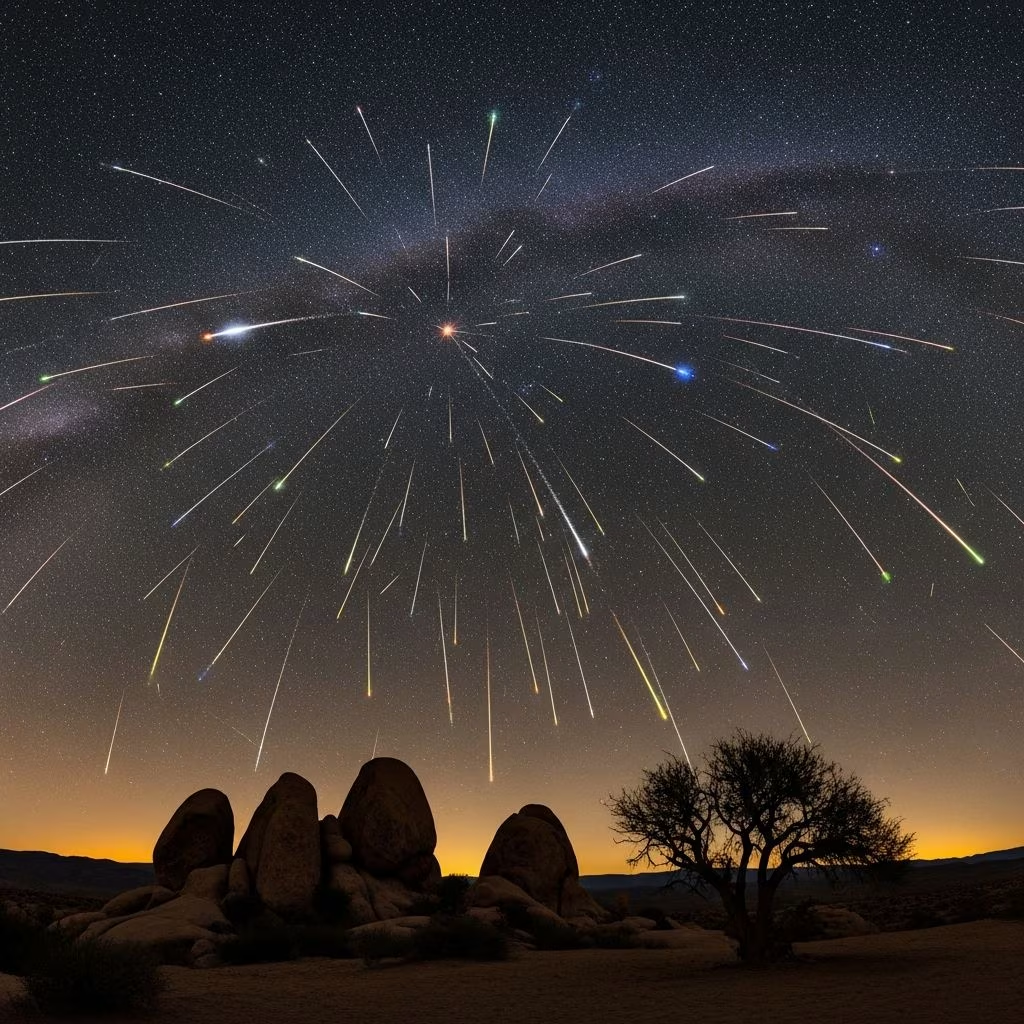
Each spring, Earth passes through the orbital debris trail of one of the most famous celestial visitors in our solar system—Halley’s Comet. This cosmic encounter produces one of the year’s most spectacular astronomical events: the Eta Aquariid meteor shower. Whether you’re a seasoned astronomer or a curious beginner, understanding how to observe this dazzling display can transform a clear night into an unforgettable celestial experience.
The Eta Aquariids represent a remarkable intersection of history, physics, and celestial mechanics. These meteors originate from dust particles left behind by Halley’s Comet as it travels through its orbit around the sun. When Earth passes through this debris field, these particles enter our atmosphere at tremendous velocities, creating brilliant streaks of light as they burn up from friction with the air.
Named after Eta Aquarii, one of the brightest stars in the constellation Aquarius, this meteor shower has captivated observers for centuries. The shower’s appearance every May serves as a reliable reminder of our planet’s journey through space and its interactions with ancient cometary materials.
The Eta Aquariid meteor shower displays a lengthy active period, spanning from approximately mid-April through late May. Specifically, observers can expect to see occasional meteors beginning around April 15 and continuing through May 27.
However, the true spectacle occurs during the peak period. For 2026, the maximum activity is predicted to occur around 3:51 UTC on May 5, with optimal viewing continuing through the early morning hours of May 6. During the peak window, ideal conditions could yield up to 60 meteors per hour, known as the zenithal hourly rate (ZHR).
In practical terms, Northern Hemisphere observers typically witness between 10 to 15 meteors per hour during peak conditions, while Southern Hemisphere observers often experience significantly higher rates due to the shower’s southward radiant position.
Successful meteor observation requires understanding when conditions align favorably. The pre-dawn hours represent the absolute best viewing window for the Eta Aquariids. This occurs because the radiant—the point in the sky from which meteors appear to emanate—rises progressively higher as night progresses into early morning.
For 2026, NASA recommends heading outside around 2 a.m. local time on May 6, allowing at least 30 minutes for your eyes to adjust to darkness before beginning observations. This timing places the Aquarius constellation higher in the eastern sky, maximizing the number of visible meteors and lengthening their apparent trails across your field of vision.
The pre-dawn viewing window extends until the sky begins brightening with the approach of sunrise. During twilight conditions, meteor visibility declines as ambient light increases, making the darkest hours between midnight and dawn the most productive observation period.
The Eta Aquariid meteor shower demonstrates a marked preference for Southern Hemisphere observers, a characteristic resulting from the shower’s radiant position relative to Earth’s orientation. Those in Australia, New Zealand, southern Africa, and South America typically experience the most prolific displays with meteor rates approaching the theoretical maximum.
Northern Hemisphere observers still enjoy excellent viewing opportunities, particularly those in southern latitudes. For instance, stargazers in the southern United States enjoy considerably better perspectives than those further north. Viewers in northern latitudes may find the Aquarius radiant positioned quite low on the horizon, requiring clear southern skies and patience for optimal results.
Regardless of hemisphere, seeking the darkest available skies dramatically improves your chances. Rural locations, state parks, and dark-sky preserves offer vastly superior viewing compared to suburban or urban areas where light pollution significantly reduces visible meteors.
Light pollution represents the primary obstacle to successful meteor observation. The human eye’s sensitivity to faint meteors increases exponentially in truly dark conditions. Even modest ambient light from nearby towns or street lighting can reduce visible meteor counts by half or more.
Identify dark-sky locations before May 6 by consulting light pollution maps available online or contacting local astronomy clubs, which often organize group observations at carefully selected sites. High-altitude locations offer an additional advantage by reducing atmospheric interference and providing naturally darker skies.
The lunar phase significantly impacts viewing quality. Fortunately, 2026 presents reasonably favorable moon conditions, as the moon will set relatively early in the evening, clearing the sky for extended observation periods without lunar interference. This alignment provides an excellent opportunity for maximizing visible meteor counts.
Contrary to popular misconception, telescopes and binoculars are unnecessary for meteor observation and actually hinder the experience by limiting your field of vision. Instead, focus on comfort-oriented equipment:
Your eyes require time to reach maximum sensitivity to faint light sources. Plan to arrive at your observation site at least 20-30 minutes before you begin systematic watching, allowing your pupils to dilate fully and your visual system to adjust to low-light conditions. During this period, avoid exposure to bright lights, including smartphone screens, as even brief bright-light exposure significantly degrades your night vision.
While meteors can originate from anywhere in the sky, concentrating your attention on the area surrounding the radiant in Aquarius increases your success rate. Position yourself lying flat on your back or reclined comfortably, as this posture allows you to monitor a larger sky area with less physical strain. For the longest and most impressive meteor trails, focus on sky areas positioned approximately 40 degrees away from the radiant, measured toward your zenith (the point directly overhead).
Don’t fixate exclusively on the radiant itself; meteors can appear throughout the sky, though they will all appear to radiate from this single point if traced backward.
Group observation offers multiple advantages beyond mere companionship. When observing in groups, participants can collectively record meteor sightings, compare observations, and maintain safety by avoiding isolated nighttime locations. This collaborative approach transforms meteor watching into a social activity while simultaneously gathering more comprehensive data about the shower’s activity levels.
Eta Aquariid meteors possess distinctive characteristics that help confirm you’re observing the correct event. These meteors are notably fast, moving at approximately 66 kilometers per second. They frequently leave luminous trails—glowing paths that persist briefly after the meteor itself disappears—a feature that makes them particularly impressive compared to slower meteor showers.
The most brilliant meteors may produce fireballs, exceptionally bright events that can illuminate your surroundings and create dramatic visual memories. Even the more modest meteors in this shower produce satisfying streaks across your field of vision.
| Planning Element | Action Items | Timeline |
|---|---|---|
| Location Scouting | Research dark-sky sites; contact local astronomy clubs; verify accessibility | 1-2 weeks before May 6 |
| Equipment Assembly | Gather chair/blanket; prepare warm clothing; test red flashlight batteries | 3-5 days before |
| Weather Monitoring | Check forecast daily; identify backup dates if clouds threaten | Days before observation |
| Physical Preparation | Get adequate sleep; plan light meals; avoid caffeine excess to prevent sleep during observation | Day of observation |
| Arrival Preparation | Arrive 30-60 minutes before target observation time; set up comfortable position | May 6 early morning |
Spring weather can prove unpredictable. If May 6 clouds appear likely, consider scouting locations the nights immediately before and after the peak, as significant meteor activity extends several days surrounding the maximum. Multiple observation nights increase your probability of encountering clear skies while still experiencing excellent meteor rates.
Maintaining a simple observation record—noting approximate times and describing meteor characteristics—engages your mind during longer viewing sessions and contributes valuable data to amateur astronomy databases. This transforms passive watching into active participation in ongoing meteor research.
The optimal window is May 6 between approximately 2 a.m. and sunrise local time. The shower’s peak occurs around 3:51 UTC on May 5, translating to early morning May 6 in most time zones.
While possible, urban light pollution dramatically reduces visible meteors. Travel to the darkest available location within practical distance for optimal results.
No guarantees exist; clouds or equipment malfunctions can prevent observations. However, following these guidelines maximizes your probability of success during this reliable annual event.
The Eta Aquariids are notably fast, bright, and frequently produce luminous trails. They also originate from Halley’s Comet, one of astronomy’s most famous celestial objects.
No; telescopes actually hinder meteor observation by restricting your field of vision. Naked-eye observation works best for this phenomenon.
Successfully observing the Eta Aquariid meteor shower combines planning, patience, and proper preparation. Begin by identifying your viewing location weeks in advance, securing comfortable seating and warm clothing. Time your observation for pre-dawn May 6, allowing your eyes adequate darkness adjustment time before the shower reaches peak activity.
Position yourself in a reclining posture, focus on the sky region surrounding the Aquarius constellation, and resist the urge to check your phone or bright lights. Most importantly, embrace the experience—meteor watching connects you directly to the cosmos and ancient celestial visitors that have inspired humanity for millennia. Whether you witness a few meteors or dozens, the experience of watching Earth’s journey through space creates lasting memories of our dynamic solar system.
