

 Travel Essentials
 Travel Essentials

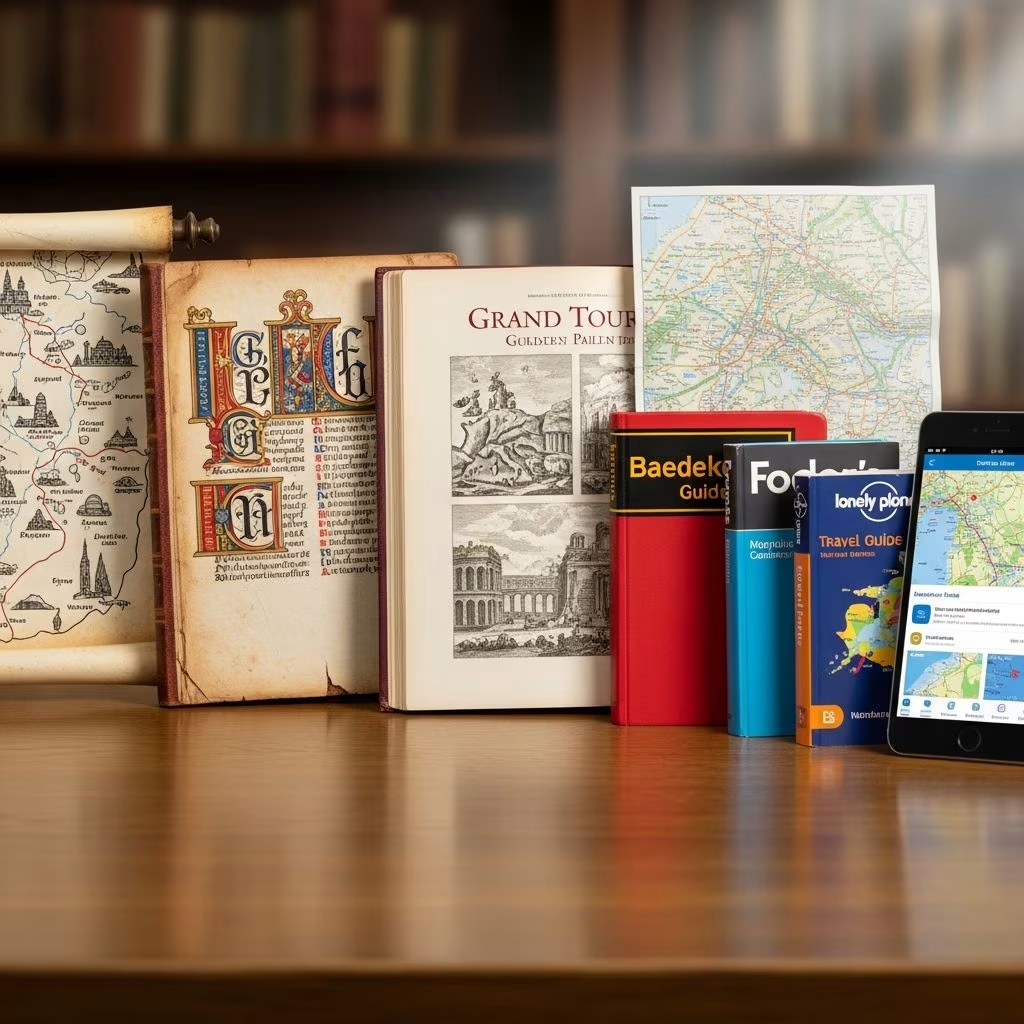
From ancient travel narratives to Baedeker and Murray, discover how guidebooks evolved into practical tools that transformed tourism.
 Travel Essentials
Travel has long captivated the human imagination, but the way people prepare for and experience journeys has undergone dramatic transformation. Before the modern era of digital travel planning, one essential tool guided adventurers, scholars, and leisure travelers: the travel guidebook. These carefully curated volumes served as windows into distant lands, offering practical wisdom alongside cultural insight. The story of how guidebooks emerged, evolved, and ultimately reshaped the tourism industry reveals much about how societies organize knowledge and encourage exploration.
The impulse to document travel experiences stretches back millennia. Ancient chroniclers understood that their observations held value for others contemplating similar journeys. Greek author Pausanias wrote detailed accounts of his travels through Greece during the 2nd Century, while Marco Polo documented his extensive journey through Asia in the 13th century. Ibn Battuta, the Moroccan explorer, traveled throughout the Eastern Hemisphere and recorded his experiences during the 14th century. These early travel narratives served a crucial function: they transported readers to places most would never visit, making distant lands tangible through detailed description.
However, these ancient texts differed fundamentally from modern guidebooks. They prioritized vivid storytelling and personal reflection over practical utility. Readers encountered them primarily as literature rather than planning tools, absorbing fascinating accounts from scholars and adventurers whose travels remained inaccessible to ordinary people. Travel was exceedingly expensive, dangerous and time consuming, limited to an adventurous few.
The emergence of more structured travel documentation coincided with a shift in European leisure culture. In the West, the guidebook developed from the published personal experiences of aristocrats who traveled through Europe on the Grand Tour. As appreciation for art, architecture, and classical antiquity became essential markers of noble education, wealthy families increasingly sponsored extended tours through Europe, particularly to Italy.
This cultural moment birthed the first intentional travel guides. Richard Lassels, writing between 1603 and 1668, created a series of manuscript guides that were eventually published posthumously in Paris and London in 1670 under the title *The Voyage of Italy*. These pioneering works established a template: organizing information about destinations, highlighting cultural attractions, and providing practical suggestions for travelers.
Between 1626 and 1649, the Dutch publishing house Elzevir produced the bestselling *Respublicae Elzevirianae* (Elzevirian Republics), described as the ancestor of the modern travel guide. Each volume provided geography, population, economy, and history information on countries across Europe, Africa, the Near East, and Far East. These pocket-sized volumes represented a significant innovation: they made geographic and cultural knowledge portable and accessible, allowing travelers to carry reference materials rather than relying on memory or manuscript consultation.
The transition from romantic travel narratives to practical, factual guidebooks crystallized through the work of a single visionary: Mariana Starke. Starke was a British poet and playwright who shared the same publisher as literary giants Jane Austen and Lord Byron. Rather than following the romantic conventions of her era, Starke recognized that travelers needed solid, actionable information.
Her 1802 book, *Travels in Italy Between the Years 1792 and 1798*, comprised travel memoirs that replaced overly romantic first-person descriptions of nature with factual advice. More innovatively, Starke wrote observations of Italian churches and villas using a subjective rating system based on one to five exclamation marks, designed to help travelers brave enough to navigate the battlefields of revolutionary France.
Recognizing that Europe’s geopolitical landscape had shifted dramatically, Starke produced a comprehensive update in 1820 titled *Information and Directions for Travellers on the Continent*. This expanded work covered Europe from Portugal to Russia and included practical advice on “tolerable” inns, horse carriage hiring, and the state of the continent’s post-roads. Starke’s innovation—combining systematic organization with practical wisdom and a rating system—established principles that would dominate guidebook publishing for centuries.
Starke’s success attracted attention from publisher John Murray, who recognized the commercial potential of guidebooks. In 1836, Murray launched his *Handbook for Travellers on the Continent*, igniting one of the world’s first guidebook series and establishing a prototype for books that followed. Murray borrowed Starke’s innovative approaches, including organizing subsections into itineraries, sightseeing spots, and inn listings.
Murray’s vision extended beyond simple adaptation of existing models. According to scholar James Buzard, the Murray style exemplified the exhaustive rational planning that characterized emerging tourist industries and British commercial organization. Rather than treating guidebooks as supplementary reading, Murray positioned them as comprehensive reference works containing everything travelers needed to know.
The 1845 Murray’s Handbook to Spain became an odyssey of travel guidebooks, combining wit, opinionated commentary, exhaustive detail, and erudition. Richard Ford’s expert essays on Spanish music provided some of the earliest insights into flamenco, while his ruminations on art and history initiated a lasting love affair with Spain among British travelers. This demonstrated how guidebooks transcended mere information delivery; they actively shaped travel culture and influenced which destinations captured travelers’ imaginations.
The rise of the Murray Handbooks in Britain coincided with Karl Baedeker’s emergence as a publisher in Germany. Baedeker, a bookseller and publisher, launched his first book, *Travels along the Rhine from Mainz to Cologne*, in 1832 based on information from an existing guide he acquired from a bankrupt publishing house.
After refining his vision with ideas borrowed from Murray, Baedeker, known as the “father of modern tourism,” developed a best-selling formula encouraging burgeoning European intelligentsia to travel independently without expensive entourages of servants and paid guides. This represented a profound shift: guidebooks were no longer luxuries for the ultra-wealthy, but tools democratizing travel access.
Baedeker’s ultimate aim was to free travelers from needing information sources outside the travel guide, covering routes, transport, accommodation, restaurants, tipping, sights, walks, and prices. In 1846, Baedeker introduced star ratings for sights, attractions, and lodgings, following Starke’s and Murray’s innovations. From 1856 onwards, Baedeker adopted red bindings and gilt lettering as hallmarks of all guides, becoming famous for clarity, detail, and accuracy.
The scope and quality of Baedeker’s work earned remarkable legacy status. The Palestinian guide was extensively mined by T.E. Lawrence during archaeological digs in the Middle East, while the encyclopedic 1929 Egyptian guide is widely considered one of the most accomplished guidebooks ever produced. Today, rare first editions of classic Baedekers can fetch up to $5,000 at auction.
The modern guidebook definitively emerged in the 1830s with the burgeoning market for long-distance tourism. Beyond Murray and Baedeker, other publishers recognized the commercial opportunity. Fodor’s has been producing travel guidebooks for American travelers since the 1930s.
In 1915, Scottish brothers James and Findlay Muirhead, who had served as English-language editors of the Baedeker series, also acquired rights to John Murray’s famous travel handbooks. In 1918, they established the Blue Guides as heirs to the great 19th-century guidebook tradition with the publication of *London and its Environs*. Through an agreement with French publisher Hachette, they co-published English and French-language guidebooks under the names Blue Guides and Guides Bleus respectively.
The Blue Guides exemplified how guidebook publishers could maintain quality while expanding scope. Blue Guide Greece, compiled by Rossiter in 1967, pioneered scrupulously edited guides designed for independent educated travelers wanting to avoid international uniformity. Alta Macadam’s Blue Guide Rome and Environs, published in 1971, became foundational, with her Italy titles subsequently becoming among the best-selling Blue Guides.
The influence of guidebooks extended far beyond providing practical information. In Europe, John Murray and Karl Baedeker established formats that would dominate the guidebook trade for over a century, emphasizing factual information, objectivity, and comprehensive knowledge. Their travel guides shaped how educated middle-class readers experienced foreign countries.
At their best, travel guidebooks have shaped culture and helped turn travel into a central aspect of modern life. They determined not merely how people traveled, but where they went, what they valued in destinations, and how they understood other cultures. By highlighting particular sites and providing expert interpretation, guidebooks essentially curated the global tourism experience.
Successful guidebooks from this era shared common features:
While digital resources have transformed travel planning, the foundational principles established by pioneering guidebook publishers remain influential. The concept of curated information, expert recommendations, and organized practical details that Starke, Murray, and Baedeker pioneered continues in modern travel applications and websites.
The guidebook industry’s history illuminates how information organization and presentation shape human experience. By developing systematic ways to present complex information about unfamiliar places, guidebook publishers didn’t merely serve travelers—they fundamentally transformed tourism from a luxury pursuit of the ultra-wealthy into a middle-class activity. They demonstrated that knowledge, when properly organized and presented, becomes a democratizing force.
The evolution from Starke’s exclamation-mark ratings to Baedeker’s comprehensive handbooks to today’s digital guides reflects humanity’s ongoing desire to make the world knowable and accessible. Each generation of travelers has relied on guides reflecting their era’s communication technologies and information priorities, yet the core impulse remains constant: the human desire to venture into unknown places armed with reliable guidance and expert knowledge.
